Commercial kitchen extraction rebalancing is often necessary after alterations because changes to ductwork, cooking equipment, extraction canopies or ventilation fans can affect how air moves throughout the kitchen. Even relatively small modifications may alter airflow resistance, extract volume and the relationship between extracted air and replacement air.
When a ventilation system becomes unbalanced, some cooking areas may experience poor smoke and steam capture. Other areas may develop excessive draughts, uncomfortable temperatures or unwanted pressure differences. These problems can occur even when the extractor fan appears to be operating normally.
Rebalancing involves assessing the modified system, measuring airflow and making suitable adjustments to restore effective ventilation. Depending on the alterations, this may require fan adjustments, ductwork modifications, supply-air changes or further system design work.
At Extractor Experts Ltd, we support commercial kitchens across London, Greater London and Surrey with extraction system design, ductwork installation, fault finding and ventilation improvements. Businesses planning kitchen refurbishments or equipment changes should consider airflow performance before putting the modified system into regular operation.
Understanding why rebalancing matters can help restaurant owners, kitchen managers and facilities teams avoid preventable ventilation problems.
What Is Commercial Kitchen Extraction Rebalancing?
Commercial kitchen extraction rebalancing is the process of assessing and adjusting airflow after changes have affected a ventilation system’s original operating conditions.
A typical commercial kitchen ventilation system includes extraction canopies, ductwork, extractor fans and arrangements for replacement air. These components work together to remove heat, steam, smoke, grease-laden vapours and cooking odours.
Each component influences the amount of air the system can move.
For example, a ductwork installation may have been designed around a particular fan and cooking line. Adding another canopy or extending the ductwork can increase resistance and change the amount of air passing through different sections.
Rebalancing helps establish whether each extraction point receives the airflow required for its intended cooking activity.
How Does Airflow Balancing Work?
Airflow balancing is not simply increasing or decreasing the extractor fan speed.
A competent ventilation engineer considers several factors, including the required extract airflow, duct resistance, fan performance, canopy capture and replacement-air arrangements.
Measurements are compared with the system’s design requirements, where these are available. Adjustments can then be made to address identified performance differences.
In multi-branch extraction systems, changing airflow through one branch can influence the others. HSE guidance on local exhaust ventilation explains why balancing should be considered when systems are reconfigured.
The objective is to achieve effective extraction throughout the modified kitchen rather than improving one area at the expense of another.
Why Do Kitchen Alterations Affect Extraction System Balance?
Commercial kitchens are frequently modified to accommodate new menus, additional equipment, revised cooking lines or changing operational requirements.
These alterations can change the conditions used when the original extraction system was designed.
1. Changes to Commercial Kitchen Ductwork
Ductwork modifications are among the most important reasons to reassess extraction performance.
Extending a duct run, adding bends, introducing a new branch or changing duct dimensions can affect airflow resistance.
For example, adding a new extraction branch may divide the available airflow between additional canopy connections. Without appropriate design and balancing, an existing canopy may receive less extraction than it requires.
A professional commercial ductwork installation assessment can help identify whether the modified duct arrangement is suitable for the required airflow.
For restaurants planning commercial ductwork installation in London, airflow requirements should be considered during the design stage rather than after installation.
2. Installing Additional Cooking Equipment
Adding fryers, grills, ovens or other commercial cooking appliances can increase the kitchen’s heat and contaminant loads.
Different appliances produce different amounts of heat, moisture and cooking fumes. Consequently, the ventilation arrangement that served the previous equipment may no longer be suitable.
A kitchen that previously used a limited number of cooking appliances may require a revised extraction design after expanding its cooking line.
Simply installing a larger extractor fan is not always the correct solution. The canopy, ductwork, replacement air and discharge arrangements must also be considered.
3. Replacing or Relocating Extraction Canopies
Commercial extraction canopies are designed to capture fumes from particular cooking areas.
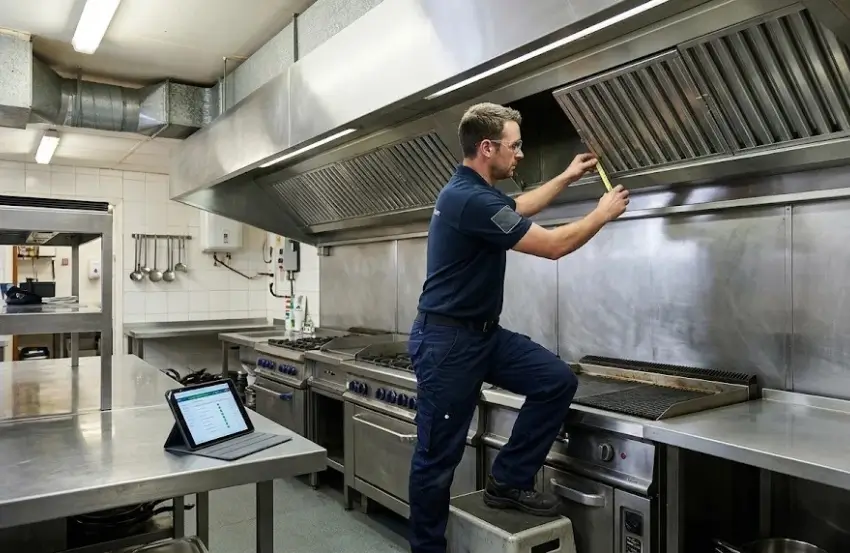
Moving a canopy, changing its dimensions or installing a different model may affect capture performance.
The distance between the cooking appliances and canopy, the surrounding airflow and the canopy’s physical arrangement can all influence its effectiveness.
After canopy alterations, airflow measurements and capture assessments help establish whether the revised arrangement performs adequately.
4. Changing Extractor Fans or Motors
Replacing a commercial extractor fan can alter system performance, even when the replacement appears similar to the original unit.
Different fans have different performance characteristics. Their delivered airflow depends on the resistance of the connected ductwork and other system components.
A fan with a higher nominal airflow rating does not automatically provide the correct extraction at every canopy.
The replacement fan must be assessed against the actual operating conditions.
5. Alterations to the Kitchen Layout
Moving partitions, creating preparation areas or changing the positions of doors and supply-air grilles can influence airflow patterns.
For example, a new partition may interfere with the movement of replacement air towards the cooking line.
Strong air currents from doors or ventilation grilles may also disturb the rising cooking plume before it reaches the canopy.
These changes can reduce extraction effectiveness without necessarily changing the extractor fan itself.
What Happens When a Commercial Kitchen Extraction System Is Unbalanced?
An unbalanced extraction system can create several operational problems.
The severity depends on the kitchen layout, cooking processes, equipment and existing ventilation design.
| Problem | Possible cause | Potential effect |
|---|---|---|
| Smoke escaping from a canopy | Insufficient capture airflow | Cooking fumes entering the kitchen |
| Excessive draughts | Poor supply-air distribution | Uncomfortable working conditions |
| Difficult-to-open doors | Excessive negative pressure | Pressure-related operating problems |
| Increased fan noise | Changed resistance or fan operating conditions | Noise and vibration |
| Uneven extraction | Poor distribution between duct branches | Inconsistent canopy performance |
| Excessive heat | Inadequate heat removal or replacement air | Uncomfortable kitchen temperatures |
| Persistent cooking odours | Inadequate capture or other system faults | Odours spreading beyond the cooking area |
These symptoms do not prove that airflow imbalance is the cause. Blocked filters, grease deposits, mechanical faults and unsuitable equipment can produce similar problems. Professional fault finding is therefore important before adjustments are made.
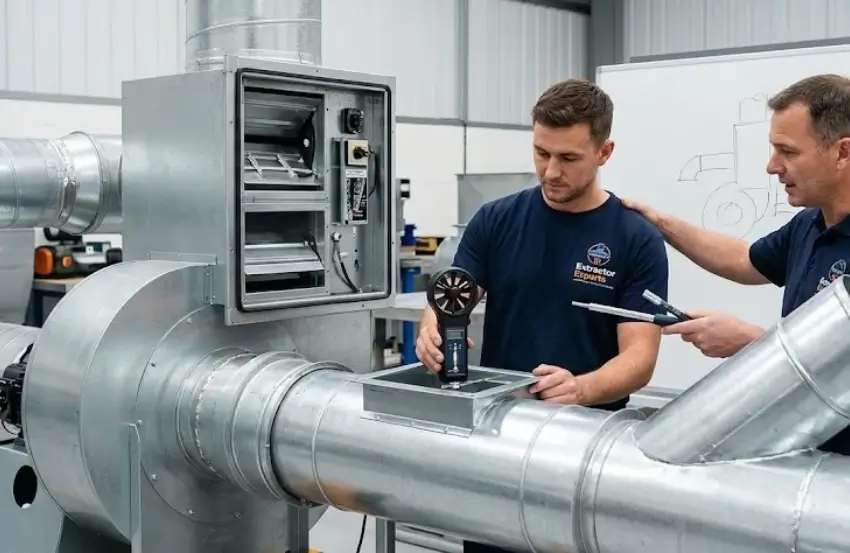
How Does Extraction Rebalancing Improve Kitchen Ventilation?
Correct rebalancing helps restore suitable airflow after modifications.
The benefits depend on the condition and design of the existing system.
Improved Smoke and Steam Capture
An appropriately balanced system helps extraction canopies capture cooking fumes before they spread into occupied kitchen areas.
This is particularly important in kitchens using equipment that produces substantial heat, steam or grease-laden vapours.
The aim is to provide suitable extraction at the cooking source while avoiding airflow patterns that interfere with canopy performance.
Better Replacement-Air Distribution
Air removed by a commercial extraction system needs to be replaced.
Without adequate replacement air, the kitchen can experience excessive negative pressure and poor ventilation performance.
Rebalancing can help identify whether the available supply air remains suitable after alterations.
The HSE emphasises the importance of adequate make-up air, particularly where gas-fired appliances are installed.
Reduced Unnecessary Fan Loading
An incorrectly configured system may place the fan outside its intended operating conditions.
Depending on the fan type and system resistance, this can affect airflow, noise, power consumption and mechanical performance.
Balancing and design checks can help identify inappropriate operating conditions. However, energy savings should not be assumed without measurements.
More Consistent Ventilation Across Cooking Areas
Where several canopies connect to a shared extraction system, appropriate airflow distribution is particularly important.
A modification to one branch may influence extraction performance elsewhere.
Assessing the complete system helps prevent one cooking area from receiving inadequate extraction while another receives more airflow than necessary.
When Should Commercial Kitchen Extraction Be Rebalanced?
Rebalancing should be considered whenever alterations could materially affect the original ventilation design or operating conditions.
Examples include adding a new extraction canopy, extending ductwork, replacing fans, changing cooking equipment or modifying the kitchen layout.
Not every minor alteration requires extensive redesign. The appropriate assessment depends on whether the modification changes airflow requirements or system resistance.
Changes That May Require Rebalancing
| Kitchen alteration | Recommended assessment |
|---|---|
| Additional extraction canopy | Review branch airflow and fan capacity |
| Extended ductwork | Assess resistance and delivered airflow |
| New high-output cooking equipment | Recalculate extraction requirements |
| Extractor fan replacement | Check fan selection and operating performance |
| Relocated cooking line | Assess canopy position and capture |
| New supply-air system | Check extract and replacement-air relationship |
| Removed duct branch | Reassess airflow distribution |
| Major kitchen refurbishment | Review and recommission the affected system |
Ideally, these checks should form part of the alteration project before the modified kitchen returns to normal operation.
How Is a Commercial Kitchen Extraction System Rebalanced?
The precise process depends on the ventilation system’s complexity and the modifications completed.
A professional assessment commonly follows several stages.
Step 1: Review the Existing Extraction Design
The engineer reviews the system arrangement, cooking equipment, canopies, ductwork, fans and supply-air provisions.
Available drawings, commissioning reports and previous airflow measurements can provide useful reference information.
The purpose is to understand the original design and identify what has changed.
Step 2: Inspect the Modified System
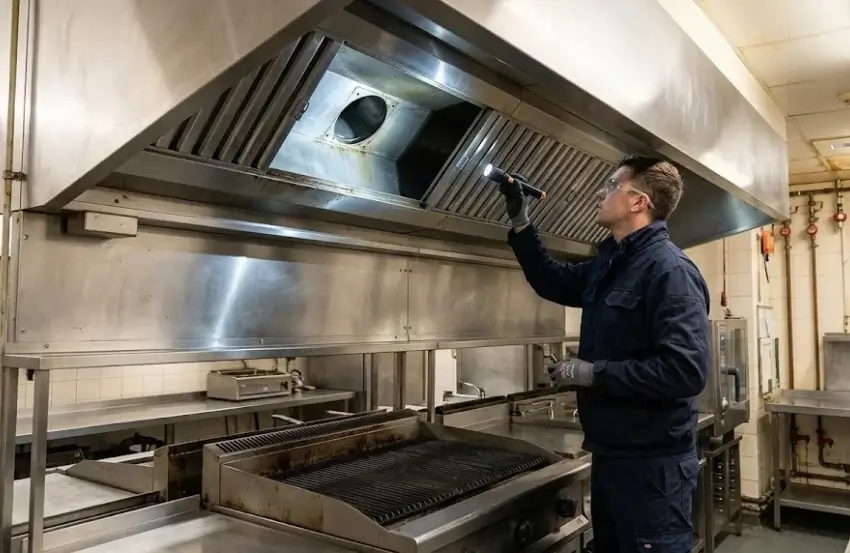
The next stage involves checking relevant components for installation defects, restrictions, leaks, damaged sections and other problems that could affect airflow.
Grease filters, accessible ductwork, fan assemblies and controls may also need inspection.
An airflow problem caused by a mechanical defect should not automatically be treated as a balancing issue.
Step 3: Measure Airflow Performance
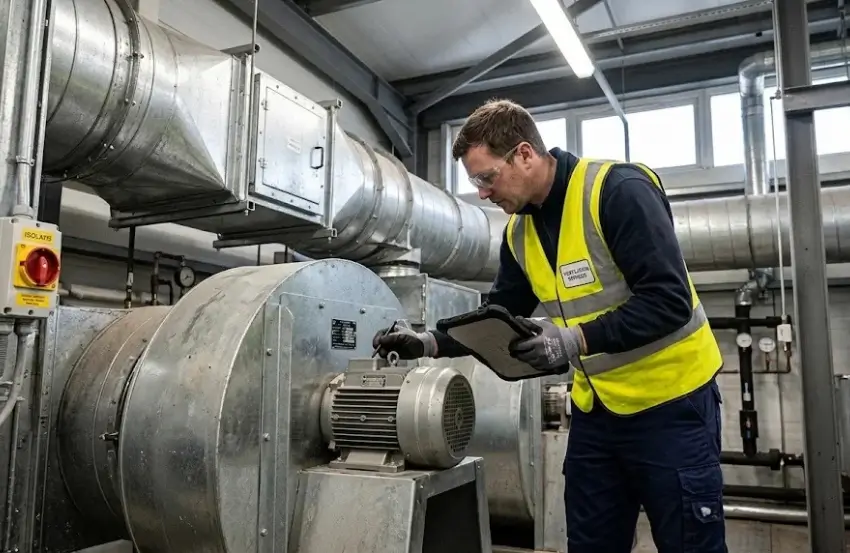
Suitable instruments and test methods are used to assess airflow at relevant points.
Measurements may include extract airflow, branch performance, supply-air delivery and pressure conditions.
Where appropriate, canopy capture performance should also be assessed under representative operating conditions.
The results help establish whether the modified system meets its intended requirements.
Step 4: Identify Required Adjustments
Depending on the findings, corrective work may involve adjusting fan controls, modifying ductwork, reviewing air supply or correcting installation faults.
Balancing dampers may be appropriate in some systems, but they should not be used as a substitute for correcting major design deficiencies.
The HSE’s HSG258 guidance specifically cautions against relying solely on dampers to rectify serious airflow imbalances.
Step 5: Test and Record the Results
After adjustments, the system should be tested again.
This confirms whether the changes have achieved the intended airflow performance without creating problems elsewhere.
Recording the measurements and configuration provides a useful reference for future maintenance, refurbishment and fault finding.
Why Is Make-Up Air Important After Extraction Alterations?
Make-up air is the replacement air introduced into a kitchen to compensate for air removed by extraction.
A commercial kitchen cannot continuously extract large quantities of air without a suitable source of replacement air.
When an extraction system is altered, the relationship between extract and supply air may also change.
For example, installing a more powerful extractor fan without reviewing the replacement-air arrangement may create excessive negative pressure.
This can affect door operation, airflow distribution and the performance of combustion appliances.
Where gas-fired or solid-fuel cooking equipment is involved, inadequate ventilation can create serious safety risks, including the accumulation of combustion products.
Kitchen operators should arrange competent assessment of affected ventilation and combustion arrangements rather than attempting adjustments themselves.
Can Commercial Ductwork Installation Affect Extraction Performance?
Yes. Commercial kitchen ductwork has a direct influence on the airflow delivered by an extraction system.
Duct length, dimensions, bends, junctions and restrictions contribute to the resistance that the fan must overcome.
Poorly planned modifications can reduce extraction performance even when the fan remains operational.
For commercial kitchen ductwork projects in London, consider the installation as part of the complete ventilation system.
A suitable ductwork design needs to account for airflow requirements, cleaning access, grease management, fire-safety considerations and the intended discharge arrangement.
The BESA DW/172 Specification for Kitchen Ventilation Systems provides recognised industry guidance covering commercial kitchen ventilation design and installation.
When ductwork alterations change the system’s operating conditions, the project team should include airflow testing and appropriate rebalancing in the project assessment.
What UK Ventilation Guidance Applies After Kitchen Alterations?
Commercial kitchen ventilation must be appropriate for the cooking processes and the risks present.
Several UK guidance documents are relevant when assessing modified extraction systems.
HSE Guidance for Catering Kitchens
The Health and Safety Executive’s guidance on ventilation in catering establishments addresses extraction, replacement air, cooking equipment and safe working conditions.
It also explains why ventilation design should consider the cooking load, kitchen layout and equipment used.
Operators should review ventilation suitability when modifications change these factors.
BESA DW/172
DW/172 is an industry specification for commercial kitchen ventilation systems.
It provides technical guidance for designers, installers and other professionals involved in commercial kitchen ventilation.
It is an industry specification, not a standalone Act of Parliament. The project and applicable obligations determine whether particular provisions are contractually required.
Relevant Building and Gas Safety Requirements
Building alterations may also involve relevant Building Regulations, fire-safety requirements and gas-safety duties.
The specific requirements depend on the premises and the work undertaken.
Suitable qualified specialists should assess the proposed modifications where combustion appliances or flues are affected.
An airflow balancing exercise alone does not establish full legal compliance.
How Can Restaurant Owners Prevent Airflow Problems During Refurbishment?
The most effective approach is to consider ventilation requirements before modifying the kitchen. Restaurant owners and facilities managers should discuss proposed changes with their kitchen designer, equipment supplier and ventilation specialist. This allows extraction requirements to be reviewed alongside the planned equipment and layout.
For example, a restaurant adding new cooking appliances should establish whether the existing canopy and fan arrangement can support the revised cooking load.
Likewise, an operator planning kitchen ductwork installation in London should consider whether the new duct configuration changes the airflow available to existing canopies.
Coordinating these decisions early can reduce the risk of discovering ventilation problems after the refurbishment is complete.
Maintaining accurate drawings, commissioning information and equipment records also makes future assessments easier.
Regular commercial kitchen extraction maintenance can help identify deterioration, restrictions and mechanical faults that may otherwise be mistaken for problems caused by recent alterations.
When Should You Contact a Commercial Extraction Specialist?
A specialist assessment is advisable when alterations have changed the ventilation arrangement or when performance problems appear after refurbishment.
Warning signs include smoke escaping from canopies, unexpected fan noise, excessive draughts, persistent cooking odours or changes in kitchen pressure. Do not ignore these symptoms simply because the extractor fan is running.
A commercial ventilation specialist can assess the system, identify likely causes and recommend appropriate corrective work.
Where a system involves gas-fired or solid-fuel equipment and there are concerns about combustion safety, stop using the affected equipment and obtain urgent advice from an appropriately qualified professional.
Extractor Experts provides commercial kitchen extraction design, ductwork installation, repair, fault finding and maintenance services for businesses across London, Greater London and Surrey.
Frequently Asked Questions
1. Is commercial kitchen extraction rebalancing necessary after ductwork alterations?
You should assess rebalancing when ductwork modifications affect airflow resistance or distribution. Testing can establish whether the altered system still delivers suitable extraction at each canopy.
2. Can a new extractor fan cause airflow imbalance?
Yes. A replacement fan may operate differently from the original unit. You should check its performance against the connected ductwork, canopy requirements, and replacement-air arrangements.
3. How do I know whether my commercial kitchen ventilation is unbalanced?
Possible signs include poor smoke capture, excessive draughts, pressure problems and uneven extraction. Other causes can lead to these symptoms, so professionals recommend airflow measurements and a diagnosis.
4. Does installing additional cooking equipment require extraction rebalancing?
Additional equipment may change the kitchen’s ventilation requirements. A specialist should review the cooking load, canopy capacity, ductwork, fan performance, and replacement air before confirming whether they need to make adjustments.
5. Can extraction rebalancing improve ventilation efficiency?
Appropriate rebalancing can improve airflow distribution and help the system operate as intended. Any reduction in energy use depends on the original problem and the corrective measures undertaken.
Conclusion: Keep Your Extraction System Performing After Alterations
Commercial kitchen extraction rebalancing helps ensure that ventilation continues to meet the kitchen’s needs after equipment, ductwork, canopy or layout changes.
Without appropriate assessment, alterations can affect airflow distribution, cooking-fume capture and replacement-air performance.
Testing the modified system and addressing identified problems helps maintain effective extraction and more suitable working conditions.
Need Help With Commercial Kitchen Extraction Alterations?
Extractor Experts Ltd supports restaurants, commercial kitchens and facilities managers with ventilation design, extraction system installation, ductwork, repairs and maintenance.
Whether you are planning a kitchen refurbishment or experiencing poor extraction following alterations, contact our team to discuss your requirements.
+44 7576 680389
Email: info@extractorexperts.co.uk
Enquiries: Extractor Experts