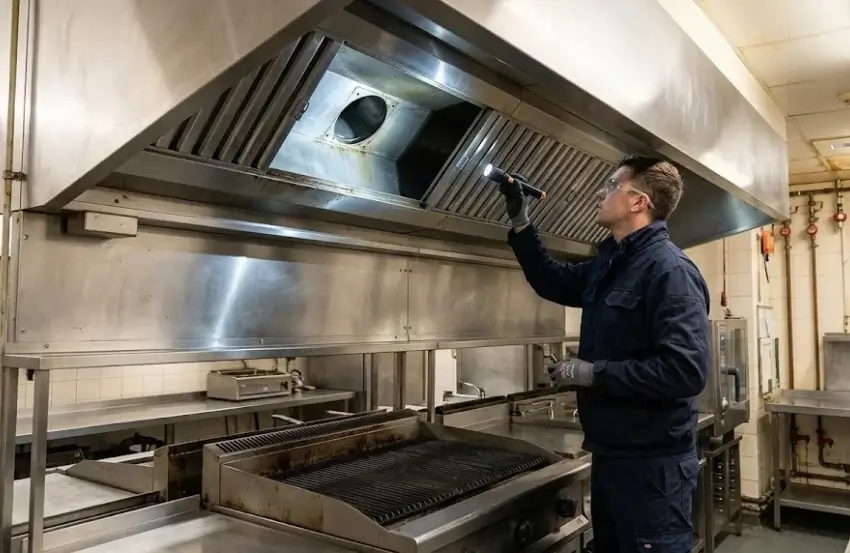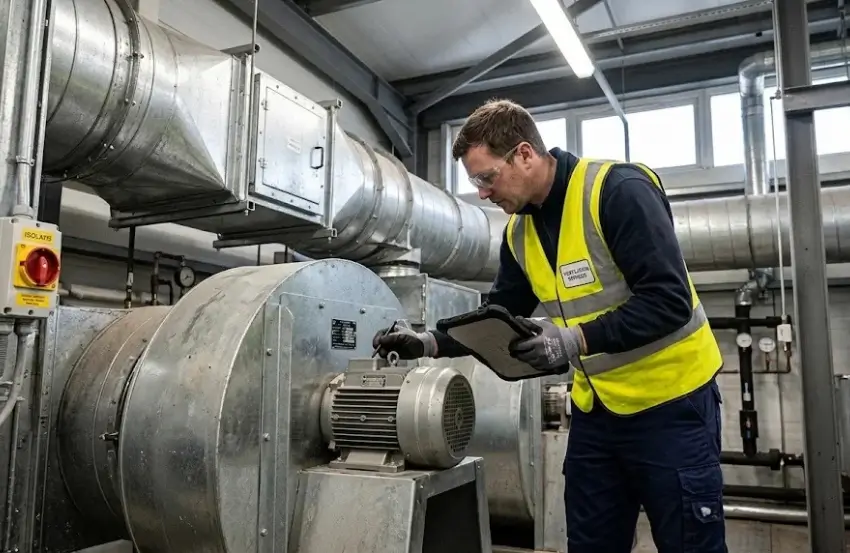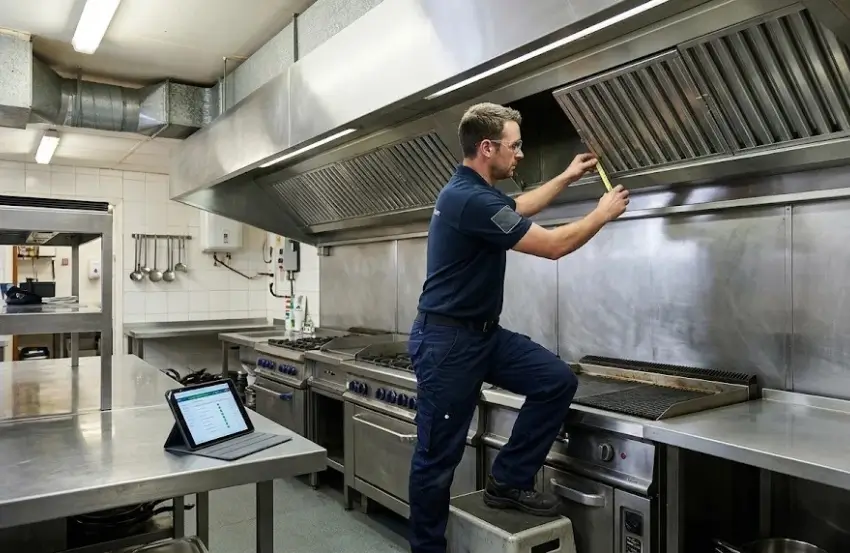
Choosing the correct commercial kitchen canopy replacement filters starts with identifying the existing filter type, measuring its outer dimensions and checking how it fits into the canopy housing. A replacement must match more than the visible opening: its width, height, depth, frame construction, drainage arrangement and compatibility with the extraction system all matter.
Commercial kitchens commonly use metal grease filters to separate grease particles from the extracted air before it enters the ductwork. These filters may look similar across different canopies, but differences in frame size, thickness and internal construction can make them unsuitable substitutes.
For restaurant owners, catering managers and maintenance teams, the safest approach is to record the existing filter specifications, check the canopy manufacturer’s information and confirm that the proposed replacement is suitable before ordering.
Extractor Experts provides commercial kitchen canopy, extraction and ventilation services across London and Surrey from its Staines-upon-Thames base. Where the correct replacement is unclear, a professional assessment can help identify the filter arrangement and whether the existing canopy housing needs attention.
This guide explains how to measure filters, recognise common designs, check compatibility and avoid ordering mistakes.
Why Correct Filter Identification Matters
Commercial kitchen extractor hood filters are not simply removable metal panels. They form part of the canopy’s grease-separation arrangement and affect how extracted air passes into the ventilation system.
When a filter is correctly specified and fitted, the intended airflow passes through its filtering elements, allowing grease to be separated before the air continues into the extraction ductwork.
An incorrectly sized or unsuitable filter can introduce several problems.
A filter that is too narrow may leave gaps around the housing. A filter that is too thick might not engage with the retaining channels. An incorrect internal design may also produce a different resistance to airflow from the original component.
These differences can affect grease capture, extraction performance and the ease of removing filters for routine cleaning.
Correct identification is therefore important for both everyday operation and longer-term system maintenance.
The relevant UK industry reference is the BESA DW/172 Specification for Kitchen Ventilation Systems, which addresses commercial kitchen ventilation design and grease separation.
What Types of Filters Are Used in Commercial Kitchen Canopies?
Before measuring a replacement, establish which type of filter the canopy currently uses.
Different filter designs may serve different grease-separation arrangements, and they should not be treated as interchangeable simply because their outer dimensions are similar.
Stainless Steel Baffle Grease Filters
Stainless steel baffle filters are commonly found in commercial kitchen extraction canopies.
They contain a series of shaped metal vanes that force grease-laden air to change direction as it passes through the filter. This helps separate grease droplets from the airflow.
The separated grease can then drain towards the collection arrangement provided within the canopy.
When identifying a baffle filter, inspect its outer frame, vane orientation, drainage openings and any handles used for removal.
Two baffle filters may have the same visible dimensions but different internal construction, so the filter specification should be checked rather than relying on appearance alone.
Metal Mesh Grease Filters
Metal mesh filters contain layers of woven or expanded metal material inside a supporting frame.
Their construction differs from baffle filters, and their suitability depends on the canopy design, cooking processes and applicable fire-safety requirements.
A mesh filter should not automatically be replaced with a baffle filter, or vice versa, without checking the system specification.
Cartridge and Specialist Filters
Some commercial extraction arrangements use cartridge-style filters or more specialised grease-separation components.
These may have particular frame profiles, fixing arrangements or performance characteristics.
For these systems, the manufacturer’s model number or technical documentation is particularly valuable. Matching only the length and width may not establish compatibility.
How to Measure Commercial Kitchen Canopy Replacement Filters
Accurate measurements are one of the most important steps when identifying a replacement.
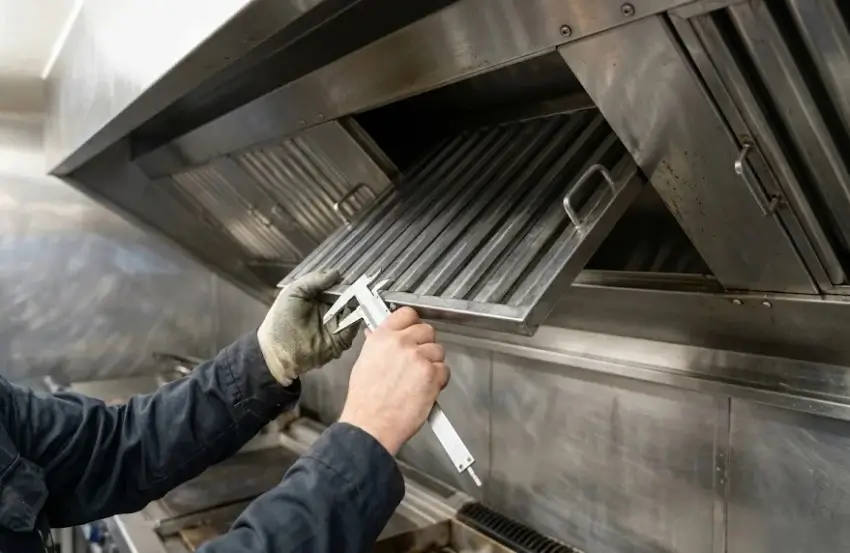
Commercial kitchen grease filters are commonly described using three dimensions: height, width and depth.
Measure in millimetres and record each dimension separately.
1. Measure the Filter Width
Width is the horizontal measurement across the filter when viewed in its intended installed orientation.
Measure from the outermost left edge of the frame to the outermost right edge.
Do not measure only the metal vanes or mesh inside the frame. The complete external frame determines how the filter engages with the canopy housing.
2. Measure the Filter Height
Height is the top-to-bottom measurement of the complete filter frame in its correct installed orientation.
This measurement is particularly important where the filter sits between upper and lower retaining channels.
Some filters need to be lifted into the upper channel before their lower edge can be positioned securely.
A replacement with the wrong height may be difficult to install or may not remain correctly supported.
3. Measure the Filter Depth
Depth, sometimes described as thickness, is measured from the front face of the filter frame to the rear face.
A filter may have the correct width and height but still be unsuitable if its depth differs from the original.
The canopy may have been designed around a particular frame thickness, and a different depth can affect seating or clearance.
4. Check the Actual Dimensions Against the Listed Size
Manufacturers sometimes describe filters using nominal dimensions that differ from their actual external measurements.
For example, a filter advertised using nominal dimensions may have slightly different actual external frame measurements. Always check the manufacturer’s confirmed dimensions before ordering.
5. Measure Every Filter in the Canopy
A canopy containing several filters does not necessarily use the same size throughout.
End filters, custom-built sections or older modified installations may have different dimensions.
Record the measurements and quantity for every filter position rather than assuming all filters are identical.
Commercial Canopy Filter Measurement Checklist
Use this checklist before contacting a supplier or arranging a professional inspection.
Replacement Filter Identification Checklist
- Record the canopy manufacturer and model, if available.
- Identify whether the filter is baffle, mesh or another design.
- Measure the complete outer width in millimetres.
- Measure the complete outer height in millimetres.
- Measure the frame depth or thickness.
- Check handle positions and drainage openings.
- Inspect the retaining channels and filter seating.
- Count all filters and identify any different sizes.
- Photograph the filter front, side and any identification labels.
- Confirm the proposed replacement specification.
How to Check Replacement Filter Compatibility
Dimensions are essential, but they do not establish complete compatibility.
A suitable commercial kitchen canopy replacement filter must also match the original filter arrangement and the operating requirements of the extraction system.
Check the Canopy Manufacturer and Model
Start by looking for an identification plate or label on the canopy.
The manufacturer and model number may be recorded on the canopy body, in installation paperwork or in maintenance documentation.
These details can help identify the original filter specification.
Where manufacturer documentation is available, use it as the primary reference rather than relying on a visually similar product.
Older or custom-made canopies may not have easily accessible model information. In those cases, accurate measurements and a physical inspection become more important.
Examine the Filter Frame and Retaining Channels
The frame must engage properly with the canopy’s filter supports.
Check whether the original filter has a flat frame, shaped edges, projecting lips or a particular seating arrangement.
Also inspect the condition of the canopy housing.
Bent retaining channels, missing supports or distorted metalwork may explain why an existing filter does not fit properly.
Ordering a replacement with identical dimensions will not necessarily solve a problem caused by damaged housing.
Confirm Baffle Orientation and Drainage
Baffle grease filters are designed to work in a particular orientation.
The internal baffles normally run vertically so separated grease can drain towards the collection arrangement.
Handles, drainage openings and the filter frame must also be positioned as intended by the manufacturer.
Rotating a rectangular filter simply to make it fit may interfere with its drainage function.
For this reason, a filter with matching overall dimensions should not automatically be considered compatible when its intended orientation differs.
Compare the Filter’s Airflow Characteristics
Two filters of the same size may have different internal arrangements and airflow resistance.
A filter with a different pressure drop may alter how air moves through the canopy.
For a straightforward like-for-like replacement, matching the original manufacturer’s specification is generally the most reliable starting point.
Where the replacement differs in construction or performance, a competent ventilation specialist should assess its suitability.
This is especially important when several filters are being changed or when the extraction system has already shown signs of poor airflow.
Common Replacement Filter Sizes and Why They Can Be Misleading
Commercial kitchen filters are available in a variety of standard and custom dimensions.
However, a catalogue description does not always represent the exact external dimensions of the filter.
Commercial kitchen grease filters are supplied in various nominal and custom sizes. However, advertised dimensions may differ from the actual external frame measurements.
Always compare the manufacturer’s confirmed width, height and depth with the existing filter before ordering. Nominal dimensions alone do not establish compatibility with a particular commercial kitchen canopy.
Even a small dimensional difference may affect how the filter sits within the housing.
A replacement must have the correct clearance for installation while remaining securely supported in its operating position.
Do not assume that a filter advertised as 500 mm wide will have the same actual frame dimensions as another product carrying a similar description.
How to Identify a Filter When the Original Is Missing
Identifying a replacement becomes more difficult when the original filter has been lost, discarded or damaged beyond reliable measurement.
In this situation, the canopy housing and manufacturer’s information become the main references.
Measure the Existing Filter Opening
Measure the available opening and inspect the upper and lower retaining channels.
Record the dimensions of the housing, but do not assume that the opening dimensions equal the required external filter dimensions.
The filter may need additional clearance to be inserted, lifted and lowered into position.
Inspect Adjacent Filters
Where other original filters remain installed, compare their construction, frame thickness, handles and drainage arrangement.
An adjacent filter may provide useful information, although it should not be assumed to be identical without checking the relevant position.
Review Previous Installation Records
Original canopy drawings, equipment schedules, supplier invoices and maintenance records may identify the intended filter type or part number.
These documents can be particularly helpful for custom-built commercial kitchen canopies.
Request a Professional Assessment
Where the correct specification remains uncertain, a professional inspection can establish whether a compatible replacement is available or whether the housing requires further assessment.
Avoid selecting a filter solely because it appears to cover the opening.
Mistakes to Avoid When Ordering Commercial Kitchen Grease Filters
Commercial kitchen grease filter replacement errors often arise from incomplete measurements or assumptions about compatibility.
One common mistake is measuring the visible filter area rather than the complete outer frame. This can result in a replacement that is too small for the retaining channels.
Another is overlooking filter depth. A replacement may match the opening but be too thick to seat correctly.
A third is assuming that all filters within the same canopy are identical. This is particularly risky where an installation has been modified or contains different filter sections.
Replacing a baffle filter with a mesh filter without checking the original specification is another potential problem. The two designs may have different performance and safety characteristics.
Finally, a replacement should not be forced into a damaged housing. A distorted retaining channel may need attention before the filter can be installed correctly.
The most effective way to avoid these errors is to combine accurate measurements with the original filter specification and a compatibility check.
When Should a Commercial Canopy Filter Be Replaced Rather Than Reused?
A filter does not necessarily need replacing simply because it has accumulated grease.
Many commercial metal grease filters are designed to be removed, cleaned and reused in accordance with the manufacturer’s instructions.
Replacement becomes more relevant when the filter has physical damage or can no longer perform as intended.
Examples include a bent frame that prevents secure seating, damaged internal baffles, corrosion affecting the structure, broken handles or drainage features that no longer function correctly.
A filter may also require replacement when it is the wrong specification for the canopy.
Where a filter is simply dirty but otherwise serviceable, appropriate cleaning may be sufficient.
The condition of the wider canopy and extraction system should also be considered. A new filter will not correct poor extraction caused by a faulty fan, blocked ductwork or an unsuitable ventilation design.
For wider system concerns, see Extractor Experts’ commercial kitchen extraction maintenance services.
When to Ask a Commercial Kitchen Extraction Specialist for Help
Filter identification is usually straightforward when the original manufacturer, model and dimensions are available.
Professional assistance becomes more useful when the canopy is custom-built, the original filters are missing, the retaining channels are damaged or a proposed replacement differs from the existing design.
It is also advisable when a filter change is being considered alongside alterations to the extraction system.
Extractor Experts works with commercial kitchen canopies, extraction systems and ventilation installations. An assessment can help establish whether the issue concerns filter compatibility, canopy condition or the wider extraction arrangement.
For businesses planning a canopy installation or upgrade, the commercial kitchen canopy service provides further information about the company’s work.
Frequently Asked Questions About Commercial Kitchen Canopy Replacement Filters
1. How do I know what size replacement filter my commercial canopy needs?
Measure the complete outer width, height and depth of the existing filter in millimetres. Compare these measurements with the manufacturer’s actual product dimensions and check the retaining channels, frame profile and installed orientation before ordering.
2. Are all commercial kitchen canopy grease filters interchangeable?
No. Filters may differ in dimensions, thickness, frame construction, internal design, airflow resistance and drainage arrangement. A replacement should match the canopy manufacturer’s specification or be confirmed as compatible by a competent specialist.
3. Can I replace a mesh grease filter with a stainless steel baffle filter?
Not automatically. Mesh and baffle filters have different constructions and performance characteristics. The canopy design and system requirements must be checked before changing filter type.
4. What should I do if my existing canopy filter has no identification label?
Measure the filter, photograph its construction and inspect the canopy for a manufacturer or model number. If the original is missing, check the housing, adjacent filters and installation records. Seek professional advice if the specification cannot be established reliably.
5. Does the thickness of a commercial kitchen grease filter matter?
Yes. Filter thickness affects how the component fits into the canopy housing. A replacement with the correct width and height may still be unsuitable if its depth prevents secure seating or differs from the intended system specification.
Conclusion: Choose the Correct Replacement Filter Before Ordering
Identifying commercial kitchen canopy replacement filters requires more than finding a panel that looks similar to the original.
The correct approach is to establish the filter type, measure the complete outer frame, check its depth and orientation, inspect the canopy housing and confirm compatibility with the original specification.
Accurate identification helps avoid ordering unsuitable components and supports the intended operation of the commercial kitchen extraction system.
For commercial kitchen operators in London, Surrey and surrounding service areas, Extractor Experts can assist with enquiries relating to kitchen canopies, extraction systems, ventilation repairs and maintenance.
Need Help Assessing Your Commercial Kitchen Canopy?
Contact Extractor Experts to discuss your requirements.