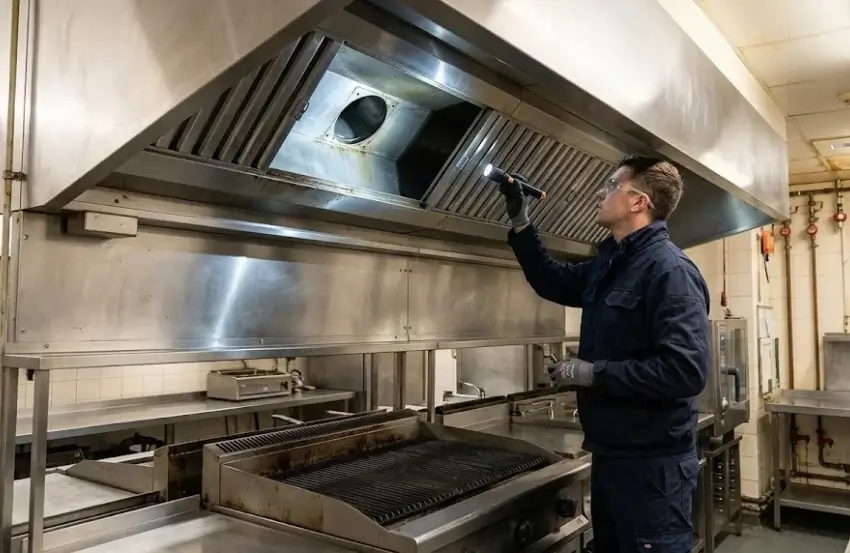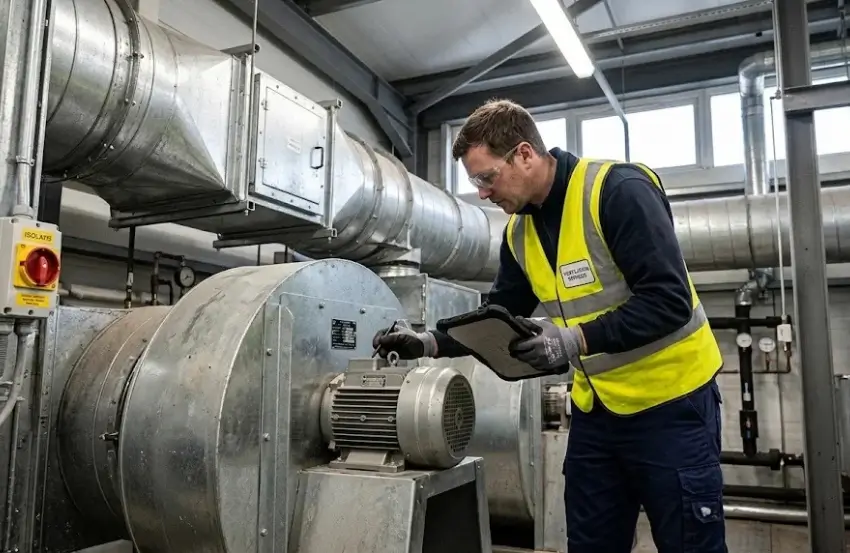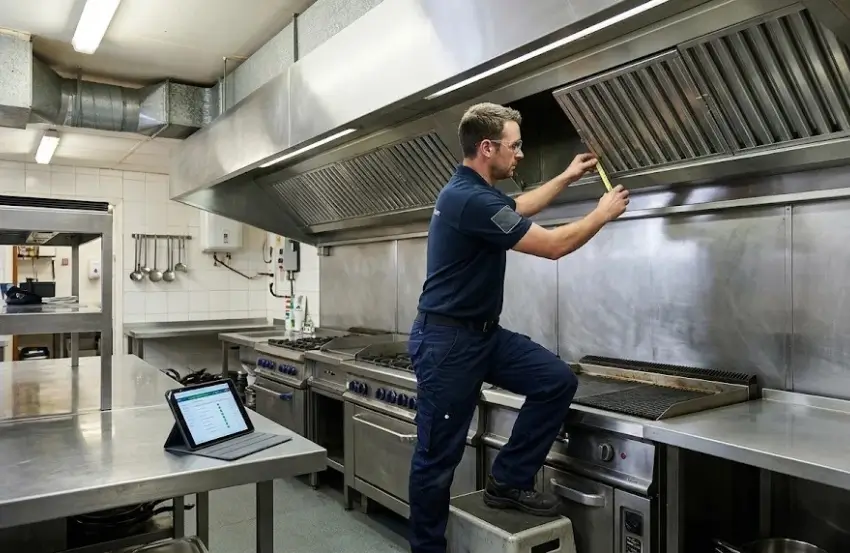
A kitchen extraction asset register should record the identity, location, technical specifications and service history of the equipment that makes up a commercial kitchen ventilation system. This includes extraction fans, motors, canopies, ductwork sections, filters, controls and associated ventilation components. Each identifiable asset should have a reference number, manufacturer and model information where available, installation details and a record of inspections, repairs and replacements.
For restaurant operators and facilities managers, the purpose is straightforward: make it easier to identify equipment, understand what it was designed to do and see what work has already been completed. A register also helps maintenance contractors locate the correct components and compare existing equipment with its original specifications.
A useful commercial kitchen extraction asset register does not need complicated software. A structured spreadsheet or facilities management system can work, provided the information is accurate, accessible and updated when equipment changes.
Extractor Experts supports commercial kitchen extraction repairs, maintenance and system assessments across London, Surrey and surrounding service areas. Understanding the equipment installed in a kitchen is an important starting point when investigating faults or planning maintenance work.
What Is a Kitchen Extraction Asset Register?
A kitchen extraction asset register is an organised inventory of the equipment installed within a commercial kitchen extraction and ventilation system. Rather than simply listing the number of extractor fans or canopies, it provides identifiable records that can be referenced during inspections, maintenance visits, fault investigations and equipment upgrades.
A typical commercial kitchen system contains several connected components. The canopy captures cooking fumes and airborne grease, ductwork carries extracted air, and the fan provides the airflow needed to move that air towards the discharge point. Controls, filters and replacement-air equipment may also form part of the installation.
These components have different specifications and maintenance requirements. Recording them individually makes the overall system easier to understand and manage.
For example, a restaurant may have two extraction fans serving separate cooking areas. Without equipment references, a maintenance report stating that an extractor motor needs attention could be ambiguous. An asset register identifies the particular fan, its location and previous repair history.
A kitchen ventilation asset register is therefore more than an equipment list. It connects individual components with the technical and maintenance information needed to manage them throughout their working lives.
What Equipment Should Be Included in an Extraction Asset Register?
The register should cover the identifiable equipment and major components relevant to the extraction system’s operation, maintenance and future replacement.
Recommended equipment categories
| Equipment | Information to identify |
|---|---|
| Extraction fans | Fan reference, model, manufacturer and location |
| Fan motors | Motor details, rating and associated fan |
| Kitchen canopies | Canopy reference, dimensions and cooking area served |
| Ductwork | System route, sections and inspection access locations |
| Grease filters | Filter type, size and associated canopy |
| Control panels | Panel identification and equipment controlled |
| Speed controllers | Controller type and associated fan or motor |
| Replacement-air units | Unit details and kitchen area served |
| Silencers and attenuators | Component location and associated duct section |
Not every kitchen will have all these components. The register should reflect the equipment actually installed rather than include generic entries for items that are not present.
Identify Each Asset with a Unique Reference
Each asset should have a consistent identification code that can be used in inspection reports, maintenance schedules and repair documentation.
For example, a facilities manager might use KEF-01 for the first kitchen extract fan, KCP-01 for a canopy and KDC-01 for a ductwork section.
These are illustrative identifiers, not prescribed industry codes. What matters is that each reference remains unique and is used consistently.
Where practical, an equipment label can be attached to an accessible, suitable part of the asset. This helps visiting engineers match the physical equipment with the corresponding record.
Record the Equipment Location
Equipment descriptions should include sufficient location information to identify the correct component without guesswork.
An entry such as “extractor fan on roof” may be inadequate where several fans are installed. A clearer description would identify the roof area, system served and any existing plant-room or drawing reference.
For ductwork, a route description or reference to an as-built drawing may be more useful than treating every short section as a separate asset.
The objective is to make equipment identifiable while keeping the register manageable.
Which Technical Specifications Should Be Recorded?
Technical specifications help engineers understand how equipment was originally selected and whether replacement components are suitable.
A commercial kitchen extraction asset register should retain the manufacturer’s information and the original design or commissioning data where available. These details are particularly useful when equipment labels become difficult to read or the original installer is no longer involved.
Extraction Fan and Motor Specifications
For extraction fans and motors, useful details may include the manufacturer, model, serial number, fan type, motor power, electrical supply, rotational speed and design airflow.
Where available, the register should also reference fan performance information, operating settings and commissioning measurements.
These values should be copied from reliable equipment documentation or confirmed by a competent engineer. They should not be estimated from the physical appearance of a fan.
An existing fan may have been replaced, modified or fitted with a different motor since the original installation. Recording the current equipment details alongside any available historical specifications helps avoid confusion.
Canopy, Filter and Ductwork Specifications
Kitchen canopies should be identified by their location, dimensions, construction details where known and the cooking equipment they serve.
For grease filters, useful records include filter type, dimensions, quantity and replacement part references. This information can help maintenance teams order suitable components without repeatedly measuring existing filters.
Ductwork records should identify the main system route, relevant dimensions where documented, accessible inspection points and connections to associated equipment.
A drawing reference can be particularly valuable where ductwork passes through ceiling voids, service risers or other areas that are not readily visible.
Keep Original Design and Commissioning Documents
The register should also provide access to relevant supporting documents, such as equipment manuals, drawings, commissioning reports and original design specifications.
These documents establish a reference point for understanding the installation. The Health and Safety Executive’s guidance on catering kitchen ventilation highlights the value of retaining design criteria, commissioning performance, maintenance requirements and inspection records so that systems can be assessed against their original specification.
The asset register does not need to reproduce every technical document. It can instead contain a document reference or secure link that allows the information to be retrieved when required.
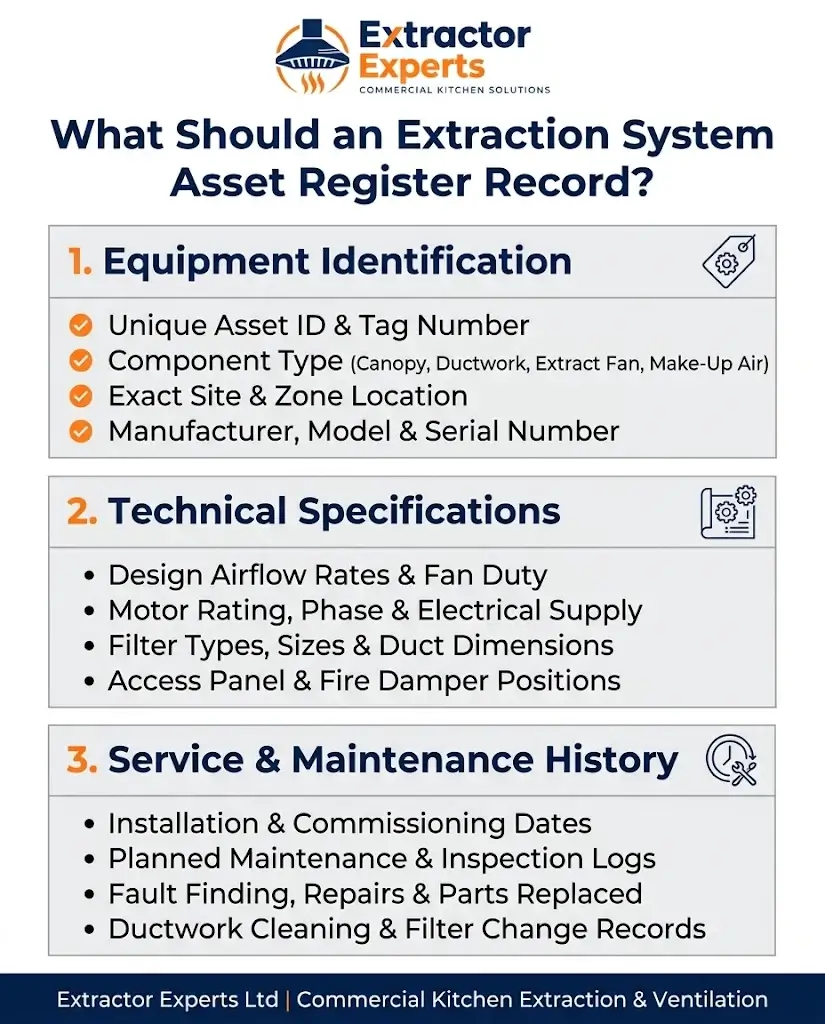
What Service History Should the Asset Register Contain?
An equipment register becomes substantially more useful when it is connected to a reliable maintenance history.
Commercial kitchen extraction maintenance records should show what work was completed, which asset was involved, when the work took place and whether further action remains necessary.
For each relevant maintenance visit, the record should identify the service date, contractor or engineer, inspection findings, completed work, replaced components and any recommendations.
It should also distinguish between work that has been completed and work that has only been proposed.
Record Routine Maintenance and Inspections
Routine maintenance entries should identify the equipment inspected and the tasks undertaken.
For example, a fan maintenance report may document the condition of accessible components, unusual noise, vibration, mechanical wear or other observations relevant to the inspection.
The register can hold a short summary and link to the full report. This avoids overcrowding the asset record while preserving the details needed for future reference.
A maintenance date alone does not demonstrate what was checked. Supporting reports should remain accessible so that the work can be understood.
Record Repairs and Component Replacements
Repair history is especially valuable for equipment that experiences recurring problems.
Suppose an extraction fan develops abnormal vibration. An engineer investigates the issue and replaces a defective component. The maintenance record should identify the fan, describe the reported fault, document the findings and state what was repaired or replaced.
If similar symptoms return, the previous repair record provides useful background for the next investigation.
Replacement components should be recorded with their relevant part numbers or specifications where available. If an entire fan or motor is replaced, the register should be updated to reflect the new equipment rather than continue showing the original unit as current.
For commercial kitchen extraction faults requiring professional attention, see Extractor Experts’ commercial extraction repair services.
Track Outstanding Maintenance Actions
An asset register should make it possible to identify unresolved maintenance issues without reading every historical report.
For example, an inspection might recommend further investigation of a noisy fan, replacement of a damaged component or verification of airflow performance.
The record should show the issue, date reported, action required, responsible party and current status.
Once the work is completed, the status can be updated and linked to the relevant repair or inspection documentation.
This creates a clear history of how equipment concerns were identified and addressed.
How Should Equipment Specifications and Service Records Be Organised?
A practical register works best when it separates relatively permanent equipment information from records that change over time.
The main asset entry should contain identifying details and current specifications. Maintenance visits, repairs and inspections can then be stored as separate records linked by the same asset ID.
This approach prevents an equipment record from becoming an excessively long collection of notes.
Example Kitchen Extraction Asset Register
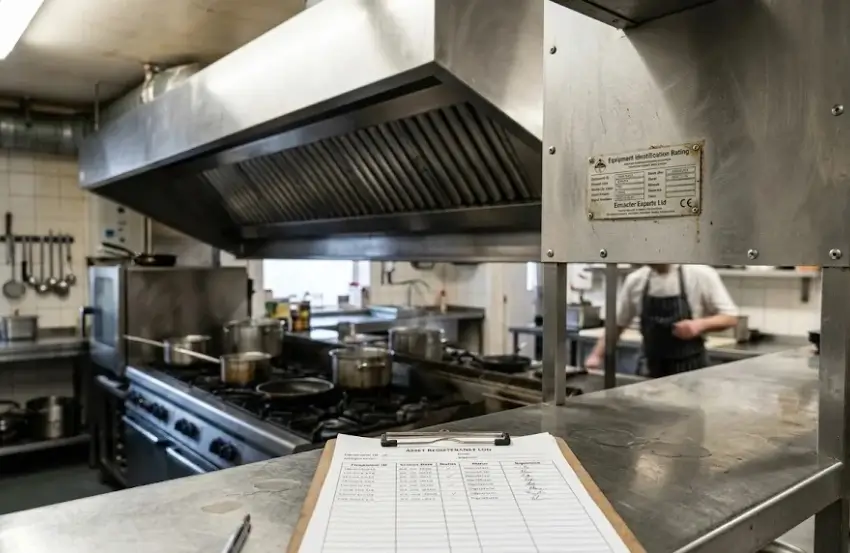
The following example shows how a basic register could be organised. All identifiers and values are illustrative, not records of an actual installation.
| Field | Example entry |
|---|---|
| Asset ID | KEF-01 |
| Equipment | Commercial extraction fan |
| Location | Main kitchen, roof plant area |
| Manufacturer | Record from nameplate |
| Model | Record from nameplate |
| Serial number | Record from nameplate |
| Motor rating | Confirm from technical data |
| Design airflow | Refer to commissioning report |
| Installation date | Enter verified date |
| Last inspection | Enter actual inspection date |
| Latest service report | Link to service document |
| Outstanding actions | Record any unresolved findings |
| Next planned service | Date agreed under maintenance plan |
For larger premises, separate tabs or database sections can be used for equipment details, service events, replacement parts and supporting documents.
The asset ID should connect these records. That allows a facilities manager to retrieve the complete history of a particular fan without searching through unrelated maintenance paperwork.
Use Consistent Naming and Document References
Consistent naming makes the register easier to maintain when different contractors visit the premises.
A fan should not be described as “roof extractor”, “kitchen fan one” and “main extract motor” across separate reports unless those terms are clearly linked to the same asset.
A simple document naming convention can help, such as an asset ID followed by a service date and document type.
For example, KEF-01-2026-10-15-service-report.pdf identifies the equipment, date and record type without opening the document.
How Often Should a Kitchen Ventilation Asset Register Be Updated?
An asset register should be updated whenever information about the installed equipment or its maintenance status changes.
The most important updates normally follow equipment installation, replacement, modification, inspection or repair. A change to a fan motor, control arrangement or equipment specification should be reflected in the current asset record.
Routine service visits should also generate an updated maintenance entry, even when no faults are identified.
The register itself does not require a universal fixed update interval. Its accuracy depends on recording relevant changes promptly and reviewing the information periodically.
A facilities manager can assign responsibility for maintaining the register and check that new service reports are filed against the correct equipment references.
Keep Previous Records When Equipment Is Replaced
When equipment is replaced, historical information should not simply disappear.
The original asset can be marked as removed or retired, with the replacement equipment assigned a new reference or clearly documented successor record.
This preserves the service history of the previous component and prevents old specifications from being mistaken for current ones.
It also helps explain why a system’s equipment configuration has changed over time.
How Does an Asset Register Support Commercial Kitchen Maintenance?
An accurate register gives maintenance contractors a clearer picture of the equipment before attending site.
Knowing the fan model, motor rating, equipment location and previous faults can help with planning an inspection and identifying information that may be needed for replacement parts.
It also allows maintenance managers to compare reports from different visits and identify recurring issues associated with the same component.
For businesses operating several kitchens, a consistent register provides a common method of documenting equipment across different premises.
The register is particularly useful during staff changes, contractor handovers or refurbishment projects, when knowledge of the original installation may otherwise be lost.
However, the register is not a substitute for physical inspection or testing. Recorded specifications may not represent the current operating condition of equipment, especially where modifications have taken place.
Professional assessment remains necessary when there are concerns about airflow, mechanical condition or system performance.
Extractor Experts provides commercial kitchen extraction maintenance and related fault-finding support for commercial premises.
Does an Asset Register Replace Maintenance or Compliance Records?
No. An asset register is an index of equipment and its associated information. It does not replace the detailed reports, inspection evidence or other documentation that may be required for a particular installation.
For example, a register may identify the date of a ductwork cleaning visit and link to the cleaning report. The underlying report remains important because it records the actual work and findings.
BESA’s TR19 Grease specification addresses the management of grease accumulation and associated fire risks within commercial kitchen extraction systems. Relevant cleaning and inspection documentation should therefore be retained separately and referenced where appropriate.
It is also important not to assume that every kitchen extraction system has the same statutory testing schedule. Specific duties depend on the equipment, processes and applicable regulations. HSE guidance for certain local exhaust ventilation systems includes examination and record-retention requirements, but these should not automatically be applied to every general kitchen ventilation installation.
A well-maintained register helps locate evidence. It does not, by itself, establish that an extraction system is compliant, clean or operating correctly.
How Can You Start an Asset Register for an Existing Kitchen?
An existing commercial kitchen may have incomplete equipment information, particularly where several contractors have worked on the system over the years.
The first stage is to collect available drawings, equipment manuals, previous inspection reports and maintenance documents.
Next, the installed equipment can be identified and matched against the available records. Where labels are missing or specifications are uncertain, those details should be marked as unverified rather than guessed.
A competent ventilation professional may be needed to confirm technical information or investigate discrepancies between existing documentation and installed equipment.
Once the main assets have been identified, their references can be used consistently in future maintenance reports.
The register can then be expanded as more reliable information becomes available. A straightforward, accurate record is more useful than a detailed spreadsheet containing assumptions.
Frequently Asked Questions
1. What information should a kitchen extraction asset register include?
A kitchen extraction asset register should include equipment identification, location, manufacturer, model, serial number, technical specifications, installation details and associated service history. It should also reference inspection reports, repairs, replacement components and outstanding maintenance actions.
2. Is an extraction asset register the same as a maintenance log?
No. An asset register identifies the equipment and its specifications, while a maintenance log records work carried out over time. The two should be connected through consistent asset reference numbers so that each component’s service history can be retrieved.
3. Should commercial kitchen ductwork be included in an asset register?
Yes. Major ductwork routes, identifiable sections and relevant inspection access points should be documented. Drawings and route references can help maintenance contractors understand the system layout, particularly where sections are concealed or difficult to access.
4. How often should a commercial kitchen extraction asset register be updated?
The register should be updated whenever equipment is installed, replaced, modified, inspected or repaired. Maintenance entries should be added following relevant service visits, and the register should be reviewed periodically to ensure the information remains accurate.
5. Can a spreadsheet be used for a kitchen ventilation asset register?
Yes. A structured spreadsheet can be suitable for a single commercial kitchen or smaller equipment inventory. Larger facilities may benefit from dedicated maintenance management software, particularly where several sites, contractors or maintenance schedules need to be managed.
Conclusion: Keep Equipment Information Accurate and Accessible
A reliable kitchen extraction asset register brings equipment identification, technical specifications and service history into one organised reference.
By recording what equipment is installed, where it is located, how it was specified and what maintenance has been completed, commercial kitchen operators can make better-informed decisions about inspections, repairs and replacements.
The most useful register is one that remains accurate as the extraction system changes. Consistent asset references, accessible technical documents and up-to-date service records help prevent confusion and preserve important equipment information.
For professional assistance with commercial kitchen extraction maintenance, fault finding or system assessment, contact Extractor Experts Ltd.
Call: +44 7576 680389
Email: info@extractorexperts.co.uk
Website: Extractor Experts
We support commercial kitchen operators across London, Surrey and surrounding service areas.