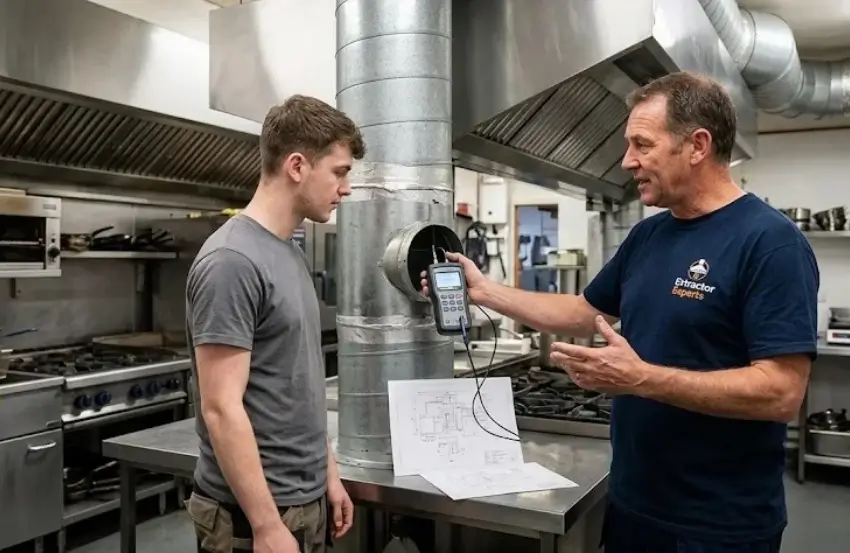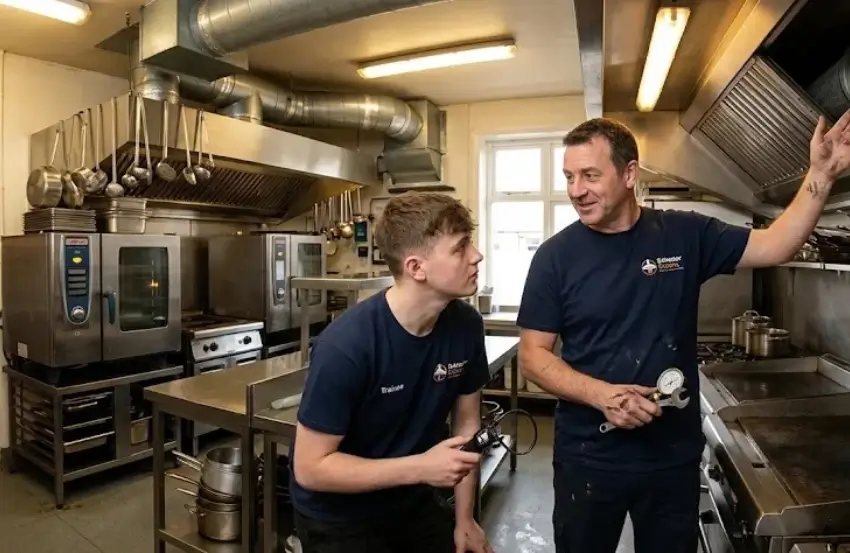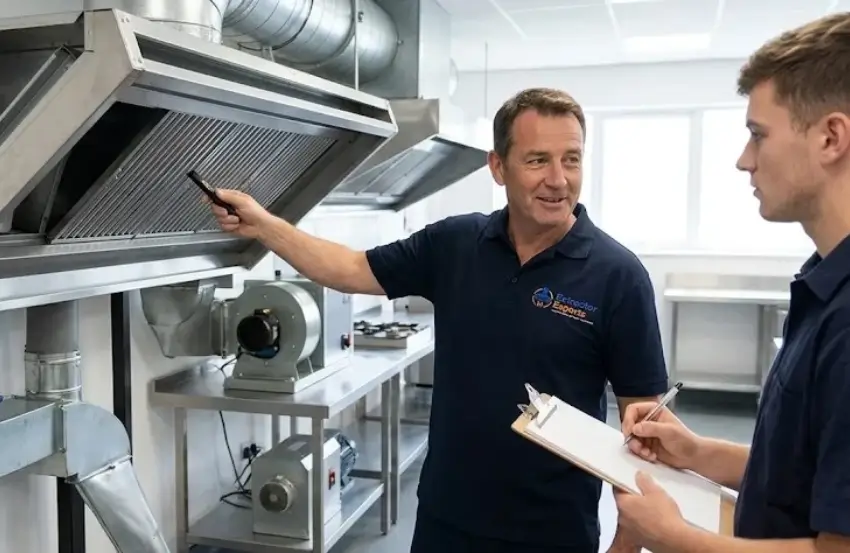
Commercial kitchen extraction ductwork works by carrying smoke, steam, heat, airborne grease and cooking fumes from an extraction canopy to a suitable outdoor discharge point. An extraction fan creates the pressure difference needed to move contaminated air through the ductwork, while grease filters help capture some of the grease before it enters the system. The ductwork forms an essential connection between the canopy, fan and external outlet. Its dimensions, route, construction and accessibility affect how effectively the entire extraction system operates. Poorly designed or damaged ductwork can restrict airflow, contribute to grease accumulation and make cleaning more difficult.
Professional commercial kitchen ductwork installation services consider the cooking equipment, required airflow, fan performance, building layout and maintenance access. Grease extract ductwork also needs particular attention to fire safety because cooking deposits can accumulate inside the system. Extractor Experts Ltd provides commercial kitchen ductwork installation, extraction system design, ventilation services, repairs and maintenance for businesses across London, Greater London and Surrey. Understanding how commercial kitchen extraction ductwork works helps restaurant owners, kitchen managers and facilities managers make informed decisions about installation, inspection, maintenance and upgrades.
What Is Commercial Kitchen Extraction Ductwork?
Commercial kitchen extraction ductwork is a network of enclosed passages that transports contaminated air away from cooking equipment. The ductwork connects the extraction canopy to the extraction fan and discharge arrangement. Depending on the building, the route may pass through ceiling spaces, service areas, plant rooms or external sections of the property. During cooking, hot air carries moisture, smoke, odours and airborne grease towards the extraction canopy. The extraction fan draws this air through the system and directs it towards the outside.
Although ductwork is often concealed, it has a major influence on ventilation performance. Every bend, transition and duct section creates some resistance to airflow. The system must be designed so that the fan can overcome this resistance while delivering the required extraction rate. Commercial grease extract ductwork is different from ordinary comfort ventilation ductwork because it handles air containing cooking grease and potentially high temperatures. Its design must therefore consider construction, leakage, fire safety, inspection and cleaning access.
What Are the Main Components of Commercial Kitchen Extraction Ductwork?
A commercial kitchen extraction system uses several connected components to remove cooking emissions.
1. Kitchen Extraction Canopy Connection
The ductwork begins at the extraction canopy or an associated connection point. The canopy captures rising cooking emissions above appliances such as fryers, grills, ovens and cooking ranges. The duct connection must be suitable for the canopy design and the required airflow. Poorly arranged connections can contribute to uneven extraction and unnecessary resistance. The canopy itself also needs appropriate grease filtration and maintenance access. Professional commercial kitchen canopy installation helps ensure that the canopy and connected ductwork are suitable for the cooking equipment.
2. Main Extraction Duct Sections
The main duct sections transport contaminated air through the building. They may be rectangular or circular, depending on the design and available space. The duct dimensions must be selected for the required airflow and the characteristics of the grease extract system. Undersized ductwork can create excessive resistance and noise. Oversized or poorly configured ductwork may also create operational and maintenance difficulties. Duct sizing should be based on a suitable ventilation design rather than available space alone.
3. Bends and Transitions
Commercial ductwork often needs to change direction to navigate structural features, building services and plant equipment. Bends and transitions allow the duct route to pass around obstacles or connect sections of different dimensions. However, abrupt changes can increase resistance and create areas where grease deposits accumulate. The design should minimise unnecessary changes in direction while maintaining practical access for cleaning.
4. Ductwork Access Panels
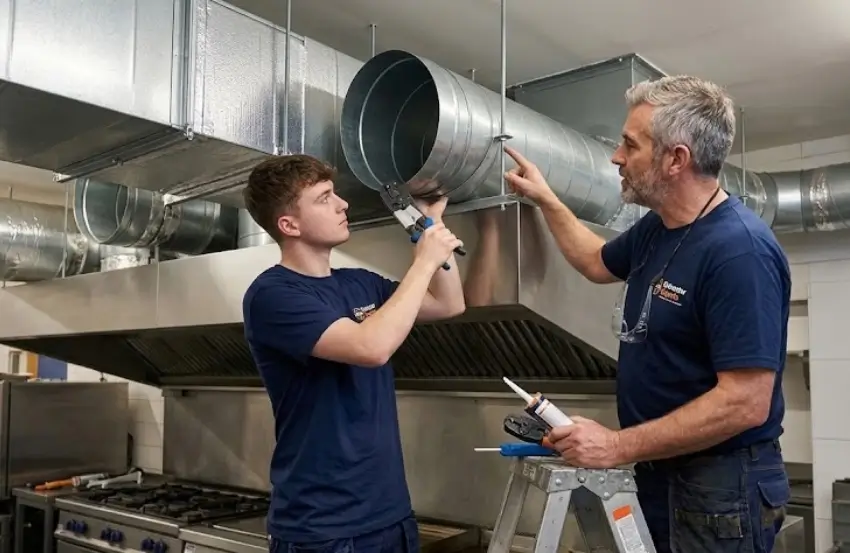
Access panels allow inspection and cleaning of internal duct surfaces. They are especially important in grease extract systems because deposits can accumulate beyond the canopy filters. Access arrangements need to consider the complete duct route, including bends, changes in direction and areas that may be difficult to reach. Panels must be suitable for the application and maintain the required integrity of the ductwork. A system without adequate access can become difficult and costly to inspect or clean.
5. Extraction Fan Connection
The ductwork connects to a fan that creates the airflow required to remove contaminated air. Fan location varies according to the installation. The fan must be selected to deliver the required airflow against the resistance of the complete duct system. A fan that performs well under low-resistance conditions may not deliver the same airflow when connected to a long or complicated duct route.
6. External Discharge Ductwork
The final section carries extracted air towards the external discharge point. The outlet location should be selected with consideration for neighbouring properties, nearby windows, air intakes and other site conditions. In densely developed areas such as London, the discharge arrangement may be a significant design consideration. The objective is to remove cooking emissions effectively while minimising avoidable impacts on the building and surrounding occupiers.
How Does Commercial Kitchen Extraction Ductwork Work Step by Step?
The airflow process follows a sequence from the cooking equipment to the external outlet.
Step 1: Cooking Generates Contaminated Air
Commercial cooking equipment produces heat, steam, smoke, odours and airborne grease. The amount and type of contamination depend on the cooking process. High-temperature frying and grilling can generate different extraction demands from lower-intensity cooking. These emissions rise towards the canopy as part of the cooking plume.
Step 2: The Canopy Captures Cooking Emissions
The extraction fan creates airflow into the canopy. This helps capture the cooking plume before it spreads into the wider kitchen. The canopy must be appropriately sized and positioned for the equipment. Strong cross-draughts, unsuitable canopy dimensions or insufficient airflow can allow fumes to escape.
Step 3: Grease Filters Collect Airborne Grease
As air enters the canopy, it passes through grease filters. These filters collect a proportion of the grease droplets carried in the airstream. The remaining air continues towards the ductwork. Grease filters do not remove all contamination, which is why the ductwork still requires inspection and cleaning.
Step 4: Contaminated Air Enters the Ductwork
The extracted air enters the connected duct system. The fan maintains the pressure difference needed to move air through straight sections, bends and transitions. The route and internal resistance influence the airflow delivered by the system. Ductwork must therefore be designed together with the fan and canopy.
Step 5: Air Moves Through the Extraction Fan
Depending on the installation arrangement, air passes through the extraction fan at the appropriate point in the system. The fan supplies the energy needed to overcome system resistance. Fan performance can be affected by mechanical deterioration, incorrect controls or changes in ductwork resistance. This is one reason why airflow testing is useful during commissioning and fault diagnosis.
Step 6: Extracted Air Leaves the Building
The air is discharged outside through the designed outlet. The discharge arrangement should consider the building layout and the surrounding environment. The system also needs suitable replacement air to compensate for the air removed from the kitchen. Without sufficient make-up air, the extraction system may struggle to operate effectively.
Why Is Proper Commercial Kitchen Ductwork Installation Important?
Professional ductwork installation affects extraction performance, maintenance accessibility and the safety of the ventilation system. A poorly installed duct route can create problems even when the canopy and fan are correctly selected.
Maintaining Effective Airflow
Ductwork must transport the required volume of air without excessive resistance. Unnecessary bends, restrictive fittings and unsuitable dimensions can increase pressure losses. The fan must be capable of overcoming these losses. Proper design and installation help the system operate closer to its intended performance.
Controlling Grease Accumulation
Grease deposits can build up inside commercial kitchen extraction ductwork. Suitable construction, routing and access arrangements support effective cleaning. However, even a well-designed system still requires regular inspection and appropriate grease removal.
Supporting Fire Safety
Grease deposits inside extract ductwork can contribute to fire spread if ignited. Commercial grease extract systems therefore require particular attention to materials, construction, routing and cleaning arrangements. Fire resistance requirements depend on the installation and the building’s fire strategy. A competent designer should consider the relevant requirements rather than assuming every duct section needs the same specification.
Reducing Unnecessary Noise
Excessive air velocity, turbulence and mechanical vibration can contribute to noise. Duct dimensions, fittings and fan selection all influence acoustic performance. Suitable design can help reduce avoidable noise while maintaining the required airflow.
Allowing Safe Maintenance
Commercial kitchen ductwork must remain accessible for inspection and cleaning. Maintenance requirements should be considered before installation rather than after the system is concealed behind ceilings or other building finishes.
How Is Commercial Kitchen Ductwork Designed?
Commercial kitchen ductwork design begins with an assessment of the cooking operation. The designer considers the type and number of appliances, the required extraction airflow, canopy arrangement and available duct route. The next stage involves calculating system resistance and selecting suitable duct dimensions. Ductwork should be designed to work with the chosen extraction fan. A suitable design also considers the external discharge arrangement, cleaning access, fire safety and the supply of replacement air. Effective commercial kitchen ventilation design considers duct dimensions, extraction airflow, fan performance and replacement-air requirements together.
In existing buildings, structural constraints and other services may influence the route. However, limited space should not be used to justify arrangements that cannot be adequately cleaned or maintained. The BESA DW/172 specification provides industry guidance for commercial kitchen ventilation design and construction. The appropriate requirements should be assessed for the specific project.
What Materials Are Used for Commercial Kitchen Extraction Ductwork?
Commercial kitchen grease extract ductwork is commonly fabricated from suitable metal materials, with construction details selected according to the system design and applicable requirements. Material thickness, jointing methods, supports and sealing arrangements all affect the completed installation. The ductwork needs to maintain suitable mechanical integrity under its expected operating conditions. The design should also address grease leakage and cleaning requirements.
Where ductwork passes through fire-resisting elements or designated fire compartments, additional fire safety considerations may apply. The specification should be developed by competent professionals using the relevant building requirements and industry guidance. Material selection should not be based solely on purchase price. The long-term suitability of the installation depends on performance, durability, accessibility and maintenance.
How Does Ductwork Size Affect Kitchen Extraction Performance?
Duct dimensions influence airflow velocity and resistance. When the same volume of air passes through a smaller duct, the air velocity generally increases. Higher velocities can increase pressure losses and noise. However, ductwork that is unnecessarily large may create other design and maintenance problems. Commercial grease extract systems require a considered balance between airflow performance and the practical management of grease deposits.
The appropriate dimensions depend on the required airflow, duct configuration and relevant design guidance. An extraction fan should be selected using the calculated system resistance. Simply installing a larger fan does not guarantee that an unsuitable duct route will perform correctly.
What Causes Commercial Kitchen Extraction Ductwork Problems?
Ductwork performance can deteriorate because of contamination, damage, design limitations or changes to the ventilation system.
Excessive Grease Build-Up
Grease deposits can accumulate on internal duct surfaces. The extent of accumulation depends on cooking activity, filtration, system conditions and cleaning arrangements. Significant deposits can increase fire risk and may affect airflow.
Restricted Duct Sections
Restrictions may develop because of internal deposits, damaged sections or other obstructions. These restrictions can increase system resistance. An airflow assessment and appropriate inspection can help establish whether a restriction is affecting performance.
Poorly Designed Bends
Unnecessary bends and abrupt transitions can increase pressure losses. They may also create difficult cleaning locations. Where these problems are significant, modifications to the duct route may be needed.
Ductwork Leakage
Poorly constructed or damaged joints can allow air or grease leakage. Leakage may reduce effective extraction performance and create maintenance or safety concerns. The appropriate repair depends on the ductwork construction and location of the defect. Where damaged ductwork affects system performance, professional commercial extraction system repairs can help address the identified fault.
Inadequate Cleaning Access
Ductwork that cannot be inspected or cleaned effectively may allow deposits to remain undetected. Access limitations should be identified during system design or a professional condition assessment.
How Is Commercial Kitchen Extraction Ductwork Installed?
A professional installation normally follows a planned sequence.
Site Survey and Assessment
The first stage involves assessing the kitchen layout, cooking equipment and possible duct routes. Existing ventilation equipment and building constraints should also be reviewed. The assessment helps identify practical installation options.
Ductwork Design and Specification
The design establishes the required airflow, duct dimensions, route, fan duty and discharge arrangement. It should also address maintenance access and relevant fire safety requirements.
Fabrication and Installation
Duct sections are fabricated or selected according to the agreed design. Installation involves fitting supports, positioning duct sections and making suitable connections. Access panels and other required components should be incorporated as specified.
Fan and Canopy Connections
The completed duct route is connected to the canopy, fan and external discharge arrangement. Connections must be suitable for the equipment and operating conditions.
Testing and Commissioning
Once installation is complete, the extraction system should undergo appropriate testing. This may include operational checks, airflow measurements and verification of relevant controls. Commissioning helps establish whether the installation delivers its intended performance.
What UK Standards and Guidance Apply to Commercial Kitchen Ductwork?
Commercial kitchen extraction ductwork must be considered within the relevant legal and technical framework. The Health and Safety Executive provides guidance on ventilation in catering establishments, including the control of cooking emissions and maintenance considerations. BESA DW/172 is an industry specification covering the design and construction of kitchen ventilation systems. BESA TR19 Grease provides industry guidance relating to the cleanliness and cleaning of grease extract ductwork. These documents are not interchangeable.
DW/172 focuses on design and construction, while TR19 Grease addresses grease extract cleaning and associated assessment practices. Legal duties may arise from health and safety, fire safety, building regulations and other requirements relevant to the installation. Industry guidance can support compliance, but following a named document does not automatically establish that every legal obligation has been met. A competent assessment should determine which requirements apply to the specific premises.
How Often Should Commercial Kitchen Extraction Ductwork Be Cleaned?
Cleaning frequency depends on cooking intensity, operating hours, the type of food preparation and the condition of the system. High-volume cooking operations may generate grease deposits more quickly than lightly used kitchens. The appropriate schedule should be based on inspection findings, relevant risk assessments and applicable guidance. The BESA TR19 Grease guidance provides an industry reference for grease extract ductwork cleanliness and cleaning practices. Kitchen operators should distinguish between routine grease filter cleaning and specialist ductwork cleaning.
Cleaning visible canopy filters does not remove deposits from concealed ductwork. Professional ductwork inspection can help establish the condition of the system and identify areas requiring attention. Maintenance records are useful for tracking cleaning history and supporting future assessments. Planned commercial kitchen extraction maintenance can help identify deterioration and support reliable ventilation performance.
When Should Commercial Kitchen Ductwork Be Repaired or Replaced?
Repair may be appropriate when damage is localised and the existing ductwork remains suitable for its intended purpose. Examples can include defective joints, damaged sections or problems with access arrangements. More extensive replacement may be necessary when the ductwork is severely deteriorated, unsuitable for the cooking operation or cannot be brought to an appropriate standard through practical repairs.
Changes to kitchen equipment may also require a review of the existing ductwork capacity. A professional assessment should consider the complete extraction system. Replacing a duct section without addressing underlying airflow or design problems may not resolve the original issue.
Commercial Kitchen Ductwork Installation Services in London and Surrey
Commercial kitchens in London often face installation challenges because of limited ceiling space, existing building services and complex routes to external discharge points. Restaurants, hotels, takeaways and other catering businesses need ductwork that supports the required extraction performance while remaining accessible for maintenance. Extractor Experts Ltd is based in Staines-upon-Thames, Surrey, and provides commercial kitchen ductwork installation services across London, Greater London and Surrey.
The company also offers extraction system design, ventilation solutions, fan repairs and maintenance. Whether the project involves a new kitchen or an existing extraction system, a professional assessment can help establish the appropriate ductwork arrangement.
Frequently Asked Questions
1. How does commercial kitchen extraction ductwork remove cooking fumes?
Ductwork carries contaminated air from the extraction canopy towards an external discharge point. An extraction fan creates the pressure difference needed to move air through the system. Grease filters help capture some airborne grease before it enters the ductwork.
2. What is the difference between grease extract ductwork and normal ventilation ductwork?
Grease extract ductwork handles air containing cooking grease and potentially high temperatures. Its construction, fire safety considerations and cleaning access requirements can differ from those of ordinary comfort ventilation ductwork.
3. Does commercial kitchen extraction ductwork need cleaning access?
Yes. Grease extract ductwork should be designed with suitable access for inspection and cleaning. Access arrangements are important because grease deposits can accumulate in concealed sections, bends and other parts of the system.
4. Can blocked ductwork reduce commercial kitchen extraction performance?
Yes. Significant restrictions can increase resistance and reduce the airflow delivered by the extraction system. A professional inspection and airflow assessment can help identify whether blocked or damaged ductwork is contributing to poor performance.
5. How do I know whether commercial kitchen ductwork needs replacing?
Replacement may be necessary when ductwork is severely damaged, unsuitable for the cooking operation or cannot be adequately repaired or maintained. A professional assessment should consider its condition, design, performance and applicable safety requirements.
Conclusion: Why Commercial Kitchen Extraction Ductwork Matters
Commercial kitchen extraction ductwork provides the essential airflow route between the canopy, extraction fan and external discharge point. Its design affects extraction performance, pressure losses, maintenance accessibility and the management of grease deposits. Correct installation helps the complete ventilation system operate as intended. Regular inspection and appropriate cleaning also help identify developing problems and maintain the condition of the system.