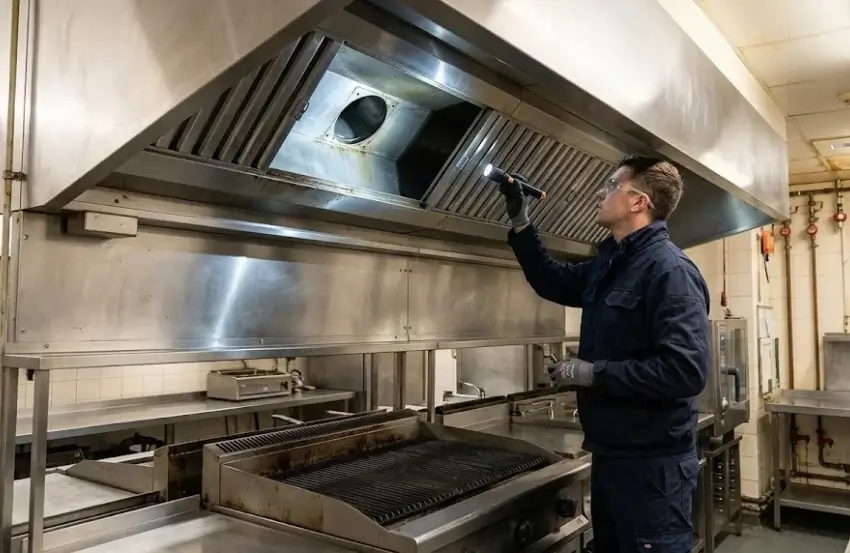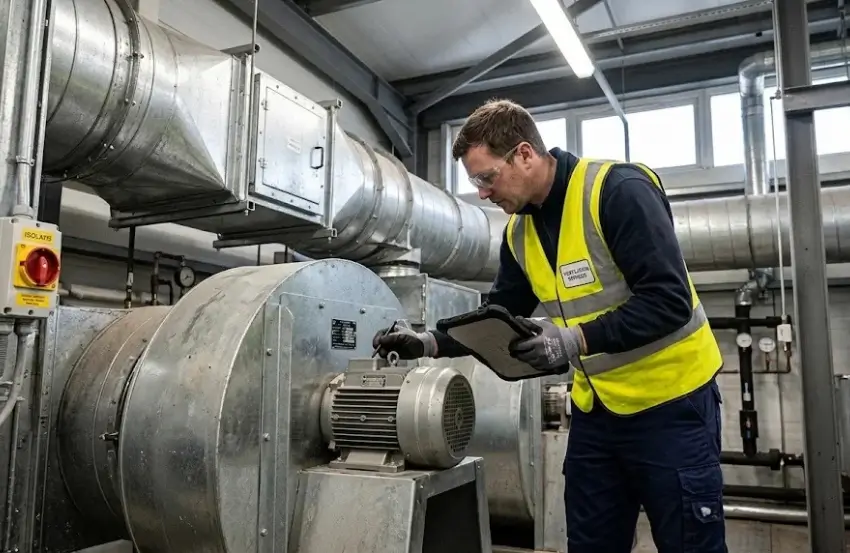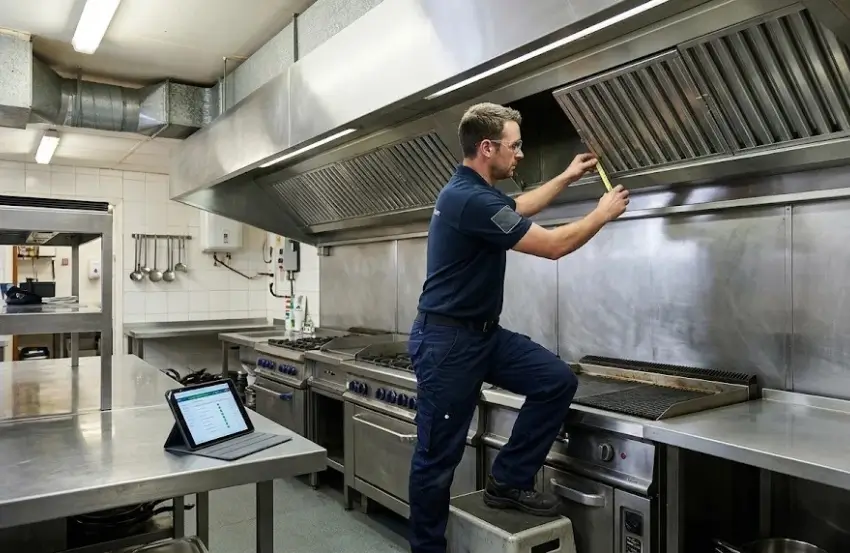
Commercial kitchen extraction static pressure is the pressure exerted by air within a ventilation system, measured independently of its velocity. It is commonly measured in Pascals (Pa) and helps engineers assess fan performance alongside airflow rates and the resistance created by ductwork, filters and other components.
Every extraction system encounters resistance as air travels from the kitchen canopy towards the discharge point. The fan must generate sufficient pressure to overcome these losses while maintaining the intended airflow rate. When resistance increases beyond the system’s design conditions, a fixed-speed fan will generally deliver less airflow.
Commercial kitchen ventilation static pressure is therefore closely connected to fan selection, ductwork design and extraction performance. A fan may be running normally but still struggle to remove cooking fumes effectively if the system resistance is too high.
For restaurant operators, kitchen managers and facilities teams, understanding this relationship helps explain why extraction performance can change after ductwork alterations, filter restrictions or equipment modifications.
Extractor Experts provides commercial kitchen extraction design, installation, fault finding and maintenance services across London, Surrey and other locations subject to availability. Understanding pressure resistance is an important part of assessing ventilation performance.
How Does Static Pressure Work in a Kitchen Extraction System?
A commercial kitchen extraction system uses a mechanical fan to draw contaminated air away from cooking equipment and discharge it outside the building.
The air normally travels through several components, including the extraction canopy, grease filters, connecting ductwork, bends and the extraction fan.
Each component introduces some resistance to airflow. The fan must produce sufficient pressure to move the required volume of air through the complete system.
Static pressure is the pressure exerted by the air independently of its movement. In ventilation engineering, it is normally considered alongside velocity pressure and total pressure.
Static pressure can be positive or negative relative to the surrounding atmosphere, depending on the measurement location. For example, ductwork upstream of an extraction fan commonly operates under negative static pressure because the fan draws air towards its inlet.
The important design consideration is not simply whether a pressure reading is high or low. It is whether the fan can overcome the total system resistance at the required airflow rate.
Static Pressure, Velocity Pressure and Total Pressure
These three measurements describe different aspects of airflow.
| Pressure Type | Meaning | Importance |
|---|---|---|
| Static pressure | Pressure exerted by air independently of its velocity | Helps assess system pressure conditions and resistance |
| Velocity pressure | Pressure associated with air movement | Used to calculate airflow velocity |
| Total pressure | Combination of static and velocity pressure | Important in fan and ductwork calculations |
| Pressure loss | Reduction in total pressure through a component or duct section | Indicates resistance the fan must overcome |
For typical low-speed ventilation measurements, total pressure is the sum of static pressure and velocity pressure.
Although these terms are related, they should not be treated as interchangeable.
A static pressure reading at one location does not automatically reveal the total resistance of the extraction system.
What Causes Static Pressure Losses in Commercial Kitchen Extraction?
Air encounters resistance whenever it moves through ductwork or changes direction. Pressure losses can occur even in a correctly designed and maintained system.
The main causes are associated with duct dimensions, airflow velocity, fittings and filtration components.
1. Resistance Inside Extraction Ductwork
Air moving through ductwork experiences friction against the internal surfaces.
Longer duct runs generally create greater frictional pressure losses than shorter runs when the duct size, airflow and other conditions remain the same.
The resistance also depends on duct dimensions, surface condition and airflow velocity.
For example, two commercial kitchens may use similar extraction fans but require different pressure capabilities because one system has a longer or more restrictive ductwork route.
The fan selection must reflect the actual installation rather than relying only on the fan’s nominal airflow rating.
For projects where ductwork layout or dimensions need improvement, professional commercial ductwork installation can help address system design requirements.
2. Duct Bends and Changes in Direction
Every change in airflow direction can introduce additional pressure loss.
Elbows, transitions and junctions disturb the airflow pattern. Poorly configured fittings can create unnecessary turbulence and increase the resistance the fan must overcome.
A system with several abrupt bends may require greater fan pressure than a comparable system with smoother transitions.
This is one reason ductwork layout matters during commercial kitchen ventilation design.
Where practical, designers can reduce unnecessary resistance by considering suitable bend geometry, duct routing and transition arrangements.
3. Grease Filters and Filtration Equipment
Commercial kitchen extraction systems use grease filters to capture grease particles before the air enters the ductwork.
These filters create an intended pressure drop.
However, accumulated grease and dirt can increase resistance, depending on the filter design and condition.
Additional filtration equipment, such as odour-control units, can also introduce significant pressure losses.
The fan must be selected with the relevant filtration equipment in mind.
A system that performs adequately with clean filters may deliver reduced airflow when filter resistance increases during operation.
4. Ductwork Size and Airflow Velocity
Duct size affects the speed at which air travels through the extraction system.
For a given airflow rate, reducing the duct cross-sectional area increases air velocity.
Higher velocity generally increases frictional and fitting-related pressure losses.
However, larger ductwork is not automatically the correct solution. Commercial kitchen extraction design must also consider appropriate transport velocities, grease management, access for cleaning and the available installation space.
The objective is to balance airflow requirements, pressure resistance and practical system design.
5. Restrictions and Alterations
System resistance can change when equipment is added or ductwork is modified.
Examples include installing additional filtration, changing a duct route, adding restrictive fittings or introducing an obstruction.
A fan originally selected for one ductwork configuration may not provide the same airflow after substantial changes.
This makes pressure assessment important when upgrading an existing commercial kitchen extraction system.
How Does Static Pressure Affect Extractor Fan Performance?
The relationship between static pressure and fan performance is one of the most important considerations in commercial kitchen ventilation.
An extraction fan does not necessarily deliver the same airflow under every operating condition.
Its performance depends on the resistance presented by the connected system.
Fan manufacturers commonly provide performance curves showing how airflow changes at different pressure conditions.
For a typical fixed-speed fan, increasing system resistance causes the operating point to move towards a lower airflow rate.
Consequently, a fan may continue operating while delivering less air than the kitchen requires.
Understanding the Fan Performance Curve
A fan performance curve describes the relationship between airflow and pressure for a particular fan under specified operating conditions.
Airflow is commonly expressed in cubic metres per second (m³/s) or cubic metres per hour (m³/h).
Pressure is usually expressed in Pascals.
The curve allows engineers to assess whether a fan can deliver the required airflow against the expected resistance.
For example, a fan might deliver a particular airflow at 300 Pa but a lower airflow at 500 Pa.
These figures are illustrative rather than specifications for a particular extraction fan.
The exact relationship depends on the fan model, speed, configuration and manufacturer’s performance data.
What Is the System Resistance Curve?
The system resistance curve represents the pressure required to move different volumes of air through the installed ductwork and components.
For many fixed ventilation systems, pressure losses increase approximately with the square of airflow.
This means doubling the airflow can produce roughly four times the pressure loss across certain components, assuming comparable operating conditions.
The actual relationship may differ because of filter characteristics, changes in airflow behaviour and other system factors.
The point where the fan performance curve intersects the system resistance curve is known as the operating point.
At this point, the pressure developed by the fan balances the resistance of the system.
The resulting airflow determines how much air the extraction system actually moves.
What Happens When Static Pressure Resistance Becomes Too High?
Excessive system resistance can prevent a fan from delivering its intended airflow.
This does not necessarily mean that the fan is defective. It may be operating according to its performance characteristics but against a more restrictive system than originally anticipated.
Potential consequences include reduced extraction capacity, poor capture of cooking fumes and changes in system noise.
The effects depend on the fan type, control arrangement and the extent of the resistance.
Reduced Extraction Airflow
When resistance increases, the airflow delivered by a typical fixed-speed extraction fan generally decreases.
This may affect the ability of the kitchen canopy to capture heat, steam and cooking fumes.
The problem can become more noticeable during busy cooking periods when several appliances operate simultaneously.
However, poor capture is not proof of excessive static pressure. Inadequate replacement air, canopy design and other faults can produce similar symptoms.
Increased Noise or Changes in Fan Operation
Unusual noise can sometimes accompany changes in airflow conditions.
Certain fans may operate less efficiently or experience unstable airflow when working outside their intended performance range.
However, high static pressure does not always increase noise.
A noisy extraction system may also have mechanical problems, vibration, loose components or unsuitable airflow velocities.
Pressure readings and fan performance data should be considered alongside mechanical inspections.
Reduced System Efficiency
A fan operating away from its efficient operating region may use energy less effectively.
In some systems, attempts to compensate for excessive resistance by increasing fan speed can increase electricity consumption and noise.
However, electrical power does not always rise simply because resistance increases.
The relationship depends on the fan characteristics and control system.
Professional assessment is therefore more reliable than assuming that a higher pressure reading automatically means higher energy use.
How Is Static Pressure Measured in Commercial Kitchen Ventilation?
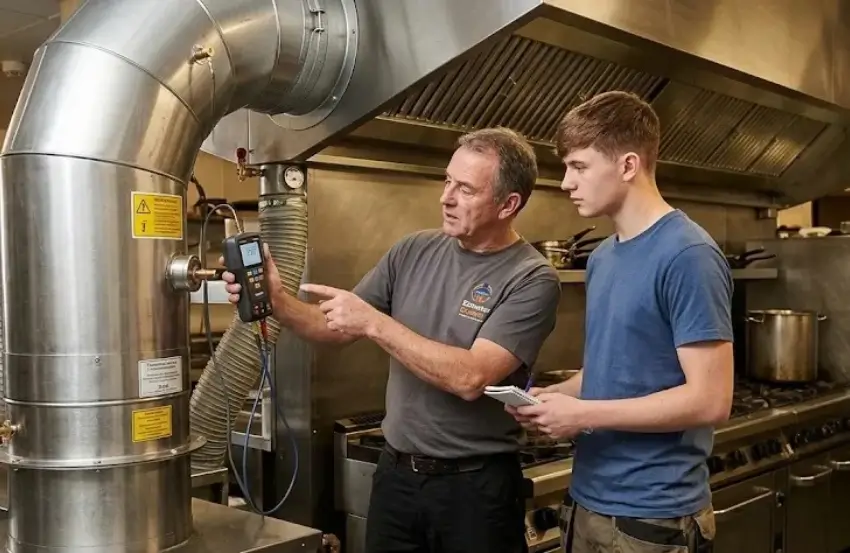
Static pressure is normally measured using suitable pressure instruments connected to correctly positioned measurement points.
Technicians may use a differential pressure meter or manometer to compare pressure at a particular location with atmospheric pressure or another measurement point.
Readings are generally expressed in Pascals.
For ductwork measurements, suitable static pressure tapping points are important because poorly positioned instruments can produce misleading results.
Airflow disturbances near bends, transitions and fans can affect measurement accuracy.
Measuring Pressure Across Components
Pressure measurements can help identify resistance across specific parts of a ventilation system.
For example, technicians may compare readings before and after a filter section to assess its pressure drop.
However, determining total pressure loss accurately can require more than two static pressure readings, particularly where duct velocities or cross-sectional areas differ.
A complete assessment may also involve airflow measurements, duct dimensions and fan performance information.
Why Pressure Measurements Need Context
A single pressure reading does not establish whether a commercial kitchen extraction system is performing correctly.
The result must be interpreted against the system’s design requirements and operating conditions.
Useful information includes:
- The required extraction airflow rate.
- The fan model and manufacturer performance data.
- The ductwork layout and dimensions.
- The condition of filters and other components.
- The actual airflow delivered by the system.
- Previous commissioning or performance measurements, where available.
Without this information, it can be difficult to distinguish normal operating pressure from excessive resistance.
Example: How Ductwork Resistance Changes Fan Performance
Consider a commercial kitchen extraction system designed to deliver 2.0 m³/s of airflow.
At that airflow, suppose the original system requires 400 Pa of fan static pressure.
After additional filtration equipment is installed, the required pressure at the same airflow increases to 550 Pa.
| Operating Condition | Required Pressure at 2.0 m³/s |
|---|---|
| Original ductwork and filtration | 400 Pa |
| Modified system with additional filtration | 550 Pa |
| Increase in required pressure | 150 Pa |
These values are hypothetical and illustrate the relationship between airflow and resistance.
The original fan may not be capable of maintaining 2.0 m³/s against the additional pressure requirement.
If it cannot, the operating point will change and the actual airflow may decrease.
The precise reduction cannot be calculated from these figures alone. The manufacturer’s fan curve and the complete system resistance characteristics are required.
This example demonstrates why adding filtration equipment or changing ductwork can affect extraction performance even when the fan itself remains unchanged.
Can Static Pressure Be Reduced Without Replacing the Fan?
In some cases, unnecessary system resistance can be reduced without replacing the extraction fan.
The appropriate approach depends on the cause.
If filters are excessively restricted, restoring them to the manufacturer’s intended condition may reduce pressure loss.
Where ductwork contains an obstruction or an unsuitable fitting, correcting the restriction may improve airflow.
During system redesign, engineers may also consider alternative duct routes, more suitable dimensions or lower-resistance components.
However, reducing resistance should not compromise necessary grease filtration, airflow velocities, fire-safety provisions or other design requirements.
It is also important to distinguish excessive resistance from insufficient fan capacity.
If the existing fan was incorrectly selected, removing minor restrictions may not be enough to achieve the required airflow.
A professional assessment should establish the operating point before recommending modifications.
Why Static Pressure Matters When Selecting a Commercial Extraction Fan
A commercial kitchen extraction fan must be selected for both the required airflow and the resistance of the connected system.
Selecting a fan solely because it advertises a high maximum airflow can be misleading.
Maximum airflow ratings may describe performance under very low resistance rather than the conditions present in an installed commercial kitchen extraction system.
A suitable selection process considers the complete ductwork route, fittings, grease filters, additional treatment equipment and discharge arrangement.
The designer then evaluates the pressure losses at the required airflow and checks whether the proposed fan can meet those conditions.
The fan’s efficiency, operating range, noise characteristics and maintenance requirements also matter.
The Building Engineering Services Association’s DW/172 specification provides recognised industry guidance for commercial kitchen ventilation system design.
Static pressure calculations form part of a wider design process, not a standalone indication that a system will perform correctly.
When Should a Commercial Kitchen Extraction System Be Professionally Assessed?
A pressure and airflow assessment may be appropriate when extraction performance changes or the system undergoes significant modifications.
Common situations include persistent poor capture of cooking fumes, unexplained changes in airflow, new filtration equipment or alterations to the ductwork.
A professional assessment may also be useful where an existing fan’s performance is uncertain or the original design information is unavailable.
The process can involve reviewing the system configuration, measuring airflow and pressure, inspecting relevant components and comparing the results with available design information.
These checks help determine whether the problem is caused by resistance, fan selection, mechanical faults or another aspect of the ventilation system.
Where poor extraction is linked to mechanical faults or fan performance problems, professional commercial extractor fan repairs may be required.
Specialist electrical and mechanical work should be undertaken by suitably competent personnel. Kitchen operators should not attempt to adjust fan controls, bypass filtration or modify extraction ductwork without appropriate technical assessment.
For commercial kitchens in London and Surrey, Extractor Experts can be contacted about extraction system fault finding, ventilation design, repairs and maintenance.
Frequently Asked Questions About Commercial Kitchen Extraction Static Pressure
1. What is static pressure in a commercial kitchen extraction system?
Static pressure is the pressure exerted by air independently of its movement. In kitchen extraction systems, static pressure measurements help engineers assess pressure conditions and the fan’s ability to overcome system resistance.
2. Does higher static pressure mean better extraction?
No. Higher static pressure does not automatically mean better extraction. The fan must deliver the required airflow against the system’s resistance. Excessive resistance can reduce airflow and negatively affect extraction performance.
3. What causes excessive static pressure in kitchen exhaust systems?
Excessive resistance can result from restrictive ductwork, sharp bends, obstructed filters, additional filtration equipment or changes to the extraction system. Measurements are needed to identify the actual cause.
4. How does static pressure affect commercial extractor fan performance?
Static pressure and system resistance influence the fan’s operating point. When resistance increases, a typical fixed-speed fan generally delivers less airflow. The exact effect depends on the manufacturer’s fan performance curve.
5. Can static pressure be measured without switching off the extraction system?
Operating pressure measurements are normally taken while the system is running under suitable test conditions. However, safe access, correctly positioned measurement points and competent testing procedures are essential.
Conclusion: Understanding Static Pressure and Fan Performance
Commercial kitchen extraction static pressure is an important part of understanding how a ventilation system performs.
Ductwork, bends, grease filters and other components create resistance that the extraction fan must overcome.
When resistance increases, the fan’s operating point can change, potentially reducing the airflow available to capture cooking fumes.
The correct approach is to evaluate pressure and airflow together rather than relying on a single pressure reading.
Understanding this relationship helps commercial kitchen operators make informed decisions about extraction system maintenance, alterations and fan performance.
Need Help Assessing Your Commercial Kitchen Extraction System?
Extractor Experts provides commercial kitchen extraction design, installation, repairs, fault finding and maintenance services.
Whether your system has experienced reduced extraction performance or you are planning modifications to existing ductwork, professional assessment can help identify the appropriate next steps.
Contact Extractor Experts Ltd
Phone: +44 7576 680389
Email: info@extractorexperts.co.uk
Website: https://extractorexperts.co.uk/
Service Areas: London, Greater London and Surrey, with other UK locations subject to confirmation.