A commercial kitchen extraction system works by capturing smoke, heat, steam, airborne grease and cooking fumes above catering equipment, then moving the contaminated air through filters and ductwork before discharging it safely outside the building. At the same time, the kitchen needs a suitable supply of fresh replacement air to maintain effective ventilation and comfortable working conditions.
The process begins at the extraction canopy, usually positioned above cooking appliances. Grease filters help separate grease particles from the extracted air, while a mechanical fan creates the airflow needed to transport cooking emissions through the ductwork. The system then discharges the extracted air through a properly designed external outlet.
A well-designed installation must balance extraction capacity, canopy performance, ductwork resistance, fan selection and replacement air. Poorly matched components can cause lingering smoke, excessive heat, draughts, noise and reduced ventilation performance.
Understanding how a commercial kitchen extraction system works can help restaurant owners and kitchen managers identify ventilation problems, plan maintenance and make informed decisions about system improvements. Where professional assistance is needed, the relevant extraction and ventilation services can help address the specific requirements of the kitchen.
What Is a Commercial Kitchen Extraction System?
A commercial kitchen extraction system is a mechanical ventilation arrangement designed to capture and remove airborne contaminants generated during commercial cooking.
Restaurants, hotels, cafés, takeaways, schools and other catering facilities use extraction systems because cooking produces significant amounts of heat, steam, grease aerosols, smoke and odours.
Without effective ventilation, these contaminants can spread through the kitchen and affect working conditions.
A typical system combines a canopy, grease filtration, ductwork, an extraction fan and an external discharge arrangement. Many installations also include mechanical replacement-air equipment, acoustic treatment and electrical controls.
The system must be designed around the cooking operation rather than selected solely by kitchen floor area.
A restaurant using high-temperature grills or fryers may have different extraction requirements from a school kitchen using ovens and lower-intensity cooking equipment.
The objective is to capture cooking emissions at source and move them out of the building without creating excessive draughts or disrupting other ventilation arrangements.
What Are the Main Components of a Commercial Kitchen Extraction System?
Several components work together to create an effective commercial kitchen ventilation system.
1. Commercial Kitchen Extraction Canopy
The extraction canopy is normally installed above the cooking equipment.
Its purpose is to collect rising cooking fumes, steam, heat and grease-laden air before these contaminants spread throughout the kitchen.
Canopy size and positioning are important because cooking emissions rise and move according to heat output, appliance arrangement and surrounding air currents.
An undersized canopy may allow smoke and steam to escape beyond its capture area.
The canopy should also provide appropriate access for cleaning and maintenance.
Different canopy configurations are available for different cooking operations, including wall-mounted and island arrangements.
The correct selection depends on the kitchen layout and equipment.
2. Grease Filters
Grease filters are fitted within many commercial kitchen extraction canopies.
They help separate grease droplets from the extracted airstream before the air enters the ductwork.
Commercial grease filters may use baffle arrangements that encourage grease particles to collect on internal surfaces and drain into designated collection areas.
These filters do not remove every contaminant from the air.
They also do not eliminate the need for ductwork inspection and cleaning.
Filters must be maintained because accumulated grease can restrict airflow and increase fire risk.
Kitchen operators should follow the equipment manufacturer’s cleaning instructions and the site’s maintenance arrangements.
3. Commercial Extraction Ductwork
Ductwork connects the canopy to the extraction fan and external discharge point.
It provides the route through which contaminated air travels out of the kitchen.
Commercial kitchen ductwork must be designed to accommodate the required airflow while accounting for pressure losses caused by duct length, bends, fittings and other components.
The route may pass through ceiling voids, service areas or external sections of the building.
Grease extract ductwork requires particular attention to construction, accessibility and cleaning arrangements.
Poorly designed ductwork can increase resistance, reduce extraction performance and make maintenance difficult.
4. Commercial Kitchen Extractor Fan
The extraction fan creates the pressure difference needed to move air through the system.
It draws contaminated air into the canopy and through the connected ductwork before discharge.
Commercial kitchens may use centrifugal, axial or other fan arrangements depending on the required airflow, system resistance and installation conditions.
A fan must be selected to operate at the required duty point.
Choosing equipment based only on motor power or maximum advertised airflow can lead to poor results.
The fan also needs suitable access for inspection, cleaning and repair.
5. External Discharge Outlet
The extracted air must be discharged to a suitable outdoor location.
The discharge arrangement should be considered during system design because its position can affect odour dispersal and the potential impact on neighbouring properties.
In London, some commercial kitchens operate close to offices, homes or other occupied buildings.
Discharge positioning may therefore require particular consideration of surrounding openings, building layout and relevant planning conditions.
A suitable outlet should support effective discharge without creating avoidable problems for the premises or neighbouring occupiers.
6. Replacement-Air System
A commercial kitchen cannot continuously remove large volumes of air without suitable replacement air entering the building.
Replacement air, also called make-up air, may be supplied naturally or mechanically depending on the installation.
Smaller kitchens may have appropriately designed natural-air openings.
Larger commercial kitchens often need mechanical supply-air systems to provide more controlled airflow.
The replacement-air arrangement should support extraction performance without creating uncomfortable draughts or disturbing the canopy’s capture of cooking fumes.
7. Ventilation Controls and Safety Interlocks
Commercial extraction systems may include fan switches, speed controllers, variable speed drives, monitoring devices and safety interlocks.
These components help control operation and coordinate extraction with other equipment.
Some commercial gas installations require suitable interlocking arrangements to address the relationship between ventilation and appliance operation.
The requirements depend on the appliance and installation.
Any gas safety work should be assessed and undertaken by appropriately qualified Gas Safe registered engineers competent for the relevant commercial equipment.
How Does a Commercial Kitchen Extraction System Work Step by Step?
Understanding the airflow process makes it easier to see how the individual components contribute to kitchen ventilation.
Step 1: Cooking Produces Heat and Airborne Contaminants
When commercial cooking equipment operates, it generates heat, steam and various airborne emissions.
Frying and grilling may also produce grease aerosols, smoke and cooking odours.
The quantity and nature of these emissions depend on the cooking method, equipment and intensity of use.
Warm air and cooking plumes generally rise towards the extraction canopy.
However, nearby air movement can influence their direction.
Step 2: The Canopy Captures Cooking Emissions
The extraction fan creates airflow into the canopy.
This helps draw the rising cooking plume into the extraction system before it spreads across the kitchen.
Effective capture depends on canopy design, extraction rate, appliance position and surrounding airflow conditions.
A powerful fan cannot necessarily compensate for a poorly positioned canopy.
The complete arrangement must be suitable for the cooking equipment.
Step 3: Grease Filters Separate Particles
As the extracted air passes through the canopy, grease filters collect a proportion of the airborne grease.
This helps reduce the amount of grease entering the ductwork.
The collected grease must be removed through appropriate cleaning and maintenance.
Even with effective filtration, grease can accumulate elsewhere in the extraction system.
That is why regular inspection remains important.
Step 4: The Fan Moves Air Through the Ductwork
The extraction fan generates the pressure required to overcome resistance within the system.
Air moves through duct sections, bends and other components towards the discharge point.
Every part of the route affects the total resistance the fan must overcome.
Long or complicated ductwork routes may require different fan characteristics from short, relatively direct installations.
The fan and ductwork should therefore be designed together.
Step 5: Contaminated Air Is Discharged Outside
The extracted air reaches the discharge outlet and leaves the building.
The discharge position should be selected to reduce the likelihood of extracted fumes or odours re-entering the premises or affecting nearby occupied areas.
Additional measures may be considered where site conditions or planning requirements make them necessary.
The exact solution depends on the building and surrounding environment.
Step 6: Fresh Air Replaces Extracted Air
As contaminated air leaves the kitchen, suitable replacement air enters through the designed supply arrangement.
This maintains the airflow needed for effective extraction and helps control the pressure relationship between the kitchen and adjoining spaces.
A lack of replacement air can cause excessive negative pressure.
Possible symptoms include difficult-to-open doors, strong draughts and poor extraction performance.
Step 7: Controls Maintain System Operation
The system’s controls regulate fan operation according to the installation design.
Some kitchens use fixed-speed extraction, while others use variable-speed equipment.
The appropriate arrangement depends on cooking demand, equipment requirements and ventilation design.
Where variable operation is used, the system must still maintain adequate ventilation under the relevant operating conditions.
Why Do Commercial Kitchens Need Extraction Systems?
Commercial kitchen extraction is necessary because cooking can release substantial amounts of heat, moisture and airborne contaminants.
An effective system helps control these emissions at source.
Removing Smoke and Cooking Fumes
Smoke and cooking fumes can affect visibility, comfort and air quality.
Capturing emissions close to the cooking equipment reduces their spread into the wider kitchen.
The extraction system must be capable of handling the cooking operation for which it was designed.
Controlling Excess Heat
Commercial cooking equipment generates significant heat.
Ventilation helps remove some of this heat while introducing suitable replacement air.
However, extraction alone does not guarantee comfortable temperatures.
The supply-air arrangement and other environmental conditions also influence kitchen comfort.
Managing Grease-Laden Air
Cooking processes can release airborne grease particles.
Grease filtration and suitable ductwork help manage these contaminants.
Because grease can accumulate within the system, cleaning and maintenance are essential parts of safe operation.
Supporting Suitable Working Conditions
Poor ventilation can create uncomfortable conditions for kitchen staff.
Effective extraction, adequate fresh air and controlled air movement help support a more suitable working environment.
Supporting Safe Combustion
Gas-fired and solid-fuel cooking equipment may have additional ventilation requirements.
Adequate air supply and appropriate extraction arrangements are important for combustion safety.
Ventilation design should consider the requirements of the installed appliances and applicable safety duties.
How Is Commercial Kitchen Extraction Airflow Calculated?
Commercial kitchen extraction airflow should be determined through a design assessment rather than guesswork.
The required rate depends on several factors, including cooking equipment, heat output, canopy arrangement, kitchen layout and the system’s intended performance.
A designer also needs to consider the resistance of the ductwork and connected components.
Fan selection must account for the airflow required at the relevant operating pressure.
The replacement-air arrangement is equally important.
For example, increasing extraction airflow without reviewing the available supply air may create an excessive pressure difference within the kitchen.
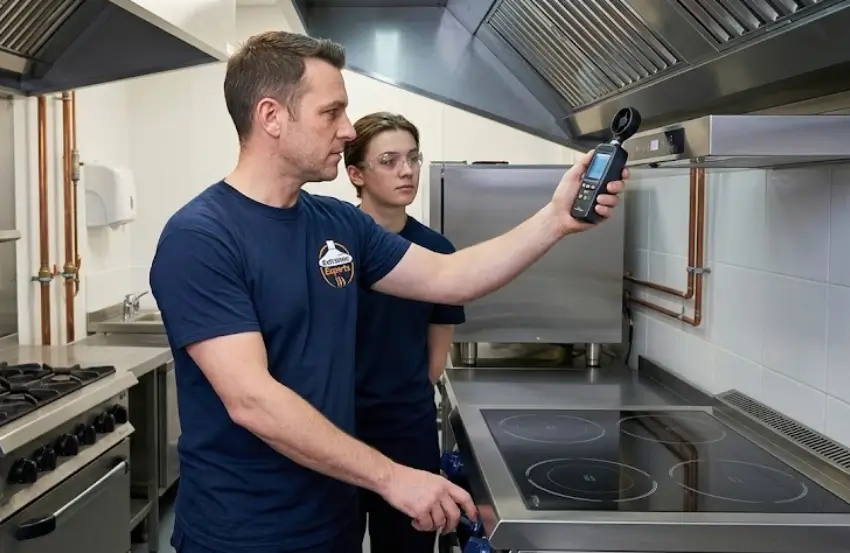
Airflow calculations should be supported by appropriate design information and verified through commissioning where required.
The Health and Safety Executive’s guidance on catering ventilation explains that extraction design should consider cooking load, equipment, layout, working conditions and maintenance accessibility.
What Happens When a Commercial Kitchen Extraction System Is Poorly Designed?
Poor extraction design can produce several operational problems.
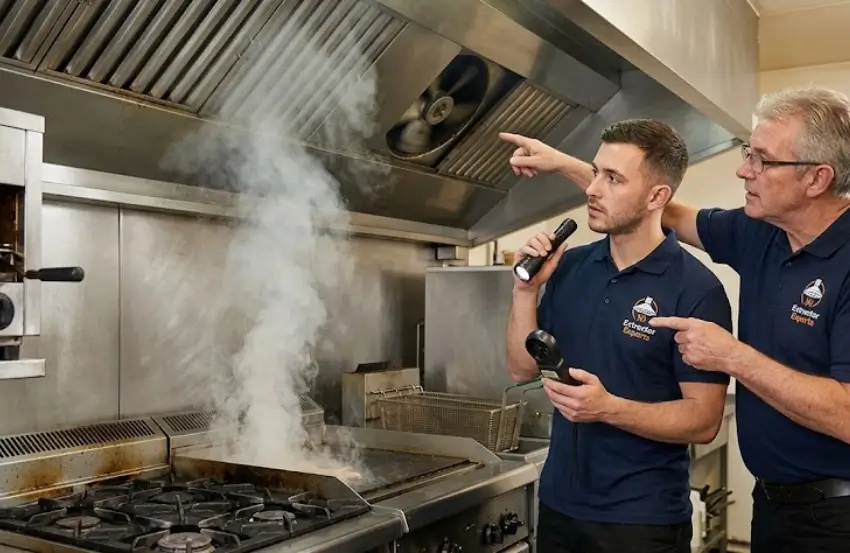
Smoke Escaping from the Canopy
An incorrectly sized canopy or inadequate airflow may allow cooking emissions to escape into the kitchen.
Strong cross-draughts can also interfere with canopy capture.
The cause should be established before increasing fan speed or replacing equipment.
Excessive Negative Pressure
When extraction exceeds the available replacement-air supply, the kitchen may develop excessive negative pressure.
This can cause uncomfortable draughts and interfere with certain building or appliance ventilation arrangements.
The solution may involve supply-air improvements or system rebalancing.
Excessive Noise
Fan noise can become a problem when equipment is poorly selected or installed.
Noise may also arise from high air velocities, vibration or mechanical faults.
Appropriate fan selection, ductwork design and acoustic measures can help control noise.
High Maintenance Requirements
Ductwork without suitable cleaning access can be difficult to maintain.
Poor access may increase the complexity of inspections and grease removal.
Maintenance accessibility should be considered from the beginning of the design process.
Inconsistent Extraction Performance
A system may perform adequately during light cooking but struggle during busy service.
This can happen when the extraction capacity is unsuitable for the actual cooking load.
A professional assessment can establish whether the issue involves airflow, equipment condition or the original design.
How Are Commercial Kitchen Extraction Systems Installed in London?
Commercial kitchen extraction installation usually begins with a site assessment.
The engineer or designer reviews the cooking equipment, kitchen layout, available space and potential ductwork routes.
The design stage then considers canopy dimensions, extraction airflow, fan selection, replacement air and external discharge.
In London, the surrounding building environment can influence the installation.
For example, restaurants located beneath other occupiers may have limited space for ductwork or plant equipment.
Some projects may also require planning considerations relating to external equipment, noise, odours or building alterations.
Once the design is agreed, installation may include fitting the canopy, constructing ductwork, installing the fan and controls, and connecting the relevant ventilation components.
The completed system should then undergo appropriate testing and commissioning.
Extractor Experts provides commercial kitchen extraction design and installation services for commercial catering premises, including restaurants, hotels, cafés and takeaways.
What UK Guidance Applies to Commercial Kitchen Extraction Systems?
Commercial kitchen ventilation must be considered within the relevant UK health and safety and building requirements.
The Health and Safety Executive publishes guidance on ventilation in catering establishments, including effective extraction, replacement air, maintenance and combustion safety.
BESA‘s DW/172 specification is an important industry reference for commercial kitchen ventilation system design and construction.
These sources serve different purposes.
Legal duties establish requirements that businesses and responsible parties must meet, while industry specifications and guidance provide technical approaches to supporting suitable design and operation.
Requirements can vary according to the building, cooking appliances and installation.
Commercial gas appliances, fire safety, planning and building work may introduce additional considerations.
Professional advice should be obtained where the applicable requirements are uncertain.
How Often Should a Commercial Kitchen Extraction System Be Maintained?
Maintenance frequency depends on the equipment, cooking intensity, operating hours and condition of the installation.
A kitchen operating high-volume frying equipment may require a different cleaning and inspection programme from a lightly used catering kitchen.
Maintenance may include inspecting grease filters, checking fan condition, reviewing controls and assessing ductwork cleanliness.
The system should also be checked when there are signs of poor performance.
These may include reduced extraction, unusual noise, vibration, recurring fan faults or cooking fumes escaping from the canopy.
Cleaning and mechanical maintenance are related but distinct activities.
The appropriate programme should reflect the system’s risk assessment, manufacturer instructions and relevant guidance.
Keeping records helps track equipment condition and identify recurring issues.
When Should a Commercial Kitchen Extraction System Be Upgraded?
An upgrade may be appropriate when the existing system no longer meets the kitchen’s operational requirements.
Common reasons include additional cooking equipment, changes to the kitchen layout, recurring extraction problems or ageing components.
An assessment should establish whether the existing canopy, ductwork, fan and replacement-air arrangement can support the required performance.
Sometimes a targeted repair or adjustment is sufficient.
Other installations may need more extensive modifications.
Replacing a fan alone is not always the correct solution because the original ductwork or air-supply arrangement may be unsuitable.
A coordinated design review can help identify the most appropriate approach.
Commercial Kitchen Extraction Services in London
Commercial kitchens throughout London rely on suitable ventilation to manage cooking emissions and support daily operations.
Extractor Experts Ltd provides commercial kitchen extraction and ventilation services, including canopy installation, extraction system design, ductwork installation, fan repairs and planned maintenance.
The company is based in Staines-upon-Thames, Surrey, and serves commercial customers across London, Greater London and Surrey.
Whether the project involves a new commercial kitchen or an existing system with performance problems, the starting point is to understand the cooking operation and ventilation requirements.
A professional site assessment can help determine the necessary equipment, installation work or corrective measures.
Frequently Asked Questions
1. How does a commercial kitchen extraction system remove smoke?
A commercial kitchen extraction system captures cooking emissions through a canopy, draws the contaminated air through grease filters and ductwork using an extraction fan, and discharges it outside the building. Suitable replacement air is also needed.
2. What are the main parts of a commercial kitchen extraction system?
The main components usually include an extraction canopy, grease filters, ductwork, an extractor fan, an external discharge outlet and electrical controls. Many installations also require a dedicated replacement-air system.
3. Does every commercial kitchen need an extraction system?
Commercial kitchens need suitable ventilation for their cooking activities. Mechanical extraction is commonly required where cooking produces significant heat, fumes, steam or grease. The exact arrangement depends on the equipment and applicable requirements.
4. Why is fresh air important in commercial kitchen extraction?
Fresh air replaces the air removed by the extraction system. Without adequate replacement air, the kitchen can develop excessive negative pressure, draughts and ventilation performance problems. It is also important for safe combustion where relevant appliances are installed.
5. How do I know whether my commercial kitchen extraction system is working properly?
Warning signs of poor performance include smoke escaping the canopy, unusual heat, excessive noise, strong draughts and reduced airflow. A professional inspection and appropriate performance measurements can help establish whether the system is operating as intended.
Conclusion: Understanding How Commercial Kitchen Extraction Systems Work
A commercial kitchen extraction system works by capturing cooking emissions at source, filtering airborne grease, transporting contaminated air through ductwork and discharging it outside.
The extraction canopy, fan, ductwork, controls and replacement-air arrangement must operate together.
Correct design, installation and maintenance help maintain effective ventilation and reduce avoidable operational problems.
Understanding the system makes it easier to recognise when repairs, adjustments or upgrades may be needed.