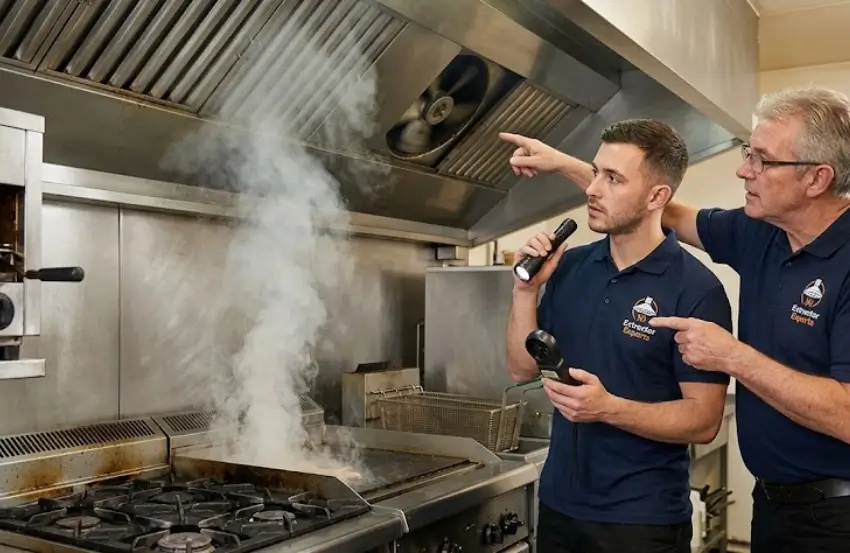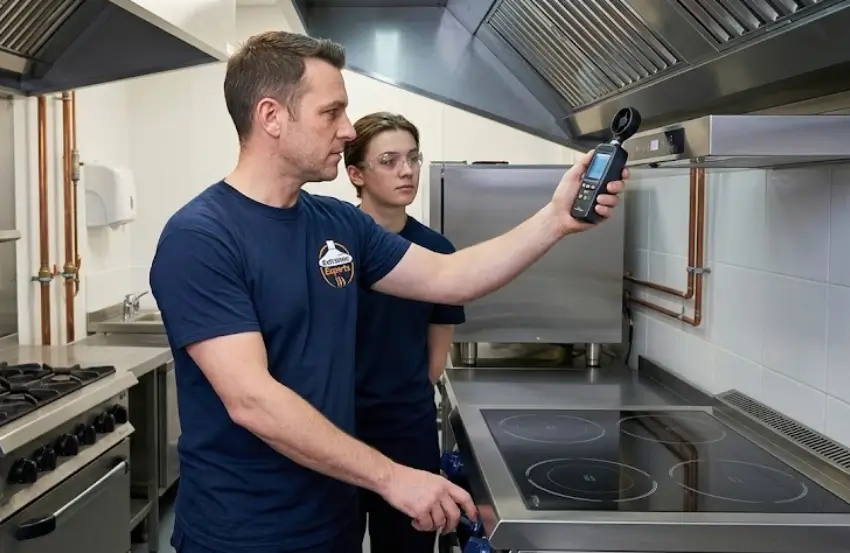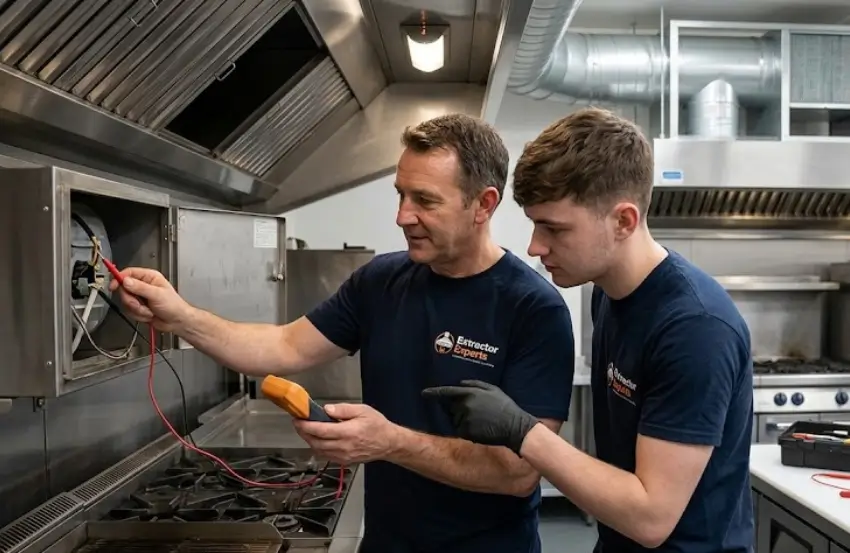
Switching from gas to electric cooking does not automatically mean a commercial kitchen extraction system needs replacing. However, the existing ventilation should be assessed before new equipment is installed. Electric appliances may eliminate combustion products from gas burners, but they can still produce significant heat, steam, smoke, grease aerosols and cooking odours.
The amount of extraction required depends on the cooking process, appliance capacity, canopy arrangement and overall kitchen design. For example, an electric fryer may still generate substantial grease-laden fumes, while an induction hob used for lighter cooking may create different ventilation demands from an open-flame gas range.
Commercial kitchen extraction for electric cooking must therefore be designed around the actual cooking emissions, not simply the energy source. Existing canopies, extractor fans, ductwork and replacement-air arrangements may remain suitable, need adjustments or require replacement.
Extractor Experts Ltd provides commercial kitchen ventilation design, extraction system installation, inspections, repairs and upgrades across London, Greater London and Surrey. A professional ventilation assessment can help establish whether an existing extraction system will remain suitable after a gas-to-electric kitchen conversion.
Do Electric Commercial Kitchens Still Need Extraction?
Yes. Commercial kitchens using electric cooking equipment generally still need suitable ventilation, and many require mechanical extraction.
Removing gas burners changes the combustion-related requirements, but it does not eliminate the airborne contaminants generated by food preparation.
Electric fryers produce grease aerosols and cooking odours. Electric griddles and grills can generate smoke and heat. Combi ovens release moisture and steam, while induction cooking can still produce fumes when food is fried, seared or cooked at high temperatures.
The appropriate extraction arrangement depends on the type and intensity of cooking.
A commercial kitchen using electric appliances exclusively for boiling and reheating may have different requirements from a high-volume restaurant using electric chargrills and deep-fat fryers.
Consequently, changing the fuel source should trigger a review of ventilation performance rather than an assumption that extraction is no longer necessary.
How Does Switching from Gas to Electric Affect Kitchen Ventilation?
The main difference is that electric appliances do not generate combustion products from burning gas at the cooking appliance.
Gas-fired equipment needs adequate combustion air and suitable arrangements for dealing with combustion products.
Electric equipment removes that particular source of combustion emissions, but heat and cooking-generated contaminants remain.
Changes to Combustion Air Requirements
Gas appliances require an appropriate air supply to support combustion.
Where all relevant gas-fired cooking appliances are removed, the ventilation requirements associated specifically with those appliances may change.
However, the kitchen still needs sufficient replacement air for its extraction system.
A kitchen can develop excessive negative pressure even when every cooking appliance is electric.
Any changes to gas-related controls, interlocks or redundant pipework must be assessed by appropriately competent professionals. Gas work must be undertaken by engineers registered and qualified for the relevant commercial gas work.
Changes to Heat Output
Electric cooking equipment can change how heat is delivered to food and the surrounding environment.
Induction appliances, for example, heat suitable cookware directly rather than using an open gas flame.
This can reduce some unwanted heat entering the kitchen, depending on the appliance and cooking operation.
Nevertheless, the cooking process itself still generates heat.
Electric ovens, fryers, grills and other high-output appliances may create substantial heat loads.
Extraction and replacement-air requirements should therefore be calculated from the proposed equipment and cooking activity.
Changes to Cooking Fumes and Grease
Cooking emissions depend heavily on what is being prepared.
Frying, grilling and roasting can generate grease aerosols, smoke and odours regardless of whether the appliance uses gas or electricity.
An electric fryer is not automatically a low-extraction appliance.
Similarly, an induction hob used for high-temperature frying may need effective capture of cooking fumes.
Grease filtration, ductwork cleaning access and appropriate maintenance remain important.
Does Induction Cooking Need Commercial Kitchen Extraction?
Induction cooking can reduce certain sources of unwanted kitchen heat because energy is transferred directly into compatible cookware.
However, induction cooking does not eliminate fumes produced by food.
Boiling, frying, sautéing and searing can still release steam, airborne grease, smoke and odours.
The ventilation requirement depends on the cooking process, equipment capacity and kitchen layout.
Induction Hobs for Light Cooking
An induction hob used mainly for gentle heating, simmering or boiling may produce a different emission profile from a gas range.
Nevertheless, steam and moisture still need to be managed.
The appropriate canopy and airflow arrangement should be assessed for the complete cooking line.
Induction Hobs for High-Temperature Cooking
High-temperature frying and searing can generate significant cooking emissions even without a flame.
A commercial kitchen that replaces gas burners with induction equipment but retains intensive frying operations may still need substantial extraction.
The existing canopy should be checked for adequate capture and containment.
Ventilation Requirements for Mixed Cooking Lines
Many kitchens use induction alongside electric ovens, fryers, grills and other equipment.
In these situations, the ventilation design should consider the combined cooking load.
Assessing individual appliances without considering their combined operation can lead to an unsuitable extraction arrangement.
Which Electric Cooking Appliances May Require Extraction?
Different electric appliances create different ventilation demands.
| Electric appliance | Main ventilation considerations |
|---|---|
| Induction hob | Steam, cooking fumes, grease and heat from the cooking process |
| Electric deep-fat fryer | Grease aerosols, heat, odours and smoke |
| Electric griddle | Heat, grease and cooking fumes |
| Electric grill | Smoke, grease, heat and odours |
| Combi oven | Steam, heat and emissions from cooking |
| Electric convection oven | Heat, moisture and cooking emissions |
| Electric boiling equipment | Steam, moisture and heat |
This table is a general guide rather than a design specification.
The need for a particular canopy or extraction arrangement depends on the equipment, cooking activity, manufacturer requirements and applicable regulations.
Can an Existing Gas Kitchen Extraction System Be Reused?
In some cases, yes.
An existing commercial kitchen extraction system may remain suitable after a gas-to-electric conversion if it can handle the proposed cooking load and meets the relevant installation requirements.
However, the system should not be reused without assessment.
Check the Existing Extraction Canopy
The canopy must provide adequate capture for the new appliance arrangement.
Changing from gas ranges to induction equipment may alter the height, position and configuration of the cooking line.
If appliances are relocated or the cooking surface changes significantly, the existing canopy may no longer cover the required area.
A professional assessment should consider canopy dimensions, overhang, mounting height and the likely cooking plume to determine whether commercial kitchen canopy installation or modification is necessary.
Check the Extractor Fan
The fan must deliver sufficient airflow against the resistance of the connected system.
The original fan may be suitable, but that should be verified.
Changes to the cooking equipment do not automatically justify reducing fan speed.
An airflow assessment can help determine whether adjustments are appropriate.
Check the Extraction Ductwork
Existing ductwork should be reviewed for condition, dimensions, routing and cleaning access.
The system must remain suitable for the type of contaminants being extracted.
A change to electric cooking does not eliminate grease accumulation where grease-producing cooking continues.
Damaged or poorly accessible ductwork may require repairs, modifications or professional commercial kitchen ductwork installation to support the new cooking equipment.
Check Replacement Air
The existing supply-air arrangement may have been designed around the original extraction and combustion-air requirements.
Removing gas appliances may change part of the air-supply calculation, but replacement air is still needed.
The revised arrangement must support extraction without causing excessive draughts or pressure imbalance.
When Does Commercial Kitchen Extraction Need Changing?
An extraction upgrade may be needed when the new equipment changes the ventilation requirements or exposes problems with the existing installation.
1. The Cooking Load Increases
Replacing several gas appliances with a larger electric cooking line can increase the overall cooking capacity.
Higher production volumes may generate more heat, moisture or grease-laden emissions.
The existing extraction system may not be adequate for the new demand.
2. The Kitchen Layout Changes
Moving equipment can affect how cooking fumes rise towards the canopy.
A canopy designed for the original arrangement may not capture emissions effectively after the conversion.
Canopy modifications or replacement may be required.
3. New Equipment Produces Different Emissions
Replacing a gas boiling range with electric frying equipment can substantially change the type of contaminants produced.
The ventilation system should be reviewed for the new cooking process.
4. Existing Airflow Is Inadequate
Smoke escaping the canopy, excessive heat and lingering cooking odours can indicate inadequate capture or extraction.
These problems should be investigated before the new appliances enter full operation.
5. The Existing System Is Damaged or Poorly Maintained
A gas-to-electric conversion provides an opportunity to inspect ageing fans, contaminated ductwork, damaged canopy components and unsuitable access arrangements.
Where significant defects exist, professional commercial kitchen extractor fan repairs or replacement of damaged ventilation components may be needed.
6. Building or Planning Requirements Have Changed
Major kitchen alterations may introduce additional building, fire safety or planning considerations.
For premises in London, external discharge arrangements and potential impacts on neighbouring occupiers can be particularly important.
The relevant requirements should be established for the individual project.
How Is Commercial Kitchen Ventilation for Electric Cooking Designed?
Ventilation design begins with an assessment of the proposed cooking equipment.
The designer reviews appliance types, heat output, cooking intensity, canopy arrangement and kitchen layout.
The extraction airflow is then considered alongside the required fan performance and ductwork resistance.
Replacement air must also be addressed.
The objective is to capture cooking emissions effectively while maintaining suitable working conditions and avoiding unnecessary energy use.
Assessing Cooking Equipment
The first stage is to establish exactly which appliances will be installed.
Equipment schedules, manufacturer information and expected operating patterns can help inform the assessment.
The designer should also consider whether several appliances will operate simultaneously.
Reviewing Canopy Capture
The canopy should be suitable for the size and position of the cooking equipment.
Capture performance depends on the relationship between the canopy, cooking plume and surrounding airflow.
The design should account for nearby doors, supply-air outlets and other potential sources of cross-draughts.
Calculating Airflow and Fan Duty
The required extraction rate should be determined using appropriate design methods.
Fan selection must consider the resistance of the complete system, including ductwork, filters and fittings.
A fan’s maximum advertised airflow is not the same as the airflow it will deliver when connected to an actual installation.
Reviewing Replacement Air
Replacement air is needed to balance the air removed by the extraction system.
Its supply should be arranged to avoid interfering with canopy capture.
The removal of gas combustion-air requirements does not remove the need to assess the overall ventilation balance.
Testing and Commissioning
Following significant modifications, appropriate testing and commissioning can help confirm whether the system performs as intended.
Checks may include airflow measurements, fan operation, control arrangements and observation of canopy capture under representative cooking conditions.
What Happens to Gas Safety Interlocks After Conversion?
Some commercial gas kitchen installations use ventilation interlocks as part of their gas safety arrangements.
When gas appliances are removed, the associated controls may need to be reviewed.
However, it is unsafe to assume that every interlock can simply be disconnected.
The kitchen may retain other gas appliances, or existing controls may also operate ventilation equipment.
A competent assessment should establish which equipment remains and what controls are still required.
Any gas work must be carried out by appropriately qualified Gas Safe registered engineers.
Electrical modifications should be undertaken by competent electrical professionals.
The extraction contractor, kitchen equipment supplier and relevant building professionals may need to coordinate the conversion.
Can Electric Cooking Reduce Commercial Kitchen Ventilation Costs?
Electric cooking can change energy consumption and the heat released into the kitchen.
Induction equipment may offer operational advantages for certain cooking processes.
However, it is not possible to assume that every conversion will reduce extraction energy costs.
The outcome depends on appliance efficiency, cooking demand, extraction airflow, replacement-air heating and cooling, and operating hours.
Reducing extraction airflow without a suitable design assessment can compromise ventilation performance.
Where demand-controlled ventilation is appropriate, controls may be considered as part of a coordinated system design.
Any potential energy savings should be assessed against the requirement to maintain effective extraction during cooking.
What UK Guidance Applies to Electric Commercial Kitchen Extraction?
UK commercial kitchens must provide suitable ventilation for their operations.
The HSE guidance on catering ventilation explains the importance of controlling cooking emissions and providing appropriate replacement air.
The HSE also provides guidance on gas safety in catering environments.
Where gas appliances remain, their combustion-air and safety requirements must continue to be considered.
BESA DW/172 is an important industry reference for commercial kitchen ventilation design and construction.
Grease-producing electric cooking may also require appropriate grease extract ductwork construction and cleaning arrangements.
Fire safety duties, building requirements and planning considerations should be reviewed according to the project.
No single rule establishes that every electric appliance needs the same extraction rate or that switching from gas automatically allows an existing system to be reduced.
A competent, site-specific assessment is the appropriate starting point.
What Should Kitchen Operators Check Before Switching to Electric?
Before ordering replacement appliances, kitchen operators should review the existing extraction system and the proposed cooking operation.
The assessment should identify the current canopy arrangement, extraction fan, ductwork route and replacement-air provision.
It should also establish whether the new equipment changes the cooking load or kitchen layout.
Equipment specifications and proposed installation drawings can help ventilation designers understand the changes.
Operators should allow sufficient time for any necessary ductwork, canopy, fan or electrical modifications.
Ventilation should be assessed before the converted kitchen begins normal service.
This helps avoid discovering performance problems during busy cooking periods.
Commercial Kitchen Extraction for Electric Cooking in London
Restaurants, hotels, cafés, schools and other commercial kitchens across London are increasingly considering electric equipment for new kitchens and refurbishment projects.
Whether the change involves induction hobs, electric ovens, griddles or fryers, the ventilation requirements should reflect the actual cooking process.
Extractor Experts Ltd is based in Staines-upon-Thames, Surrey, and provides commercial kitchen ventilation design, extraction installation, system inspections, repairs and upgrades across London, Greater London and Surrey.
For businesses replacing gas appliances with electric alternatives, an extraction assessment can help identify which existing components remain suitable and which may need modification.
Frequently Asked Questions
1. Do electric commercial kitchens need extraction systems?
Yes, many electric commercial kitchens require mechanical extraction because cooking still generates heat, steam, grease, smoke and odours. The appropriate ventilation arrangement depends on the appliances and cooking processes.
2. Does switching from gas to induction mean I can remove the extractor fan?
Not automatically. Induction removes gas combustion emissions at the appliance, but cooking can still produce fumes and moisture. The extraction system should be assessed before any fan or canopy is removed.
3. Can I keep my existing extraction canopy after switching to electric?
Possibly. The existing canopy may remain suitable if its size, position and performance match the new cooking equipment. Changes to appliance layout or cooking intensity may require modifications.
4. Does an electric fryer need commercial kitchen extraction?
Electric fryers can generate substantial grease aerosols, heat and cooking odours. They commonly require suitable extraction and grease management arrangements. The exact requirements depend on the appliance and installation.
5. Should commercial kitchen ventilation be tested after a gas-to-electric conversion?
Yes, appropriate testing is advisable where the conversion changes the equipment, airflow requirements or ventilation system. Commissioning can help verify extraction performance and identify problems before normal kitchen operation.
Conclusion: Does Switching from Gas to Electric Require Extraction Changes?
Switching from gas to electric cooking changes the source of heat and removes combustion emissions from the appliances being replaced.
However, commercial kitchen extraction remains important because food preparation still generates steam, smoke, grease and odours.
An existing canopy, fan and ductwork system may remain suitable, but this should be confirmed through an appropriate assessment.
The decision should depend on the proposed cooking equipment, kitchen layout, extraction performance and relevant safety requirements.