Commercial kitchen extraction fault finding is the process of identifying why a kitchen ventilation system is not operating correctly. It involves checking the extraction fan, electrical controls, grease filters, ductwork, airflow and replacement-air arrangements to locate the cause of poor performance or complete system failure. A professional engineer usually begins by reviewing the symptoms and operating history. The next stage involves inspecting relevant components, carrying out appropriate electrical and mechanical checks, and measuring ventilation performance where necessary. Once the fault is identified, the engineer can recommend repairs, maintenance or equipment replacement.
Common problems include extractor fans that fail to start, reduced airflow, unusual noises, overheating motors, damaged fan components and restricted ductwork. However, similar symptoms can have different causes, making accurate diagnosis essential. Extractor Experts Ltd provides commercial kitchen extraction troubleshooting, fault finding, repairs and maintenance for restaurants, hotels, takeaways and other commercial catering premises across London, Greater London and Surrey. Understanding how the diagnostic process works helps kitchen operators recognise warning signs, avoid unnecessary equipment replacement and arrange suitable professional assistance before problems become more disruptive.
What Is Commercial Kitchen Extraction Fault Finding?
Commercial kitchen extraction fault finding is a systematic investigation of the components responsible for removing cooking fumes, heat, steam and airborne grease.
A typical commercial extraction system includes a canopy, grease filters, ductwork, extraction fan, electrical controls and discharge arrangement. It also relies on an appropriate supply of replacement air.
These components work together to maintain suitable ventilation conditions during cooking.
When one component fails or performs below its intended capacity, the entire system can be affected.
For example, a kitchen may experience poor smoke capture even though the extraction fan continues running. The underlying problem could be restricted ductwork, incorrect fan speed, insufficient replacement air or a change in cooking equipment.
Effective fault finding identifies the actual cause rather than relying on the most obvious symptom.
The process can involve visual inspection, airflow testing, mechanical assessment and electrical diagnosis by appropriately competent personnel.
What Are the Most Common Commercial Kitchen Extraction Faults?
Commercial kitchen extraction systems can develop electrical, mechanical and airflow-related problems.
Recognising the symptoms helps operators provide useful information when arranging a professional inspection.
1. Commercial Kitchen Extractor Fan Not Working
An extraction fan that fails to start is one of the clearest signs of a system fault.
Possible causes include electrical supply problems, a failed motor, faulty controls, damaged wiring, a defective contactor or a problem with a variable speed drive.
Some systems also use safety interlocks that can prevent fan operation under certain conditions.
An engineer needs to establish whether the problem originates from the electrical supply, control system or fan assembly.
Repeatedly resetting a tripped electrical protection device without identifying the cause can be unsafe.
Electrical testing and repairs should be completed by appropriately qualified personnel.
2. Reduced Extraction Airflow
Reduced airflow can be difficult to identify because the fan may still be operating.
Kitchen staff may notice that smoke, steam or cooking odours are no longer being captured effectively.
Possible causes include dirty grease filters, restricted ductwork, fan deterioration, incorrect fan speed or inadequate replacement air.
An airflow assessment can help determine whether the system is delivering its intended extraction performance.
The investigation should consider the entire ventilation arrangement rather than focusing only on the fan.
3. Unusual Fan Noise
Commercial extraction fans normally produce some operating noise.
However, grinding, rattling, scraping or excessive vibration may indicate a developing mechanical problem.
Worn bearings, damaged impellers, loose fixings or other mechanical defects can contribute to unusual sounds.
The exact cause cannot be confirmed from noise alone.
A professional inspection can determine whether maintenance, component repair or replacement is appropriate.
4. Extractor Fan Overheating
A motor that repeatedly overheats may be experiencing excessive load, inadequate cooling or an electrical fault.
Possible causes include damaged bearings, motor deterioration, control problems or operation outside the equipment’s intended conditions.
Thermal protection may stop the motor temporarily, allowing it to restart after cooling.
Repeated overheating should not be ignored.
Continued operation can worsen equipment damage and increase the risk of an unexpected breakdown.
5. Blocked or Restricted Extraction Ductwork
Commercial kitchen ductwork can accumulate grease and other deposits over time.
Excessive build-up may restrict airflow and affect system performance.
Other restrictions can include damaged duct sections, unsuitable fittings or foreign objects.
The location and extent of the restriction must be established before corrective work is planned.
Cleaning requirements and mechanical repairs should be assessed separately because not every airflow problem can be solved through cleaning.
6. Faulty Extraction Controls
Commercial extraction systems may use switches, controllers, timers, variable speed drives and interlocks.
A control fault can prevent the fan from starting or cause inconsistent operation.
Some faults may appear only under particular operating conditions.
For example, a fan may operate correctly at one speed but develop problems at another.
Professional fault finding should examine the relevant control sequence alongside the fan’s electrical and mechanical condition.
What Are the Warning Signs of Commercial Kitchen Ventilation Problems?
Extraction faults often produce warning signs before complete system failure.
These signs may become more noticeable during busy cooking periods when the kitchen generates greater quantities of heat, steam and airborne contaminants.
Smoke Escaping from the Canopy
A commercial kitchen canopy should capture cooking emissions effectively under its intended operating conditions.
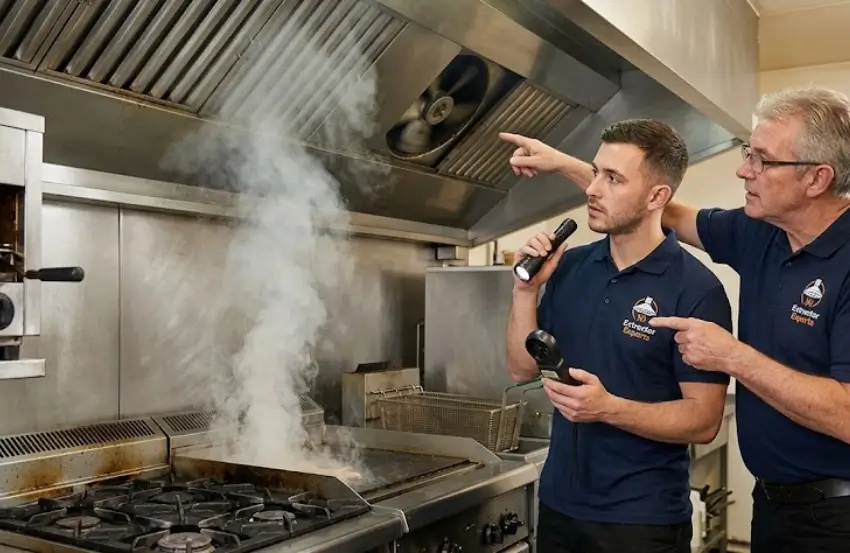
When smoke escapes from the front or sides, the extraction system may not be performing as required.
Possible explanations include inadequate airflow, incorrect canopy positioning, disturbed air movement or changes to the cooking equipment.
An engineer should assess both extraction performance and canopy capture.
Excessive Heat in the Kitchen
Commercial kitchens naturally generate heat.
However, an unusual increase in temperature may indicate that the ventilation system is not removing heat as intended.
Reduced extraction, poor replacement-air distribution or additional cooking loads can contribute to uncomfortable conditions.
Temperature alone is not a reliable measure of extraction performance, so further assessment may be required.
Strong or Unusual Cooking Odours
Persistent cooking odours may indicate that contaminated air is not being captured or discharged effectively.
The problem could involve airflow, canopy performance, ductwork or the building’s pressure relationships.
An investigation should establish whether the system is extracting effectively before recommending modifications.
Fan Stops Unexpectedly
A fan that stops during operation may have an electrical, mechanical or control-related fault.
Repeated interruptions can affect kitchen operations and may require urgent professional attention.
The system should not be repeatedly restarted without understanding why it stopped.
Increased Vibration
New or excessive vibration can indicate a mechanical defect.
The cause might involve the fan assembly, mounting arrangements or connected components.
Prompt investigation can help prevent further damage.
How Does Professional Commercial Kitchen Extraction Fault Finding Work?
Professional diagnosis follows a structured process to identify faults efficiently and safely.
The exact sequence depends on the installation, reported symptoms and available technical information.
Step 1: Review the Reported Problem
The engineer begins by establishing what has changed.
Useful information includes when the problem started, whether the fan operates at all, whether the fault is intermittent and whether any recent maintenance or equipment changes have occurred.
The engineer may also review previous inspection reports, commissioning information and maintenance records.
These details can help narrow down the possible causes.
For example, a fault appearing immediately after fan replacement may require a different investigation from a gradual reduction in extraction performance.
Step 2: Assess Immediate Safety Risks
Before testing equipment, the engineer considers whether the reported fault creates an immediate safety concern.
The assessment may involve electrical hazards, moving machinery, access arrangements and the presence of combustion appliances.
A failed or ineffective extraction system may also affect the safe operation of cooking equipment.
Where safe ventilation cannot be maintained, affected cooking operations may need to stop until the problem has been assessed and suitable conditions restored.
The Health and Safety Executive provides guidance on ventilation in catering establishments, including the importance of adequate extraction and replacement air.
Step 3: Inspect the Extraction Canopy and Filters
The canopy is a useful starting point when the reported problem involves poor capture of smoke or steam.
The inspection may consider grease filter condition, canopy positioning, visible damage and signs of escaping cooking emissions.
Dirty or incorrectly fitted filters can affect system performance.
However, removing filters or changing their arrangement without proper assessment is not an appropriate solution.
The canopy and filters should be maintained according to the system’s design and relevant cleaning requirements.
Step 4: Inspect the Extraction Fan
The engineer examines the fan assembly for signs of mechanical damage or deterioration.
Depending on access and equipment type, the assessment may consider bearings, impellers, mountings and other relevant components.
Unusual noise, excessive vibration and evidence of overheating can provide diagnostic clues.
Any inspection involving moving parts requires appropriate isolation and safe working procedures.
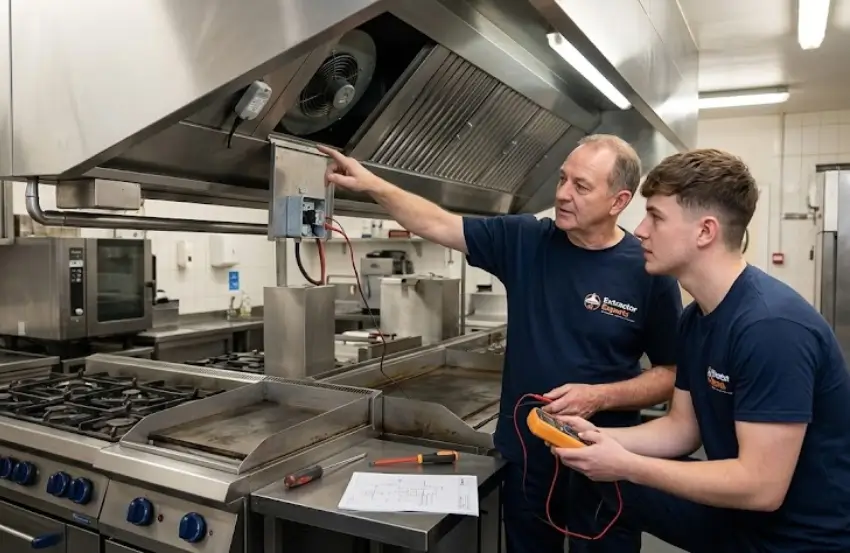
Step 5: Test Electrical Components and Controls
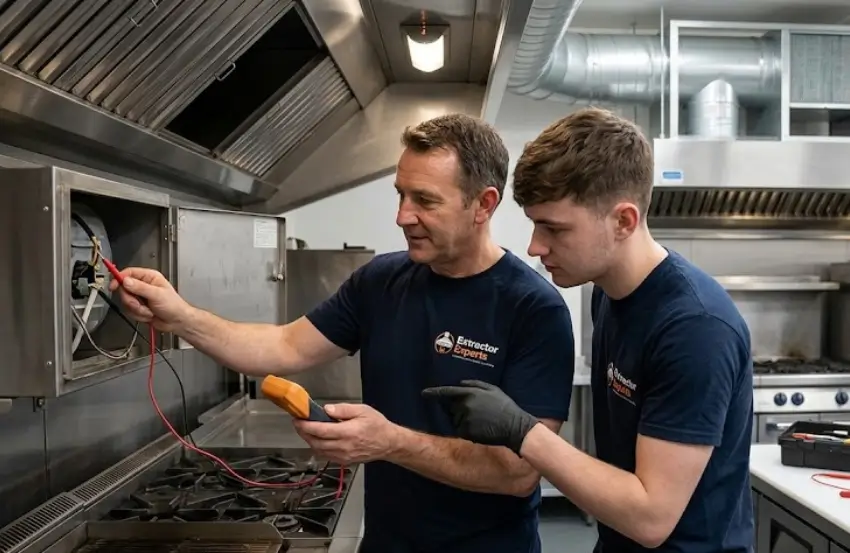
Electrical testing can help identify why a fan fails to start, stops unexpectedly or operates inconsistently.
The investigation may involve the electrical supply, motor, protective devices and relevant controls.
Testing should be completed by appropriately competent personnel using suitable procedures and equipment.
A failed motor is not the only possible cause of a non-operational fan.
Identifying the actual electrical or control fault can prevent unnecessary replacement of otherwise serviceable equipment.
Step 6: Check Ductwork and Airflow Restrictions
Where airflow is inadequate, the engineer may inspect accessible ductwork and relevant system components.
Possible problems include grease accumulation, damaged sections, obstructions and excessive resistance.
The inspection may identify a need for specialist cleaning, repair or further investigation.
A visual inspection alone may not establish the full extent of concealed ductwork problems.
Additional access or testing may be required.
Step 7: Measure Extraction Performance
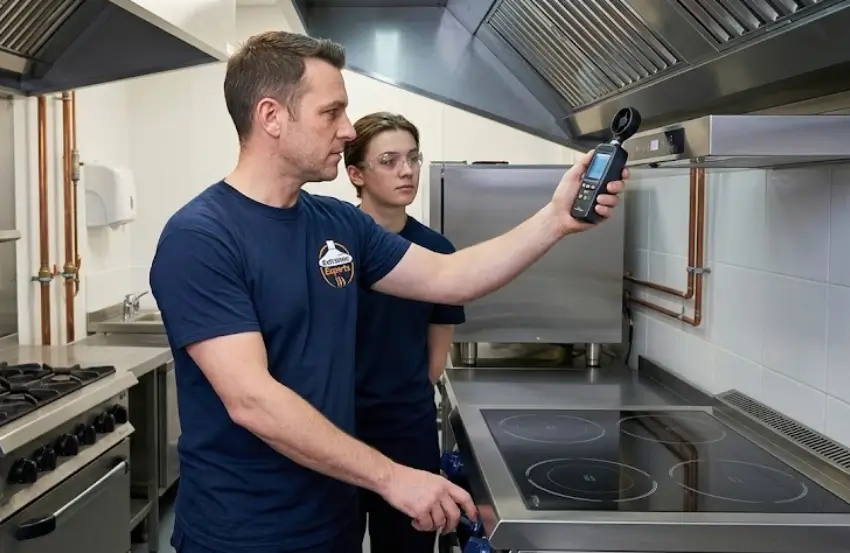
Airflow measurement helps establish whether the system is delivering its intended performance.
The engineer may use appropriate instruments to measure airflow, air velocity or pressure differences.
Results should be interpreted using the system design and available commissioning information.
A fan that runs does not necessarily deliver sufficient extraction.
Likewise, poor canopy capture does not always mean the fan motor is defective.
Measured evidence helps distinguish between these situations.
Step 8: Check Replacement Air and System Balance
Extraction systems require suitable replacement air.
Insufficient make-up air can contribute to poor performance and excessive negative pressure.
An engineer may assess supply-air equipment, intake restrictions and the relationship between extraction and replacement airflow.
This is particularly important when a kitchen has undergone refurbishment or a change in cooking equipment.
A fault-finding assessment should consider whether the system is still suitable for its current operating requirements.
Step 9: Identify the Fault and Recommend Corrective Work
Once the investigation is complete, the engineer can explain the findings.
The recommendation may involve repairing a control component, replacing a damaged fan part, cleaning restricted ductwork, restoring supply airflow or upgrading unsuitable equipment.
Where the problem relates to the original system design, a broader ventilation review may be appropriate.
The goal is to address the cause rather than temporarily hide the symptoms.
Step 10: Verify Performance After Repairs
Fault finding should not end when a component has been repaired or replaced.
The system should be checked to confirm that the reported problem has been resolved.
Verification may involve operational testing, airflow measurements and checking relevant controls.
Where significant modifications have been made, commissioning or rebalancing may be necessary.
Recording the findings provides useful information for future maintenance.
Commercial Kitchen Extraction Faults and Possible Solutions
| Fault or Symptom | Possible Cause | Professional Action |
|---|---|---|
| Extractor fan will not start | Electrical supply, motor or control fault | Electrical and control diagnosis |
| Weak extraction | Restricted airflow or incorrect fan performance | Airflow testing and system inspection |
| Grinding noise | Bearings or mechanical damage | Fan inspection and repair assessment |
| Excessive vibration | Impeller or mounting problem | Mechanical inspection |
| Fan stops repeatedly | Motor protection or control issue | Electrical and mechanical testing |
| Smoke escaping canopy | Poor capture or insufficient extraction | Canopy and airflow assessment |
| Strong draughts | Air pressure imbalance | Extract and supply-air evaluation |
| Recurring grease accumulation | Cleaning or system performance issue | Inspection and maintenance review |
These are possible explanations, not confirmed diagnoses. Similar symptoms can arise from several different faults.
Can Commercial Kitchen Extraction Faults Be Repaired?
Many commercial kitchen extraction faults can be repaired, depending on the equipment condition and the cause of failure.
Examples may include faulty control components, damaged fan parts, defective bearings and certain electrical problems.
However, repair is not always the most suitable option.
A severely deteriorated motor, extensively damaged fan assembly or equipment that no longer meets the kitchen’s operational requirements may justify replacement.
The decision should consider equipment condition, repair feasibility, spare-part availability and the performance required.
A professional diagnosis helps determine whether the problem can be resolved through a targeted repair.
Replacing an extractor fan without investigating ductwork restrictions or replacement-air problems may leave the original performance issue unresolved.
When Is Extractor Fan Replacement Better Than Repair?
Replacement may be appropriate when the existing fan has sustained major damage, suitable replacement parts are unavailable or repeated repairs are no longer practical.
It may also be necessary when changes to the kitchen have increased the required extraction capacity.
However, a replacement fan should be selected using the system’s airflow and pressure requirements.
Installing a larger or more powerful fan without reviewing the wider ventilation arrangement can create additional problems.
Fan replacement should therefore consider ductwork resistance, controls, replacement air and canopy performance.
Where equipment specifications have changed, the system may require recommissioning.
Can Blocked Ductwork Cause Extraction System Failure?
Restricted ductwork can significantly affect commercial kitchen extraction performance.
As resistance increases, the airflow delivered by the fan may change according to its operating characteristics.
Grease deposits, damaged ductwork and other obstructions can contribute to the problem.
However, ductwork restrictions do not necessarily cause the fan motor to stop.
The effects depend on the fan, system design and nature of the restriction.
A professional assessment can establish whether ductwork cleaning, repairs or other corrective work is needed.
Grease extract systems also require appropriate cleaning and maintenance to control fire risks associated with accumulated deposits.
Industry guidance such as BESA TR19 Grease can inform cleaning and inspection practices, while the exact requirements should be considered alongside applicable legal duties and the installation’s risk assessment.
How Does Negative Pressure Affect Extraction Fault Diagnosis?
Negative pressure can complicate commercial kitchen extraction troubleshooting because it may produce symptoms similar to mechanical fan problems.
A kitchen may have a working extraction fan but insufficient replacement air.
This can create strong draughts, unusual door behaviour and unstable airflow conditions.
Poorly positioned supply-air outlets can also disturb the capture of cooking fumes.
An engineer should therefore avoid assuming that weak extraction always means the fan needs replacement.
The assessment should consider extract airflow, supply airflow and the building’s pressure relationships.
Correcting the air balance may improve performance without replacing the extraction fan.
Why Is Commercial Kitchen Extraction Fault Finding Important for Safety?
Commercial kitchen ventilation helps remove heat, steam, airborne grease and other cooking contaminants.
Poor extraction can affect working conditions and the control of cooking emissions.
Where gas-fired appliances are installed, ventilation problems may also affect combustion safety.
The Health and Safety Executive highlights the need for suitable ventilation and adequate replacement air in catering establishments.
Potential combustion or flue-related problems require assessment by appropriately qualified professionals.
Gas appliance work must be carried out by engineers registered and competent for the relevant category of commercial gas equipment.
Electrical faults, moving machinery and contaminated ductwork can create additional hazards during maintenance.
For these reasons, technical fault finding should not be treated as a do-it-yourself repair task.
Kitchen staff can report symptoms and check accessible operating indicators, but they should not open electrical panels, bypass interlocks or dismantle fan equipment.
How Can Planned Maintenance Prevent Extraction Faults?
Planned maintenance helps identify deterioration before it causes an unexpected breakdown.
Commercial kitchen extraction systems operate in demanding environments where heat, grease and extended operating hours can affect equipment condition.
Maintenance activities may include checking fan operation, inspecting accessible components, reviewing controls and assessing ventilation performance.
Grease filters and ductwork also need appropriate inspection and cleaning arrangements.
The maintenance schedule should reflect the equipment, cooking activity, operating hours and relevant risk assessment.
A system used intensively throughout the day may require different attention from one operating for shorter periods.
Keeping maintenance records can help identify recurring faults and changes in performance.
These records also provide useful information when an engineer investigates a new problem.
What Should Kitchen Managers Do When an Extraction Fault Occurs?
The first priority is to consider whether the kitchen can continue operating safely.
A complete extraction failure, suspected electrical fault or possible combustion safety issue should be treated seriously.
Affected cooking operations may need to stop until competent personnel have assessed the situation.
Kitchen managers should record the symptoms, including unusual sounds, visible smoke escape, control-panel indications and the time the fault occurred.
Details about recent repairs, cleaning or equipment changes can also help the investigation.
Do not bypass safety interlocks, repeatedly reset protective devices or attempt electrical repairs.
Avoid running equipment that shows signs of serious mechanical damage.
A professional fault-finding visit can establish the cause and recommend the appropriate corrective work.
Commercial Kitchen Extraction Fault Finding in London and Surrey
Restaurants, cafés, takeaways, hotels and other commercial catering businesses depend on reliable extraction systems. Unexpected ventilation problems can disrupt cooking operations and affect staff working conditions. Commercial kitchens in London and Surrey may also have challenging ventilation arrangements because of restricted plant space, existing ductwork and changes to building layouts. These conditions can make accurate fault diagnosis especially important.
Extractor Experts Ltd is based in Staines-upon-Thames, Surrey, and provides commercial kitchen extraction fault finding, fan repairs, maintenance and ventilation services across London, Greater London and Surrey. The appropriate service depends on the reported problem and the condition of the existing installation. ProfessioHsnal assessment can help determine whether the system requires targeted repairs, maintenance or a wider ventilation upgrade.
Frequently Asked Questions
1. How do engineers diagnose commercial kitchen extraction faults?
Engineers review the reported symptoms, inspect relevant equipment and carry out appropriate electrical, mechanical and airflow checks. They then identify the likely cause and recommend corrective work. Testing after repairs helps verify whether the problem has been resolved.
2. Why is my commercial kitchen extractor fan not working?
Possible causes include electrical supply faults, damaged motors, defective controls, failed protective components or mechanical problems. A professional diagnosis is needed because several faults can produce the same symptom.
3. Can a commercial extraction fan run but provide poor airflow?
Yes. A fan may operate while airflow remains inadequate because of restricted ductwork, incorrect speed, mechanical deterioration or insufficient replacement air. Measuring system performance helps identify the cause.
4. How often should commercial kitchen extraction systems be inspected?
Inspection and maintenance frequency should reflect equipment condition, cooking intensity, operating hours and the installation’s risk assessment. Manufacturers’ instructions and relevant industry guidance should also be considered. There is no single interval suitable for every component or kitchen.
5. Should I repair or replace a faulty commercial kitchen extraction fan?
The decision depends on the fault, equipment condition, availability of replacement parts and required performance. Repair may be suitable for isolated defects, while significant damage or unsuitable equipment may justify replacement. Professional fault finding should come first.
Conclusion: Identify Extraction Faults Before They Become Bigger Problems
Commercial kitchen extraction fault finding helps identify the underlying causes of poor ventilation, fan failure and inconsistent system performance. Problems can originate from electrical controls, motors, fan components, ductwork restrictions or inadequate replacement air.
Because different faults can produce similar symptoms, replacing equipment without proper diagnosis may not resolve the problem. A structured inspection, supported by appropriate testing and performance verification, provides a more reliable basis for repairs and maintenance.