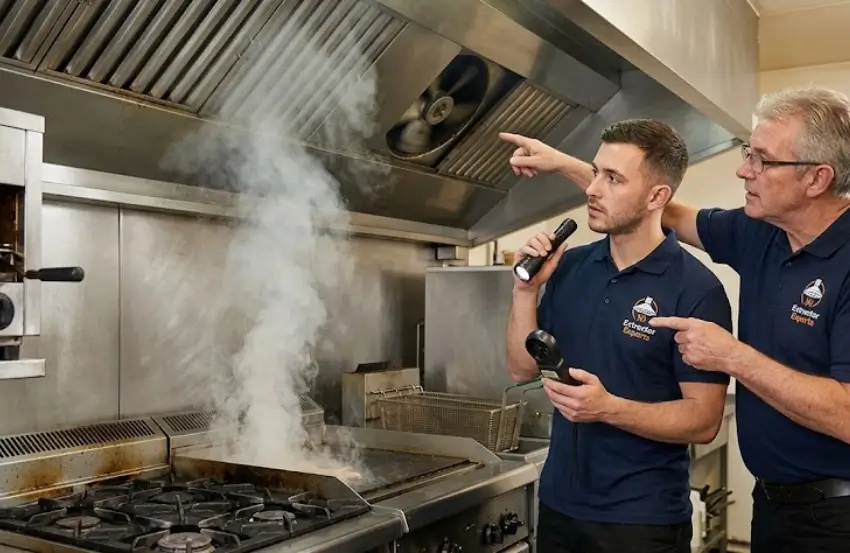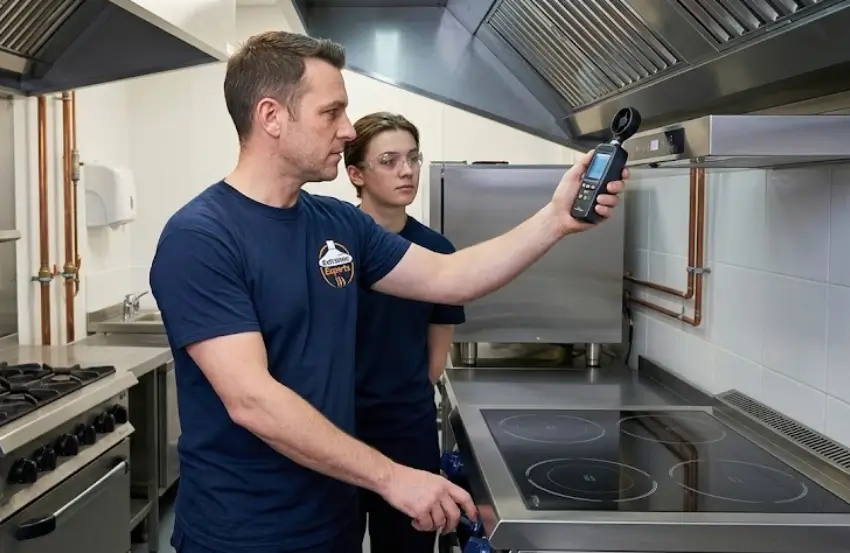
Choosing between commercial extraction fan repair or replacement depends on the fan’s condition, the cause of the fault, repair costs, replacement-part availability and the ventilation requirements of the kitchen. Minor mechanical or electrical faults may be repairable, while severe damage, repeated breakdowns or an unsuitable fan may make replacement the more practical long-term option.
For restaurants, hotels, cafés, takeaways and other commercial kitchens, a reliable extraction fan is essential. It helps remove heat, cooking fumes, grease-laden air and odours through the kitchen ventilation system. When the fan stops working properly, kitchen temperatures can rise, cooking fumes may escape the canopy and daily operations can be disrupted.
However, a noisy or underperforming extraction fan does not automatically need replacing. Problems involving worn belts, damaged bearings, electrical controls or restricted airflow may be resolved through professional repairs.
Extractor Experts Ltd provides commercial kitchen extractor fan repair, fault finding, replacement and ventilation maintenance services across London, Greater London and Surrey. Understanding the warning signs, repair options and replacement considerations can help commercial kitchen operators make informed decisions without paying for unnecessary equipment.
What Are the Signs That a Commercial Extraction Fan Needs Attention?
Commercial kitchen extraction fans operate in demanding environments. Long operating hours, airborne grease, heat and continuous mechanical movement can gradually affect performance. Recognising the early signs of trouble can help prevent unexpected breakdowns.
Unusual Noise During Operation
A commercial extractor fan should operate within its expected noise range. Grinding, rattling, squealing or knocking sounds may indicate developing mechanical problems.
Possible causes include worn bearings, loose components, damaged impellers or deteriorating drive belts.
Some faults may be resolved by replacing individual components. Others require a more detailed inspection to establish whether the fan assembly remains suitable for continued use.
Reduced Kitchen Extraction Performance
Poor extraction is another common warning sign.
Cooking fumes may escape from the canopy, heat can build up around cooking equipment, or staff may notice that the ventilation system no longer performs as effectively as before.
Although a failing fan can cause these symptoms, reduced airflow may also result from dirty filters, grease-restricted ductwork, unsuitable replacement-air arrangements or control faults.
A professional assessment should identify the actual cause before any replacement decision is made.
Excessive Fan Vibration
Unusual vibration can indicate imbalance, loose mounting arrangements, worn bearings or damage to rotating components.
Continued operation may increase mechanical wear and potentially affect connected ductwork or support structures.
The cause should be investigated promptly, particularly where vibration has recently increased.
Repeated Electrical Trips
An extraction fan that repeatedly trips a protective device or fails to start may have an electrical or mechanical problem.
Potential causes include motor faults, damaged wiring, faulty controls, overloaded components or mechanical resistance.
Repeatedly resetting a tripped system without identifying the cause is not an appropriate solution.
A competent professional should inspect the installation and establish whether the fault can be safely repaired.
Frequent Breakdowns
Repeated failures can indicate that a fan is approaching the end of its economical service life.
However, recurring faults may also result from an underlying system problem that has never been corrected.
For example, a fan operating outside its intended duty may continue to experience difficulties even after individual components are replaced.
Understanding the underlying cause is essential before deciding whether a replacement is justified.
When Is Commercial Extractor Fan Repair the Better Option?
Commercial extractor fan repair is often appropriate when the fault is isolated, replacement components are available and the remaining equipment is in satisfactory condition.
The aim is to restore reliable operation without replacing components unnecessarily.
Repairing Worn Fan Bearings
Bearings support the rotating shaft and help the fan operate smoothly.
Over time, bearing wear may cause noise, vibration or increased mechanical resistance.
Where the fan’s construction permits bearing replacement and the remaining components are serviceable, repairing the assembly may be practical.
The technician should also check for associated damage and investigate why the bearings failed.
Replacing Damaged Drive Belts
Some commercial extraction fans use belt-driven systems. Belts can wear, stretch or deteriorate through normal operation. This may affect fan speed and extraction performance. Replacing worn belts and checking pulley condition, alignment and tension can restore performance where no wider mechanical fault exists. Not all commercial fans use belts, so the correct repair depends on the installed equipment.
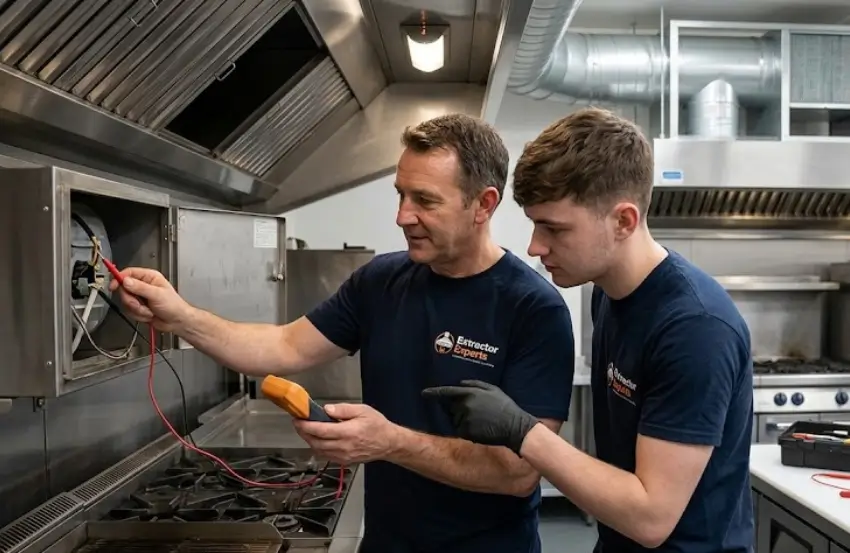
Fixing Electrical Controls
A fan may stop operating because of a faulty control component rather than a failed motor.
Potential issues include contactors, control panels, switches, protective devices and associated wiring.
Professional fault finding can identify whether a specific component needs attention.
Electrical repairs must be undertaken by appropriately competent personnel, with the equipment safely isolated and tested.
Addressing Impeller Problems
The impeller is responsible for moving air through the extraction system.
Grease contamination, imbalance or physical damage can affect its performance.
Depending on its condition, the solution may involve professional cleaning, balancing, repair or component replacement.
Severely damaged impellers may make a complete fan replacement more appropriate.
Repairing a Fan With an Otherwise Sound System
Repair is particularly attractive when the fan is correctly sized, the ductwork is suitable and the system previously delivered adequate extraction.
In these circumstances, replacing a defective component may restore performance without changing the complete ventilation arrangement.
The decision should still account for repair costs, equipment condition and the likelihood of further failures.
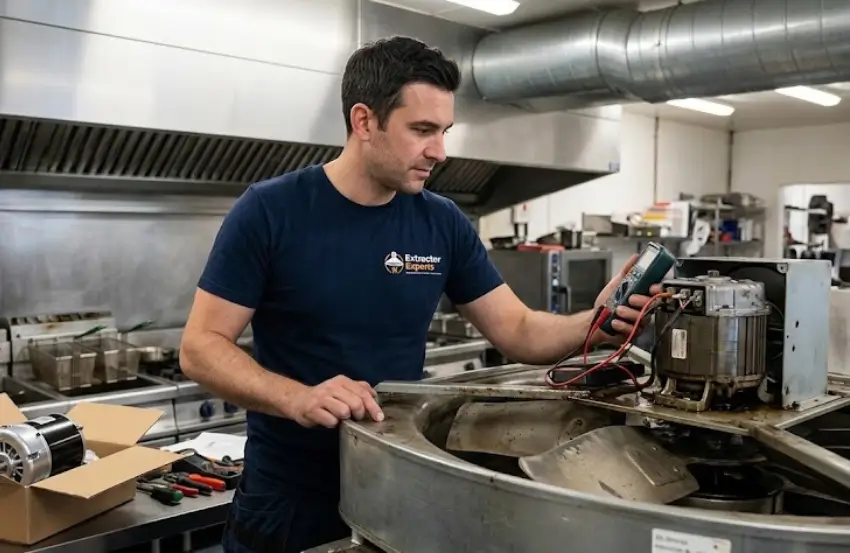
When Should a Commercial Extraction Fan Be Replaced?
Commercial extractor fan replacement becomes more appropriate when repairs are no longer reliable, economical or technically suitable.
Replacement should address the underlying problem rather than simply exchange one fan for another.
The Fan Has Extensive Mechanical Damage
Major damage to the casing, shaft, impeller or other essential components may make repairs impractical.
Where structural or mechanical integrity is compromised, replacement may provide a safer and more dependable solution.
The decision depends on the damage, available parts and the manufacturer’s recommendations.
Replacement Parts Are No Longer Available
Older commercial extraction fans can become difficult to maintain when essential components are discontinued.
Even a relatively minor fault may become expensive or impractical when suitable parts cannot be obtained.
In these circumstances, replacing the equipment may reduce the risk of prolonged future downtime.
The Fan Breaks Down Repeatedly
Frequent repair visits can create ongoing expenses and disruption.
A fan that repeatedly develops faults may no longer offer dependable service, particularly in a busy commercial kitchen.
Before replacing it, the technician should establish whether the repeated failures are caused by the fan itself or by wider system conditions.
The Fan Cannot Meet Current Airflow Requirements
Commercial kitchens sometimes change their cooking equipment, operating hours or production capacity.
A fan originally selected for a lighter cooking operation may no longer provide sufficient extraction.
Replacing the fan may be appropriate where a proper ventilation assessment shows that the existing equipment cannot meet the required duty.
However, fan selection must also consider ductwork resistance, canopy capture, noise and replacement air.
Installing a more powerful fan without reviewing the complete system can introduce new problems.
The Existing Fan Is Unsuitable for the Application
A replacement may be necessary when the installed equipment is not appropriate for the kitchen’s operating conditions.
Factors can include temperature exposure, grease contamination, installation arrangement, required pressure and maintenance accessibility.
A suitable replacement should be selected for the actual system duty and operating environment.
Commercial Extraction Fan Repair vs Replacement: What Are the Differences?
| Factor | Repair | Replacement |
|---|---|---|
| Initial cost | Often lower for isolated faults | Usually higher initial expenditure |
| Best suited for | Serviceable fans with specific faults | Severely damaged, unsuitable or unreliable fans |
| Equipment lifespan | Extends use of existing equipment | Provides a new fan with a new service life |
| Downtime | May be shorter when parts are available | Depends on procurement and installation requirements |
| Airflow improvement | Restores original performance where the fault is corrected | Can address inadequate fan duty when correctly designed |
| Long-term value | Strong when the remaining equipment is sound | Strong when repeated repairs are uneconomical |
| Maintenance | Existing components still require attention | New equipment also requires planned maintenance |
The lowest initial cost is not always the most economical decision.
A relatively inexpensive repair can offer good value when the fan is otherwise reliable. Conversely, repeatedly repairing a deteriorating unit may become more expensive than replacing it.
The appropriate choice depends on the equipment and the actual cause of failure.
How Much Does Commercial Extractor Fan Repair or Replacement Cost?
Commercial extraction fan repair and replacement costs vary considerably.
There is no reliable universal price because commercial kitchens use different fan types, capacities, controls and installation arrangements.
Factors Affecting Repair Costs
Repair costs depend on the fault, labour requirements, replacement components and equipment accessibility.
Replacing a straightforward control component may involve less work than dismantling a large fan assembly to investigate motor or shaft damage.
Roof-mounted fans, difficult access and specialist lifting requirements can also influence the work involved.
Factors Affecting Replacement Costs
Replacement costs depend on the required fan specification, airflow duty, installation location and compatibility with existing ductwork and controls.
Additional work may be necessary where the original mounting arrangement is unsuitable or the ventilation requirements have changed.
Electrical connections, commissioning and airflow verification should also be considered.
Should You Compare Repair Costs With Replacement Costs?
Yes. A useful comparison considers the full expected cost rather than the immediate quotation alone.
This includes the proposed repair, likelihood of additional failures, anticipated downtime, replacement equipment costs and any necessary system modifications.
A professional assessment can help determine whether the existing fan has sufficient remaining service life to justify repair.
How Does a Professional Commercial Kitchen Extractor Fan Assessment Work?
An effective repair-versus-replacement decision starts with fault finding.
Replacing equipment without identifying the problem can waste money and leave the original issue unresolved.
Step 1: Review the Reported Symptoms
The technician first establishes what has changed.
The kitchen operator may report unusual noise, insufficient extraction, repeated trips or complete fan failure.
Information about recent maintenance, previous repairs and changes to cooking equipment can help identify possible causes.
Step 2: Inspect the Fan and Associated Components
A professional inspection may include the motor, bearings, belts, impeller, mountings, controls and electrical connections.
The exact inspection depends on the fan design and reported fault.
Electrical and mechanical safety procedures must be followed throughout.
Step 3: Assess the Wider Extraction System
A fan does not operate independently of the kitchen ventilation system.
Ductwork restrictions, filter contamination, canopy design and replacement-air arrangements can affect performance.
The assessment should therefore consider whether the apparent fan problem is actually caused by another component.
Step 4: Evaluate Repair Feasibility
Once the cause is established, the technician can consider whether repair is practical.
Relevant factors include parts availability, component condition, repair complexity and the fan’s remaining useful life.
Where a repair is technically feasible, the expected reliability of the repaired equipment should also be considered.
Step 5: Recommend Repair or Replacement
The final recommendation should explain the fault, available options and any limitations.
Where replacement is required, the proposed fan should be suitable for the kitchen’s airflow and operating requirements.
The system should be checked following the work to establish whether the intended performance has been restored.
Why Is Correct Fan Sizing Important When Replacing an Extractor Fan?
Commercial extractor fan replacement is not simply a matter of matching the physical dimensions of the old unit.
The fan must deliver the required airflow against the resistance created by the ductwork, filters, canopy and other system components.
A fan that is too small may fail to capture and remove cooking contaminants effectively.
An incorrectly selected larger fan can also create problems, including excessive noise, increased energy consumption or unwanted negative pressure.
The correct selection depends on the complete ventilation design.
For restaurants and commercial kitchens in London, additional factors such as nearby residential properties and planning conditions may also affect fan selection.
Where appropriate, acoustic performance and discharge arrangements should be reviewed alongside airflow requirements.
Can a Faulty Commercial Extraction Fan Affect Kitchen Safety?
Yes. An underperforming extraction fan can reduce the effectiveness of the kitchen’s ventilation system.
Commercial cooking produces heat, moisture, airborne grease and fumes that need to be controlled.
Poor extraction can allow contaminants to accumulate within the working environment.
Where gas-fired equipment is installed, inadequate ventilation can create additional concerns because safe combustion and removal of combustion products depend on suitable ventilation conditions.
The Health and Safety Executive provides guidance on ventilation in catering establishments, including the importance of effective extraction and adequate replacement air.
A failed or seriously underperforming extraction system should be assessed before affected cooking operations continue. Where safe ventilation cannot be maintained, the relevant equipment or operation should not be used until the problem is resolved.
How Can Planned Maintenance Reduce Fan Repairs?
Regular maintenance helps identify developing problems before they cause unexpected failures. A commercial kitchen extraction system operates under conditions that can gradually affect mechanical components and airflow performance. Planned inspections provide an opportunity to identify wear, contamination and operating changes.
Monitor Bearings and Drive Components
Bearings, belts and other moving components can deteriorate over time. Inspection helps identify abnormal wear, noise or vibration before a major failure develops.
Keep Filters and Ductwork Maintained
Grease contamination can restrict airflow and increase the burden on the extraction system. Cleaning requirements depend on cooking activity, system design and contamination levels. Filter maintenance and professional ductwork cleaning should form part of an appropriate kitchen extraction maintenance programme.
Check Fan Performance
Changes in airflow, vibration or operating noise can indicate developing problems. Comparing performance with the system’s design requirements can help determine whether maintenance or further investigation is necessary.
Maintain Accurate Service Records
Maintenance records help establish the history of the equipment. They can reveal recurring faults, previous component replacements and changes in performance. This information becomes particularly useful when deciding whether another repair is worthwhile.
Why Is Professional Extraction Fan Repair Important for London Businesses?
Commercial kitchens across London operate in a wide range of building types. Restaurants, hotels, takeaways, schools and catering facilities may have very different extraction arrangements. Some systems use accessible inline fans, while others rely on roof-mounted equipment or fans positioned within plant areas. A professional assessment considers these differences rather than applying the same repair approach to every installation.
Commercial extraction fan repairs may involve electrical systems, moving mechanical components and equipment installed at height. These activities require appropriate technical competence, safe isolation procedures and suitable access arrangements. Extractor Experts provides commercial kitchen extraction fault finding, fan repairs, replacement and planned maintenance services for businesses across London, Greater London and Surrey.
Frequently Asked Questions
1. Is it better to repair or replace a commercial extractor fan?
Repair is generally preferable when the fault is isolated and the fan remains in good condition. Replacement may be more appropriate when damage is extensive, parts are unavailable, breakdowns are frequent or the fan no longer meets the kitchen’s requirements.
2. Can a commercial kitchen extractor fan motor be repaired?
Some motor-related faults can be repaired, depending on the motor design, condition and parts availability. A professional inspection is needed to determine whether motor repair, motor replacement or complete fan replacement is the most practical option.
3. Why is my commercial extraction fan making a loud noise?
Possible causes include worn bearings, damaged impellers, loose components, belt problems or excessive vibration. The fan should be professionally inspected to identify the cause before further damage develops.
4. How long does a commercial kitchen extraction fan last?
There is no fixed lifespan for every commercial extraction fan. Service life depends on equipment quality, operating hours, maintenance, environmental conditions and mechanical loading. Regular inspections help assess the remaining condition of the equipment.
5. Can Extractor Experts repair or replace commercial extraction fans in London?
Yes. Extractor Experts provides commercial extraction fan fault finding, repairs, replacement and ventilation maintenance services for commercial kitchens in London, Greater London and Surrey. A professional assessment can help identify the appropriate solution.
Conclusion: Should You Repair or Replace Your Commercial Extraction Fan?
The decision between commercial extraction fan repair or replacement should be based on the equipment’s actual condition rather than its age alone. Minor mechanical faults, control problems and replaceable components may make repair the sensible choice. Extensive damage, repeated breakdowns, unavailable parts or inadequate airflow capacity may justify replacement.
Most importantly, the underlying fault should be identified before work begins. A problem caused by blocked ductwork, unsuitable airflow or another ventilation component will not necessarily disappear when the fan is replaced. Extractor Experts Ltd provides commercial kitchen extractor fan repair, replacement, fault finding and planned maintenance services across London, Greater London and Surrey.