Commercial kitchen negative pressure occurs when a kitchen’s extraction system removes more air than the available replacement air can adequately replenish. This creates a pressure difference between the kitchen and surrounding spaces. While a controlled level of negative pressure can help contain cooking odours, excessive negative pressure may cause uncomfortable draughts, difficult-to-open doors, poor ventilation performance and potentially dangerous conditions around combustion appliances.
The most common causes include insufficient make-up air, incorrectly balanced extraction and supply fans, blocked air inlets, poorly designed ventilation systems and changes to cooking equipment without corresponding airflow adjustments. Fixing the problem requires more than simply reducing extractor fan speed or opening a window. A professional assessment should establish how much air is being extracted, how replacement air enters the kitchen and whether the ventilation system maintains safe conditions during cooking.
Extractor Experts Ltd provides commercial kitchen ventilation design, extraction system installation, fault finding and maintenance services across London, Greater London and Surrey. Understanding the causes, warning signs and appropriate corrective measures can help commercial kitchen operators maintain safer, more comfortable and more reliable working environments.
What Is Negative Pressure in a Commercial Kitchen?
Negative air pressure means the air pressure inside the kitchen is lower than the pressure in an adjacent area or outside the building. Commercial extraction fans create this condition by removing air through kitchen canopies and ductwork. When air leaves the building, replacement air must enter through a suitable route. Without sufficient replacement air, the extraction system can create an excessive pressure difference. For example, a commercial kitchen extraction system might remove several thousand cubic metres of air per hour. The exact volume depends on the cooking equipment, canopy design and ventilation requirements.
When the replacement-air arrangement cannot support the required extract rate, air may be drawn through door gaps, corridors or other unintended openings. This can cause uncomfortable draughts and interfere with the intended movement of air through the building. Importantly, negative pressure is not always undesirable. Some commercial kitchens are intentionally maintained at a slightly lower pressure than adjoining spaces to help prevent cooking odours from spreading. The problem arises when the pressure difference becomes excessive, unstable or incompatible with the kitchen’s ventilation and combustion safety requirements.
What Causes Commercial Kitchen Negative Pressure?
Several conditions can create commercial kitchen negative pressure problems. The cause is not always the extraction fan itself.
1. Insufficient Make-Up Air
Insufficient make-up air is one of the most common causes of excessive negative pressure.
A commercial kitchen canopy removes contaminated air from the cooking area. This extracted air needs to be replaced through a suitable fresh-air supply.
Smaller kitchens may receive some replacement air through appropriately designed natural ventilation openings.
Larger installations often require mechanical supply-air systems to provide controlled replacement airflow.
When the available supply is inadequate, the kitchen may draw air from adjoining rooms, corridors or unintended openings.
This can affect comfort and interfere with the building’s wider ventilation arrangements.
2. Extraction Fans Removing Too Much Air
An extraction fan must be selected to deliver the airflow required by the cooking operation.
However, installing a larger fan does not automatically improve ventilation.
A fan that extracts substantially more air than the supply system can replace may create excessive negative pressure.
This can happen when an existing fan is replaced without reviewing the complete ventilation system.
It may also occur after changes to fan controls or operating speeds.
Professional airflow calculations and commissioning are important when selecting or modifying extraction equipment.
3. Blocked Fresh-Air Inlets
Replacement-air systems rely on unobstructed air paths.
Blocked intake grilles, dirty supply filters, closed dampers or poorly maintained air-handling equipment can restrict incoming air.
Even when the extraction system operates normally, the available replacement airflow may become insufficient.
This imbalance can gradually develop as filters become contaminated or equipment deteriorates.
Regular maintenance helps identify restrictions before they affect kitchen operation.
4. Poorly Balanced Supply and Extract Systems
Commercial kitchens often use separate extract and supply fans.
These systems need to operate together.
An imbalance may occur when the extraction fan operates at full capacity while the supply fan runs at a lower speed or fails to start.
Faulty controls, incorrect commissioning or changes to the building’s ventilation arrangements can contribute to this problem.
The result may be excessive negative pressure even though both systems appear to be functioning.
5. Changes to Cooking Equipment
Commercial kitchen ventilation requirements can change when new appliances are installed.
A restaurant that introduces additional fryers, grills or other high-output equipment may need to review its canopy and extraction arrangements.
Increasing extraction without considering replacement air can create pressure problems.
Kitchen refurbishments should therefore include a review of both extract and supply airflow requirements.
6. Poor Ventilation System Design
An extraction system designed without considering the complete building can create pressure imbalances.
Common design issues include inadequate fresh-air provision, unsuitable ductwork arrangements, incorrect fan selection and poorly positioned supply-air outlets.
The movement of air between the kitchen and surrounding spaces also needs consideration.
A professional ventilation design should establish how air enters, moves through and leaves the kitchen.
What Are the Signs of Negative Pressure in Commercial Kitchens?
Excessive negative pressure may produce several noticeable symptoms.
These warning signs can help kitchen managers identify when a professional assessment is necessary.
Kitchen Doors Are Difficult to Open
One recognisable symptom is a door that becomes unusually difficult to open while the extraction system is running.
The pressure difference across the doorway may be contributing to the resistance.
A door that suddenly closes or pulls strongly towards its frame may also indicate an airflow imbalance.
However, door behaviour alone does not establish the cause. Mechanical door faults and other building pressure conditions can produce similar symptoms.
Strong Draughts Around Doorways
When the kitchen requires more replacement air than the designed supply provides, air may enter through gaps around doors and other openings.
Staff may notice strong draughts near entrances, corridors or service areas.
These uncontrolled air movements can affect comfort and may interfere with canopy capture.
Cooking Odours Moving Unexpectedly
A kitchen’s ventilation system should help control the movement of cooking fumes and odours.
Unusual airflow patterns can draw air from neighbouring spaces or cause odours to move in unexpected directions.
Pressure imbalance can contribute to these problems, although ductwork, canopy performance and building airflow should also be investigated.
Poor Extraction Performance
A kitchen may experience lingering fumes or heat even when the extraction fan is operating.
Insufficient replacement air can affect the system’s ability to deliver its intended performance.
However, similar symptoms can result from dirty filters, restricted ductwork or fan faults.
A complete assessment is needed to distinguish these causes.
Unusual Noise or Whistling
Air moving rapidly through small gaps can produce whistling sounds.
These noises may become noticeable around doors, vents or other openings when the extraction system operates.
A sudden change in airflow noise can indicate that the pressure conditions have changed.
Is Commercial Kitchen Negative Pressure Dangerous?
Excessive negative pressure can create safety concerns, particularly in kitchens using gas-fired or solid-fuel cooking equipment.
The level of risk depends on the appliances, ventilation arrangement, building conditions and extent of the pressure imbalance.
Combustion Air Problems
Gas appliances require adequate air for safe combustion.
Where replacement air is insufficient, combustion conditions may be affected.
The Health and Safety Executive warns that inadequate air supply or incorrect flue arrangements can contribute to incomplete combustion and the accumulation of dangerous combustion products, including carbon monoxide.
This is why changes to kitchen extraction or replacement-air systems must consider the requirements of installed combustion appliances.
Backdraughting Risks
Excessive negative pressure may interfere with certain flued combustion appliances by affecting the intended movement of combustion products.
The risk depends on the appliance and flue arrangement.
This is not something kitchen staff should attempt to diagnose by adjusting fan speeds or opening equipment.
Where combustion safety is in doubt, affected appliances should not be used until appropriately competent professionals have assessed the installation.
Uncomfortable Working Conditions
Strong draughts, temperature differences and poor contaminant capture can affect staff comfort.
A poorly balanced system may draw cold outdoor air through unintended openings during winter.
During busy service periods, inadequate ventilation can also contribute to uncomfortable working conditions.
Disruption to Kitchen Operations
Pressure problems can affect doors, ventilation performance and the operation of connected equipment.
Where the underlying issue is serious, kitchen operations may need to be restricted until safe conditions can be restored.
Early investigation can help prevent recurring disruption.
How Do You Fix Commercial Kitchen Negative Pressure?
The correct solution depends on the cause of the pressure imbalance.
There is no universal adjustment that will resolve every commercial kitchen ventilation problem.
Step 1: Arrange an Airflow Assessment
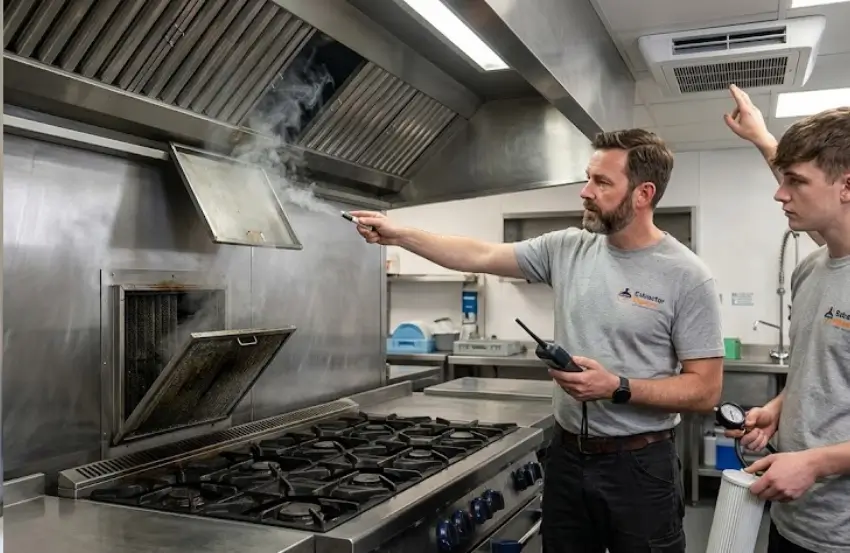
A professional assessment should examine the extraction and replacement-air arrangements.
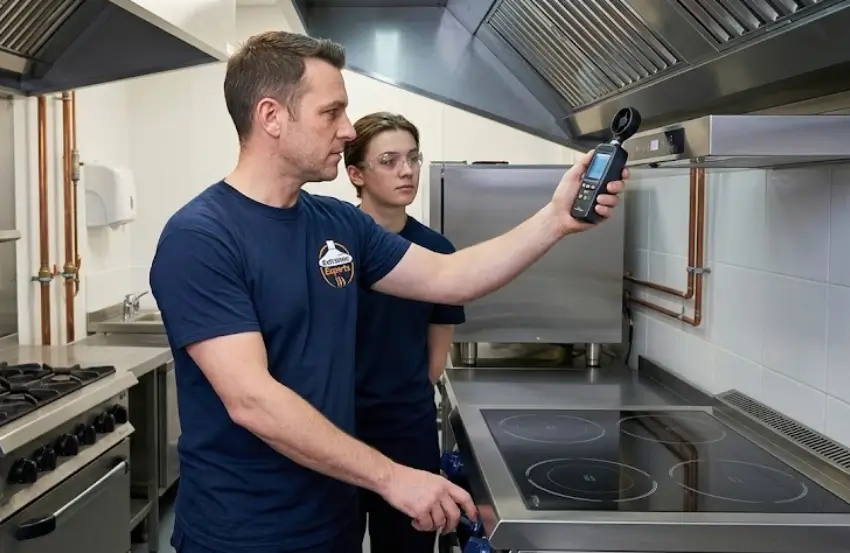
This may involve measuring airflow rates, checking fan operation and assessing pressure differences between the kitchen and adjoining spaces.
The results can help establish whether the extraction system is removing more air than the available supply can adequately replace.
Measurements should be taken under representative operating conditions.
Step 2: Check the Make-Up Air System
The replacement-air arrangement should be inspected for restrictions or mechanical faults.
Potential problems include blocked filters, obstructed intake grilles, closed dampers or underperforming supply fans.
Restoring the intended supply airflow may resolve the pressure imbalance where the original system design remains suitable.
Step 3: Balance Extract and Supply Airflow
Where the system has separate extraction and supply fans, their operation may need adjustment.
The objective is not necessarily to make the supply and extract volumes identical.
Some kitchens require a controlled pressure relationship with adjoining areas to contain odours and cooking contaminants.
The correct balance should be determined by the ventilation design, cooking operation and building requirements.
Step 4: Review Extraction Fan Performance
An extraction fan may be operating outside its intended duty.
A professional inspection can establish whether the fan selection, speed and control arrangements are appropriate.
Reducing extraction without proper assessment can compromise canopy capture and cooking-fume removal.
Fan adjustments should therefore be based on measured performance rather than guesswork.
Step 5: Improve Replacement-Air Distribution
Supplying enough air is only part of the solution.
The air must also enter the kitchen in a way that supports effective ventilation.
Poorly positioned supply outlets can create draughts or disturb the airflow patterns needed for canopy capture.
Ventilation design may need to consider diffuser positioning, air velocity and distribution across the kitchen.
Step 6: Upgrade the Ventilation System Where Necessary
Some installations require more than a minor adjustment.
Where the original design cannot provide suitable replacement air, additional supply-air equipment or other ventilation modifications may be necessary.
A kitchen refurbishment or significant change in cooking equipment may also justify a wider redesign.
Any proposed upgrade should account for airflow, ductwork, fan capacity, controls and combustion safety.
Commercial Kitchen Negative Pressure: Problems and Solutions
| Problem | Possible Cause | Recommended Action |
|---|---|---|
| Doors difficult to open | Excessive pressure difference | Measure kitchen pressure and review air balance |
| Strong draughts | Inadequate controlled replacement air | Assess supply-air capacity and distribution |
| Extraction performance problems | Insufficient make-up air or system restrictions | Test extract and supply airflow |
| Supply fan not operating | Electrical, mechanical or control fault | Arrange professional fault finding |
| Pressure changes during service | Poorly coordinated fan controls | Review operating sequences and controls |
| Problems after a kitchen refurbishment | Changed extraction requirements | Reassess the complete ventilation design |
| Combustion safety concerns | Inadequate air supply or flue interaction | Stop affected appliance use and arrange competent assessment |
How Much Make-Up Air Does a Commercial Kitchen Need?
The required make-up air volume depends on the extraction rate, intended pressure relationship and the wider building ventilation arrangement.
There is no single percentage that is suitable for every commercial kitchen.
A professional designer should calculate the required airflow based on the cooking equipment, canopy performance, room layout and relevant ventilation requirements.
The assessment should also consider how air moves between the kitchen and neighbouring spaces.
Some air may be transferred from suitable adjoining areas, but the arrangement must not introduce contamination or compromise the ventilation of those spaces.
Replacement air should come from appropriate clean sources.
For larger kitchens, mechanical supply-air systems can provide more controlled airflow than relying entirely on natural openings.
The Health and Safety Executive’s catering ventilation guidance recognises both natural and mechanical replacement-air arrangements, depending on the installation.
Why Is Air Balancing Important for Commercial Kitchen Ventilation?
Air balancing helps establish whether the ventilation system is delivering its intended performance.
A commercial kitchen needs enough extraction to capture cooking contaminants while maintaining suitable replacement airflow.
Excessive extraction relative to available supply can create pressure problems.
Insufficient extraction can allow heat, fumes and airborne grease to escape the canopy.
The correct relationship depends on the kitchen’s design and operating conditions.
Air balancing may involve measuring extract airflow, checking supply volumes and assessing pressure differences.
The results should be considered alongside canopy capture and any combustion appliance requirements.
Proper commissioning is especially important after installing new equipment, replacing fans or modifying the ventilation system.
Can Negative Pressure Affect Gas Appliances?
Yes. Excessive negative pressure and inadequate replacement air can create particular concerns where gas-fired appliances are installed.
Gas appliances require sufficient air for safe combustion.
Certain flue arrangements can also be affected by adverse pressure conditions.
The Health and Safety Executive emphasises the importance of adequate make-up air and suitable flue arrangements in catering kitchens.
Where there are concerns about incomplete combustion, carbon monoxide or flue performance, the affected appliances should not be used until assessed by an appropriately qualified Gas Safe registered engineer competent for the relevant commercial catering equipment.
Ventilation adjustments should be coordinated with the appliance safety assessment.
Never assume that a stronger extraction fan will automatically make a gas-fired kitchen safer.
How Can You Prevent Negative Pressure in a Commercial Kitchen?
Preventing pressure problems starts with suitable ventilation design and continues through maintenance and periodic performance checks.
Design Extraction and Supply Together
The extraction canopy, ductwork, fan and replacement-air arrangements should be considered as one system.
Planning these components together reduces the risk of installing extraction equipment that the building cannot adequately support.
Maintain Fresh-Air Filters and Inlets
Dirty filters and obstructed supply-air openings can gradually reduce replacement airflow.
Routine maintenance should include the components responsible for bringing air into the kitchen.
Inspect Fan and Control Operation
Extract and supply fans need to operate as intended.
Faulty controls or changes to operating speeds can create imbalances.
Professional inspection helps identify developing faults.
Review Ventilation After Equipment Changes
New cooking appliances or increased production may change the ventilation requirements.
A review should establish whether the existing extraction and replacement-air systems remain suitable.
Keep Commissioning and Maintenance Records
Airflow measurements and maintenance records provide useful reference information.
They can help engineers identify changes in system performance and investigate recurring pressure problems.
Why Do London Commercial Kitchens Experience Air Pressure Problems?
Commercial kitchens in London can operate within buildings where ventilation space and external-air access are restricted.
Restaurants, takeaways and hotel kitchens may share buildings with other commercial or residential occupiers.
Existing ductwork, limited plant space and the location of external openings can complicate replacement-air design.
Some premises also undergo refurbishments or changes of use that alter their ventilation requirements.
In these situations, simply increasing extraction capacity may create additional pressure problems.
A coordinated approach should consider the building layout, canopy performance, supply-air route and surrounding spaces.
Extractor Experts Ltd provides commercial kitchen ventilation design, extraction system installation, repairs and planned maintenance services across London, Greater London and Surrey.
When Should You Arrange a Professional Ventilation Assessment?
A professional assessment is appropriate when pressure-related symptoms persist, ventilation performance changes or the kitchen’s operating requirements are modified.
Warning signs include difficult-to-open doors, excessive draughts, unusual airflow noises, poor canopy capture and repeated supply-air equipment faults.
An assessment is particularly important where gas-fired or solid-fuel appliances may be affected.
The objective should be to identify the underlying cause and determine the necessary corrective work.
Depending on the findings, the solution may involve maintenance, airflow adjustment, fan repairs, additional make-up air or a wider ventilation redesign.
Frequently Asked Questions
1. What causes negative pressure in a commercial kitchen?
Negative pressure occurs when extraction removes more air than the available replacement-air supply can adequately replenish. Common causes include insufficient make-up air, blocked supply filters, unbalanced fans and unsuitable ventilation design.
2. Is negative pressure normal in commercial kitchens?
A controlled level of negative pressure may be intentional to help contain cooking odours. Excessive or unstable negative pressure is problematic because it can cause draughts, door resistance and potential combustion safety concerns.
3. How do you fix negative pressure in a restaurant kitchen?
The solution usually begins with measuring extract and supply airflow. Corrective work may include clearing air-supply restrictions, repairing supply fans, balancing airflow or upgrading the replacement-air system.
4. Can negative pressure affect commercial gas appliances?
Yes. Inadequate replacement air and adverse pressure conditions can affect combustion or flue performance in some installations. Gas appliance safety concerns require assessment by a suitably qualified commercial Gas Safe registered engineer.
5. Can an extractor fan cause excessive negative pressure?
Yes. An extraction fan can contribute to excessive negative pressure when it removes more air than the replacement-air arrangement can support. However, the correct solution depends on the complete ventilation system, not simply fan speed.
Conclusion: Fix Commercial Kitchen Negative Pressure at Its Source
Commercial kitchen negative pressure becomes a problem when extraction and replacement air are not properly coordinated.
Insufficient make-up air, blocked supply components, incorrect fan settings and unsuitable ventilation design can all contribute to excessive pressure differences.
The consequences may include strong draughts, difficult-to-open doors, reduced ventilation performance and combustion safety concerns.
A professional assessment helps establish whether the solution involves maintenance, airflow balancing, repairs or a wider ventilation upgrade.