Commercial cooker hoods are only one part of what makes a catering kitchen safe, cool enough to work in, and compliant with UK guidance.
Extractor Experts, a UK commercial kitchen extraction specialist, is here to help decide wether “hood or canopy?” and more often “which canopy, airflow, ductwork actually fits this kitchen?”
The details below include some technical terms regarding kitchen extraction system . if you prefer a quick breakdown call our team for a free Consultation . We’ll explain everything you need to know on plain , simple language .
TL;DR: Summary
- In most UK catering kitchens, a commercial cooker hood should be specified as a correctly sized kitchen extract canopy linked to the right fan, ductwork, filters, discharge route, and make-up air, not bought as a standalone hood.
- HSE guidance says fumes and heat should be removed at source, each appliance should sit under an appropriately sized canopy, and the system must also be easy to clean and maintain.
- BESA DW/172 is the core UK industry specification for commercial kitchen ventilation design, installation, and maintenance, so layout, cooking load, cleaning access, and discharge position all matter.
- Make-up air is critical: UK guidance commonly points to replacement air at about 85% of extract rate, with enough supply to avoid strong draughts, negative pressure, and combustion problems at gas appliances.
- Extractor Experts treats canopy sizing around the real appliance line-up, because a hood that is too small leaks heat and grease, while an oversized one can waste energy and space.
The useful distinction is this: a canopy captures fumes, but the full extraction system determines whether that capture works consistently during busy service. Once you compare canopy type, cooking load, replacement air, and maintenance access, the choice becomes much clearer.
What is the difference between a kitchen extract canopy and a commercial cooker hood?
In UK catering, a kitchen extract canopy is the hood-like capture unit above appliances, while “commercial cooker hood” is often used more loosely for the canopy or the whole extraction setup. HSE guidance focuses on capture at source, which starts with the canopy but does not end there.
That wording matters because buyers sometimes compare products that are not the same .
One quote may cover only the stainless canopy shell and the filters.
Another may include the fan, ductwork, fire-rated penetrations, controls, and the whole set up.
A simple rule helps. If you are asking what sits over the range, fryer, or chargrill, you are usually talking about the canopy.
If you are asking whether the kitchen will stay cooler, remove grease fumes, and avoid carbon monoxide build-up at gas-fired equipment, you are talking about the whole ventilation system.
A common misunderstanding is that a “bigger hood” solves every extraction problem. well, It does not. If the canopy is oversized but the duct route is restrictive or the fan duty is too low, capture still fails.
Which matters more: the hood itself or the full extraction system?
The full system matters more. Extractor Experts design the canopy performance around the fan, ductwork, and controls, because HSE and BESA guidance both point to ventilation as a designed system rather than a single metal hood.
A canopy can only capture what the airflow pulls into it. That means filter resistance, duct pressure drop, fan selection, and discharge position all affect results.
BESA describes DW/172 as the definitive industry standard for commercial kitchen ventilation systems, which is a reminder that sizing the visible hood is only one stage of design.
This is also where trade-offs appear. A compact canopy may suit a low ceiling, but if the cooking line includes fryers and chargrills, the extract rate has to match the heavier cooking load. A quieter fan may improve comfort, yet if noise reduction comes from under-specifying airflow, the kitchen pays for it later in heat, grease staining, and poor air balance.
“Extractor Experts design canopy, filters and extract rate to the actual grills, fryers, ovens that sits on site, rather than treating every commercial cooker hood as interchangeable.”
What commercial cooker hood types are used in UK kitchens?
Most UK kitchens use a small group of canopy types chosen by cooking style, kitchen layout, and ceiling height. Wall-mounted, island, condensate, and capture-jet canopies cover most practical requirements.
The important point is not the name , but what the hood has to control.
Steam-heavy equipment, open frying, and central cooking suites all produce different air movement and grease behaviour.
- Wall-mounted extract canopy: Used where appliances run against a wall. It is common in restaurants, cafés, schools, and takeaways because the rear wall helps contain the thermal plume.
- Island canopy: Used over central cooking blocks. It needs careful airflow design because capture is exposed on all sides.
- Capture-jet canopy: Uses additional air movement to improve capture efficiency. It can help where space is tight or where designers want strong performance without an excessively large canopy.
- Condensate canopy: Suited to steam-only loads like dishwashers or some combi oven areas. It is not the same thing as a grease extract canopy.
- Low-height or bespoke canopy: Chosen where soffits, services, or restricted headroom limit standard options.
- Retrofit or replacement canopy: Useful when the kitchen layout stays broadly the same but the old hood is damaged, poorly sized, or awkward to clean.
How do you size a commercial cooker hood step by step?
Correct sizing starts with all the appliance line-up first , not the room size.
Extractor Experts uses the actual grills, fryers, ovens, and other appliances to size the canopy area, filters, and extract rate, which matches both HSE guidance and DW/172 logic.
Step 1 is to map the cooking equipment exactly as it will operate in the shop . A fryer that runs all day creates a different load from an oven used once in a while . HSE says the design needs to reflect cooking load, amount of equipment, kitchen shape, staffing, and cleaning needs.
Step 2 is to set canopy dimensions and position. HSE guidance is clear that each appliance and other heat or fume source should have a canopy, sized appropriately and placed as close as possible to the source. If the canopy leaves gaps at the edges, heat and grease escape before the extract can capture them.
Step 3 is to calculate airflow from cooking intensity . UK government guidance commonly refers to canopy velocity targets of about 0.25 m/s for light loading, 0.35 m/s for medium loading, and 0.5 m/s for heavy loading. If the kitchen moves from oven-only production to frying and chargrilling, the hood may need more than a simple resize. It may need a different canopy type and a stronger duct and fan package.
One pro tip is to avoid sizing by memory from a previous site. Two kitchens with the same square footage can need very different commercial cooker hoods if one runs pizza ovens and the other runs fryers, and open-flame equipment.
How do cooking load and appliance layout change canopy design?
Cooking load changes almost everything. Fryers, griddles, bratt pans, and chargrills usually need more aggressive capture than ovens or steaming-only equipment.
This is why “one hood over the lot” can be misleading.
Ceiling height matters as well. The further the canopy sits from the cooking surface, the more room there is for the plume to spread. If a kitchen has a low ceiling, a compact canopy may fit perfectly, but still need careful filter arrangement and airflow control to avoid grease bypass.
A common mistake is rating all appliances by heat output alone. In practice, grease content, moisture, open flame, and cooking behaviour also matter .
How much make-up air does a kitchen need step by step?
A commercial cooker hood only works properly when replacement air is planned at the same time. UK government guidance commonly sets dedicated make-up air at about 85% of extract flow rate, with enough general ventilation to support safe and comfortable operation.
Step 1 is to calculate or verify the extract requirement. That figure sets the scale of the replacement air problem. If the system removes a large volume of air and the building does not replace it, the kitchen drops into negative pressure.
Step 2 is to supply replacement air where staff can tolerate it and where capture is not disrupted. HSE guidance says good ventilation should bring in cool, clean air while avoiding strong draughts. That means air should support the thermal plume moving into the canopy, not blow it sideways.
Step 3 is to confirm combustion air for gas appliances and pressure balance across the room. If doors are being pulled shut, pilot lights become unstable, or smells drift into customer areas, the make-up air strategy may be wrong even if the fan appears to run normally.
“Extractor Experts uses make-up air balance to stop doors being pulled shut, protect gas appliance air supply and reduce cold draughts.”
Where should ductwork and discharge be placed step by step?
Ductwork should take the shortest practical, cleanable route to a safe discharge point. Good hood performance can be lost quickly by long runs, sharp bends, poor access, or a badly chosen discharge location.
Step 1 is to minimise resistance. Every bend, reducer, and unnecessary metre of duct adds pressure drop. If the route becomes complex, the fan has to work harder to achieve the same airflow.
Step 2 is to preserve cleaning access. HSE says kitchen ventilation should be easy to clean, and DW/172 treats maintenance access as part of design, not an afterthought. If access doors are missing or unreachable, grease builds where nobody can properly inspect it.
Step 3 is to place discharge so extracted air can disperse safely. The outlet should not create nuisance at doors, windows, or fresh air intakes. If discharge is too low or trapped by nearby structures, odours and fumes can recirculate into the building.
A useful comparison is roof discharge versus low-level wall discharge. Roof discharge often gives better dispersion, but structure, planning constraints, and maintenance access can complicate installation. Wall discharge may be simpler, yet it needs very careful positioning.
What are the signs your extraction system is failing?
Failure signs are usually obvious before total breakdown. Hotter kitchens, grease staining, unusual noise, vibration, alarms, and poor airflow balance all suggest the commercial cooker hood system is not performing as designed.
Many kitchen owners wait for a fan failure, but underperformance often starts earlier. Filters clog, belts wear, dampers drift, ductwork accumulates grease, or make-up air falls out of balance. The result is a kitchen that feels harder to work in long before equipment stops.
Typical warning signs include:
- Rising heat: staff complain the cookline feels much hotter than usual
- Grease marks: staining appears on nearby walls, ceilings, or canopy edges
- Noise changes: rattling, humming, or vibration suggests restriction or wear
- Door issues: doors pull shut or become harder to open because of negative pressure
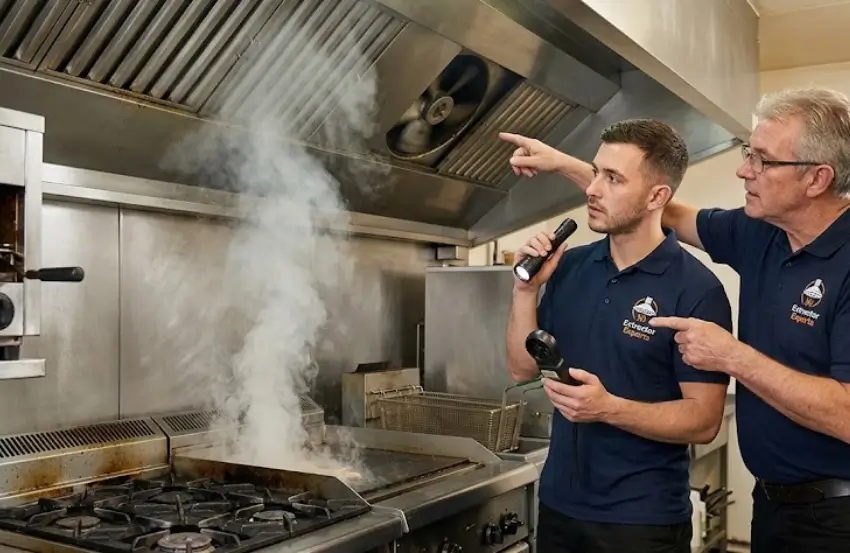
- Poor capture: smoke or steam rolls out from the canopy front during peak service
- Alarm activity: interlocks, controls, or gas safety systems begin tripping
A good pro tip is to treat noise and draughts as engineering clues, not just comfort complaints. They often point to airflow imbalance before hygiene or fire risk becomes visible.
How often should commercial cooker hoods be cleaned and maintained?
Cleaning and maintenance should follow cooking intensity, grease load, and access conditions, not a generic calendar. HSE expects systems to be easy to clean, and any grease-laden commercial cooker hood needs routine filter care plus planned inspection of the wider system.
Baffle filters are the first line of grease separation, so they need regular attention. If they clog, airflow drops and grease carry-over into the duct can rise. That means worse capture, higher fire risk, and more strain on the fan.
Planned maintenance should look beyond the canopy face. Fan condition, belts, electrical controls, access panels, duct cleanliness, and airflow balance all matter. A common misconception is that a polished hood front means the system is clean. In reality, the hidden duct route often determines risk.
Where duty is heavy, cleaning intervals tighten. Where the load is lighter, inspection can confirm whether the planned schedule is still right. The key is evidence from use, not guesswork.
Can you retrofit an existing commercial cooker hood or should you replace it?
Retrofitting can work when the canopy shell is usable and the main problem sits in airflow, filtration, controls, or ductwork. Full replacement is better when the hood is badly sized, hard to clean, or no longer matches the appliance layout.
A retrofit might include new baffle filters, revised fan selection, improved controls, fresh duct sections, or a better make-up air arrangement. This route can reduce downtime and preserve existing builder’s work.
Replacement becomes more sensible if the menu has changed, the cookline has been moved, or the old canopy has poor geometry for capture. A wall canopy serving a new island layout is usually the wrong starting point. The same applies if the existing hood is too small and leaves consistent escape paths at the edges.
If your kitchen is being refitted anyway, replacement often gives more freedom to improve compliance, cleaning access, and discharge design in one package. If the shell and layout are basically sound, retrofit can be the faster, lower-disruption answer.