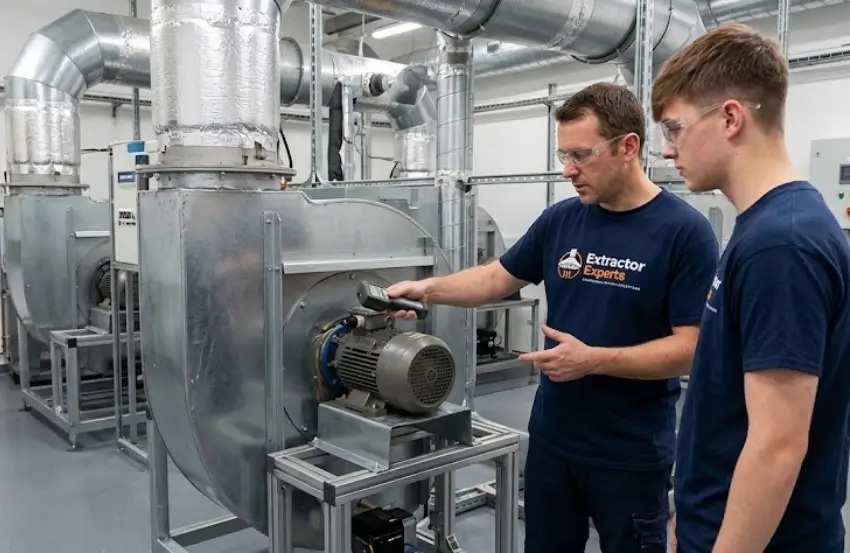
Commercial extraction fan vibration is commonly caused by an unbalanced impeller, worn motor bearings, loose mounting components, misaligned drive parts or damaged vibration isolators. In commercial kitchens, uneven grease accumulation on rotating fan components can also contribute to vibration. The problem may begin as a slight rattle before developing into excessive shaking, grinding noises or reduced extraction performance.
A commercial kitchen extraction fan must operate reliably to remove heat, smoke, steam and airborne cooking contaminants. Excessive vibration can affect mechanical components, transmit noise through connected ductwork and increase the likelihood of an unexpected breakdown.
The most important warning signs are unusual rattling, visible fan movement, persistent humming or grinding, changes in airflow and vibration travelling through walls or ductwork. These symptoms should be investigated rather than treated as normal operating noise.
At Extractor Experts, we provide commercial kitchen extraction fault finding, repairs and maintenance for businesses across London, Surrey and other confirmed service areas. Understanding the likely causes of vibration helps kitchen operators recognise developing faults and arrange a professional inspection before further damage occurs.
What Causes Commercial Extraction Fan Vibration?
Commercial extraction systems contain rotating mechanical components operating under demanding conditions. Fans may run for extended periods while handling warm air, moisture and airborne grease particles.
A small amount of mechanical vibration is unavoidable in rotating equipment. However, excessive or increasing vibration indicates that something may be affecting the fan’s balance, alignment, bearings, support structure or operating conditions.
The following are common commercial extractor fan vibration causes.
1. Unbalanced Fan Impeller
An unbalanced impeller is one of the most common causes of commercial extraction fan vibration.
The impeller contains blades that rotate to move air through the extraction system. When its mass is distributed unevenly around the shaft, the rotating assembly generates forces that cause vibration.
In commercial kitchens, imbalance can develop because grease deposits accumulate unevenly on the impeller blades. Corrosion, physical damage or a missing balance weight can also affect the rotating assembly.
Common symptoms include vibration that becomes stronger as fan speed increases, a repeated humming sound and movement around the fan housing.
Professional inspection may involve examining the impeller, identifying contamination or damage and assessing whether cleaning, repair or dynamic balancing is required.
2. Worn or Damaged Fan Bearings
Bearings support the fan shaft and allow it to rotate smoothly. Over time, bearings may deteriorate because of mechanical loading, contamination, lubrication problems or normal wear.
Damaged bearings can create additional friction and irregular shaft movement, leading to vibration and noise.
Warning signs may include grinding, rumbling, squealing, excessive bearing temperature or vibration that progressively worsens.
Bearing problems should not be ignored. Continued operation may damage the shaft, motor or other connected components.
A qualified technician can assess bearing condition and determine whether lubrication, adjustment or replacement is appropriate for the fan design.
3. Loose Mounting Bolts and Support Structures
Commercial extraction fans are commonly installed on roof structures, external brackets, mechanical supports or plant-room bases.
Loose mounting bolts, deteriorated brackets or damaged support frames can allow the fan assembly to move more than intended.
This movement may amplify existing vibration and transfer mechanical noise into the building.
A vibrating fan can also place repeated stress on fixings, potentially making the original problem worse.
During an inspection, engineers should assess the mounting arrangement, support structure and mechanical connections. Any loose or damaged components must be corrected using suitable installation procedures.
4. Motor and Shaft Misalignment
Some commercial extraction fans use direct-drive motors, while others use belts, pulleys or couplings to transfer power to the fan shaft.
Misalignment between rotating components can introduce uneven mechanical forces.
Possible causes include incorrect installation, movement in motor mounts, worn drive components or previous maintenance work that has affected alignment.
Symptoms can include abnormal vibration, increased bearing wear, belt deterioration and unusual mechanical noise.
Correcting misalignment requires appropriate measuring equipment and knowledge of the fan’s drive arrangement. Replacing worn parts without addressing alignment may allow the vibration to return.
5. Damaged Vibration Isolators
Vibration isolators help reduce the transfer of mechanical movement from extraction equipment into its supporting structure.
Depending on the installation, isolators may include rubber mounts, spring assemblies or other engineered components.
Over time, these parts can deteriorate, compress, become damaged or lose their intended performance.
When isolation becomes ineffective, vibration may travel through structural supports, ceilings, walls and connected ductwork.
This can make a fan seem considerably louder inside the building, even when the main rotating assembly has not changed significantly.
A professional assessment should establish whether the vibration originates from the fan itself or is being amplified by the supporting installation.
6. Grease Build-Up and Poor Maintenance
Commercial kitchen extraction systems regularly handle grease-laden air. Although canopy filters capture some grease, deposits can still accumulate within fans and ductwork.
Uneven deposits on an impeller may alter its balance. Grease contamination can also make inspection and maintenance more difficult.
Poor maintenance may allow small problems to develop unnoticed, particularly where fans are positioned on roofs or in restricted plant areas.
Regular inspection, appropriate cleaning and mechanical condition checks help identify these issues.
However, cleaning alone will not correct every vibration problem. A fan with damaged bearings, a bent shaft or faulty mounting components may require mechanical repairs.
For ongoing support, explore our commercial kitchen extraction maintenance services.
7. Ductwork Resonance and Airflow Problems
Not every vibration-related noise comes directly from the fan motor.
Commercial extraction ductwork can transmit mechanical vibration and amplify sound when its panels, supports or connections respond to operating forces.
In some systems, unstable airflow, unsuitable operating conditions or resonance can contribute to noise and vibration.
Loose ductwork connections and inadequate support may make these symptoms more noticeable.
The relationship between fan speed, ductwork geometry and mechanical support should be considered during diagnosis.
Government guidance on commercial kitchen exhaust systems identifies ductwork resonance and fan-related noise as relevant considerations in kitchen ventilation design.
What Are the Warning Signs of a Vibrating Commercial Extractor Fan?
Recognising changes in the way a commercial kitchen extraction system operates can help prevent more serious mechanical damage.
COMMON SYMPTOMS AND POSSIBLE CAUSES
| Warning sign | Possible cause | Recommended response |
|---|---|---|
| Excessive shaking | Impeller imbalance or loose mounts | Arrange prompt inspection |
| Grinding or rumbling | Bearing wear or mechanical contact | Stop safely and seek urgent assessment |
| Rattling from the housing | Loose panels, bolts or components | Inspect professionally |
| Vibration through ductwork | Structural transmission or resonance | Check supports and isolation |
| Reduced extraction airflow | Fan or system performance fault | Request airflow and mechanical checks |
| Repeated electrical trips | Motor, control or electrical fault | Stop using and arrange qualified diagnosis |
| Increasing noise over time | Progressive wear or looseness | Book fault finding before further deterioration |
These symptoms are indicators, not confirmed diagnoses. Several different faults can produce similar vibration patterns.
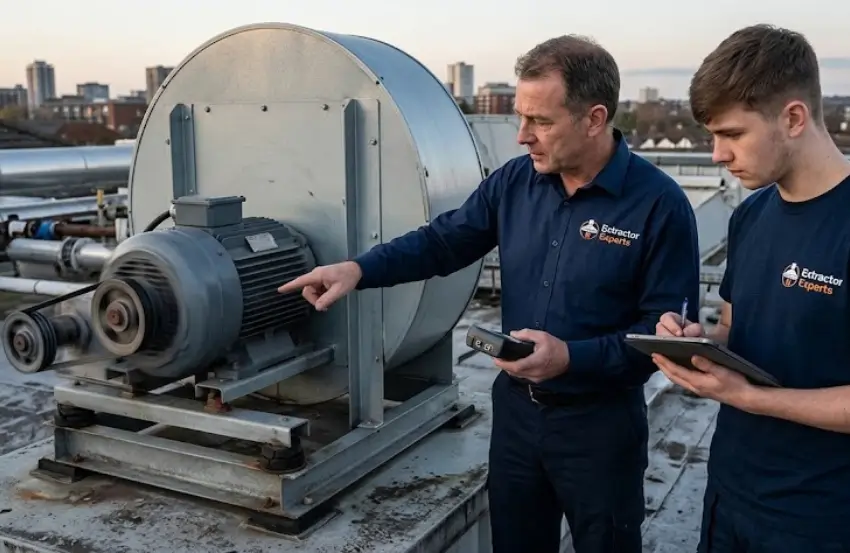
Unusual Noise During Kitchen Operation
A noticeable change in fan noise is often one of the first warning signs.
A fan that previously operated with a consistent sound may begin producing rattling, grinding, humming or intermittent knocking.
Noise can change with fan speed or become more noticeable during busy cooking periods.
Kitchen staff should report new or worsening sounds rather than assuming they are normal.
Visible Shaking or Movement
A commercial extraction fan should remain securely supported during operation.
Visible movement of the fan housing, mounting structure or connected ductwork may indicate excessive vibration.
Movement should be observed only from a safe location. Staff should not touch moving equipment or access exposed mechanical components to investigate.
Reduced Kitchen Extraction Performance
Vibration may occur alongside a reduction in extraction performance, although the two symptoms do not always have the same cause.
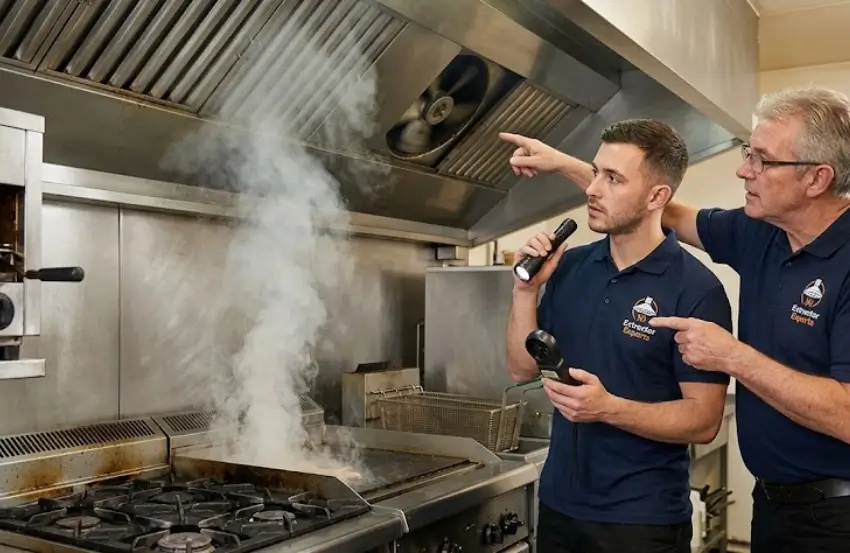
Kitchen staff might notice smoke escaping the canopy, excessive heat, lingering cooking fumes or poor airflow.
These problems can also result from blocked filters, ductwork restrictions, inadequate replacement air or other system faults.
A complete assessment should therefore consider the fan and the wider extraction system.
Repeated Mechanical or Electrical Problems
Frequent bearing replacements, recurring belt problems or repeated fan shutdowns may indicate an unresolved underlying issue.
Electrical trips can have several causes and should never be attributed to vibration without testing.
Repeatedly resetting a protective device without investigating the fault may expose equipment and staff to further risks.
Is Commercial Extraction Fan Vibration Dangerous?
Excessive commercial extraction fan vibration can become a safety and operational concern when it is caused by mechanical deterioration, loose components or structural problems. A severely vibrating fan may place additional stress on bearings, shafts, mounts and ductwork connections. The resulting damage can affect equipment reliability and potentially lead to unexpected failure.
Commercial kitchen ventilation also has an important role in removing heat, fumes and cooking contaminants. The Health and Safety Executive explains that effective kitchen ventilation should be easy to clean, maintained properly and designed to operate quietly without problematic vibration. Where extraction performance is compromised, the implications depend on the cooking equipment and ventilation arrangement.
The HSE guidance on ventilation in catering kitchens explains the importance of properly designed and maintained commercial kitchen ventilation systems. Excessive fan vibration may indicate mechanical problems that require professional attention to maintain safe and reliable extraction performance.
In particular, kitchens using gas-fired or solid-fuel appliances require appropriate ventilation and combustion-safety arrangements. A faulty extraction system should not be treated as merely an inconvenience. Stop the affected equipment and seek urgent professional advice where vibration is severe, components appear loose, there is burning smell or smoke, or the fan is making violent mechanical noises. Kitchen operations may also need to stop until the ventilation system is assessed and safe operation is confirmed.
How Do Professionals Diagnose Commercial Kitchen Extraction Fan Vibration?
A reliable diagnosis involves identifying the source of vibration rather than replacing components based on guesswork.
Different faults can produce similar symptoms. For example, impeller imbalance, bearing deterioration and mechanical looseness may all cause shaking.
Professional commercial kitchen extraction fault finding generally follows a structured process.
Initial System Assessment
An engineer reviews the reported symptoms, the fan’s operating history and any recent maintenance or repairs.
The assessment may include the fan arrangement, drive type, mounting location, ductwork connections and ventilation controls.
Information about when the vibration began and whether it changes with fan speed can be particularly useful.
Mechanical Inspection
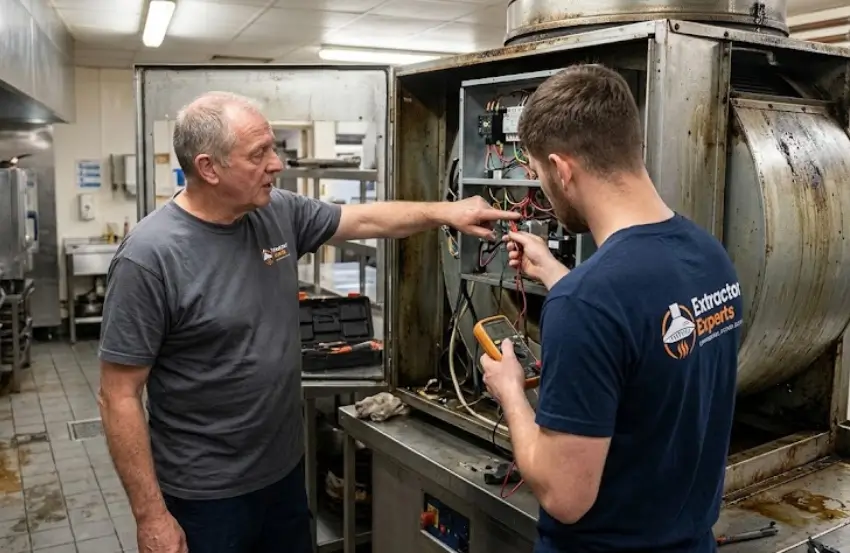
Following safe isolation, an engineer may examine the impeller, bearings, motor mounts, drive components, support frame and vibration isolators.
The purpose is to identify visible wear, damage, contamination, looseness or misalignment.
Electrical and mechanical checks must be completed by appropriately competent personnel.
Vibration Measurement and Analysis
Where necessary, specialist equipment can measure vibration at suitable points on the fan assembly. Vibration frequency and amplitude can help engineers distinguish between possible mechanical problems. For example, an imbalance commonly produces vibration related to rotational speed, while bearing defects can generate different frequency patterns. The precise interpretation depends on the fan design, operating speed and measurement conditions. Manufacturer guidance and engineering assessment are essential.
The FETA guide to fan noise and vibration provides technical guidance on fan noise and vibration. Understanding vibration characteristics helps engineers investigate potential problems involving rotating components, mounting arrangements and mechanical operating conditions.
Repair Recommendations
Once the cause has been identified, suitable corrective work may include impeller cleaning, component replacement, alignment correction, mounting repairs or specialist balancing.
An engineer should also consider whether the underlying problem could return.
For example, balancing an impeller without correcting recurring grease contamination may not provide a lasting solution.
Extractor Experts provides commercial extraction fan repairs and fault finding for businesses requiring professional assistance.
Can You Continue Using a Vibrating Commercial Extractor Fan?
Whether continued operation is appropriate depends on the severity of the vibration, the cause and the consequences of extraction failure.
A small, stable vibration within the manufacturer’s operating limits is different from sudden, severe shaking accompanied by grinding or visible movement.
However, kitchen staff cannot reliably determine safe vibration limits by listening to the equipment.
A fan that begins vibrating unexpectedly should be reported and assessed promptly.
Where severe vibration, abnormal heating, mechanical contact or unstable mounting is suspected, the equipment should be shut down safely and inspected before restarting.
Commercial kitchen operators should also consider whether cooking activities can continue safely without the affected extraction system.
This is particularly important where the system supports appliances that produce combustion gases.
How Can Commercial Kitchen Extraction Fan Vibration Be Prevented?
Preventive maintenance helps reduce the likelihood of mechanical faults developing into unexpected breakdowns.
The appropriate inspection schedule depends on the fan manufacturer, system design, operating hours, cooking intensity and site conditions.
Regular Fan and Motor Inspections
Routine inspections can identify early signs of bearing deterioration, abnormal noise, damaged supports and changes in operating behaviour.
Recording these findings allows maintenance teams to identify recurring faults rather than treating each breakdown separately.
Appropriate Grease Cleaning
Grease management is essential for commercial kitchen extraction systems.
Filters, fans and ductwork should be inspected and cleaned at intervals appropriate to their condition and use.
Cleaning should be performed using suitable methods that avoid damaging fan components or disturbing balance weights.
Check Mechanical Supports
Mounting brackets, fixings, support frames and vibration isolators should be assessed during planned maintenance.
Deteriorated components can increase the transmission of vibration into the building.
Monitor Changes in Fan Performance
Kitchen operators can help by reporting unusual noise, changes in extraction effectiveness or repeated shutdowns.
A maintenance record showing the date, symptoms and operating conditions provides useful information for engineers.
Maintain the Complete Ventilation System
A commercial kitchen fan forms part of a wider ventilation system.
Canopies, filters, ductwork, replacement air arrangements and controls all affect overall performance.
Maintaining only the fan while ignoring the wider system can leave important faults unresolved.
For more information, see our commercial kitchen extraction systems page.
Should You Repair or Replace a Vibrating Commercial Extractor Fan?
Not every vibrating fan requires complete replacement.
A fan may be repairable when the main assembly remains serviceable and the fault involves replaceable bearings, drive components, mounting hardware or correctable imbalance.
Replacement may be more appropriate where the impeller or housing is severely damaged, major components are no longer available or the existing equipment is unsuitable for the kitchen’s ventilation requirements.
The decision should consider equipment condition, repair feasibility, parts availability, expected reliability and overall system performance.
Repeated repairs without addressing the underlying cause can create further disruption.
A professional inspection provides the information needed to compare repair and replacement options.
Where a replacement is necessary, the selected fan should be suitable for the required airflow, pressure, operating conditions and existing ventilation design.
Why Commercial Kitchen Operators Should Act Early
An extraction fan can continue operating while a mechanical problem develops.
This may create the impression that the system is functioning adequately, particularly when airflow has not yet changed noticeably.
However, vibration places repeated forces on mechanical components. Over time, those forces may contribute to accelerated wear and additional damage.
Early diagnosis can help reduce avoidable disruption and support more informed maintenance decisions.
For restaurants, hotels, catering facilities and other commercial kitchens, reliable extraction is important for both working conditions and continuity of operations.
Businesses across London and Surrey can contact Extractor Experts to discuss unusual fan vibration, recurring extraction faults or planned maintenance requirements.
Frequently Asked Questions
1. Why is my commercial extractor fan vibrating?
Commercial extractor fan vibration can result from an unbalanced impeller, worn bearings, loose mounting components, motor misalignment or damaged vibration isolators. Uneven grease accumulation may also contribute. A professional inspection is needed to identify the actual cause.
2. Can grease build-up cause commercial kitchen extraction fan vibration?
Yes. Uneven grease deposits on rotating impeller blades can affect their balance and cause vibration. Appropriate cleaning may resolve contamination-related imbalance, although additional inspection is needed to rule out mechanical damage.
3. Is it safe to operate a commercial extractor fan that is shaking?
Severe or increasing shaking should not be ignored. Stop the equipment safely and arrange professional assessment, especially where there is grinding, visible movement, overheating or suspected mechanical damage. The safety of continued kitchen operation must also be considered.
4. Can worn fan bearings cause excessive vibration?
Yes. Worn or damaged bearings can produce irregular shaft movement, grinding noises and increased vibration. Continued operation may damage other components. Bearing condition should be assessed by a competent technician.
5. How can I reduce vibration in a commercial extraction fan?
Reducing vibration requires identifying its cause. Depending on the fault, corrective work may involve impeller cleaning, balancing, bearing replacement, alignment adjustments, mounting repairs or vibration isolator replacement. Regular maintenance can help detect developing problems.
Conclusion: Get Commercial Extraction Fan Vibration Checked Before It Gets Worse
Commercial extraction fan vibration is often an early indication of mechanical imbalance, bearing wear, loose mounting components or other developing faults.
Recognising warning signs such as unusual noise, visible shaking and changes in extraction performance allows commercial kitchen operators to respond before equipment damage becomes more serious.
At Extractor Experts, we support businesses with commercial kitchen extraction repairs, fault finding, maintenance and ventilation system assessments.