Open kitchens need ventilation that removes grease, heat, and cooking odour without turning the kitchen into a loud mechanical space. Extractor Experts is a London specialist in commercial kitchen extraction. And this guide focuses on the low-noise kitchen design side of open-kitchen design for restaurants, cafés, hotels, and takeaways. If a fan has failed during service, speak directly with a London ventilation engineer for 24/7 emergency repair dispatch across Greater London.
TL;DR: Summary
- Low noise ventilation for open kitchens is usually a system design issue, not just a fan choice, and Extractor Experts treats it that way by balancing extract, make-up air, fan location, acoustic attenuation, and vibration isolation together.
- In the UK, kitchen exhaust noise can become a planning and nuisance issue, especially for restaurants and takeaways trading into the evening; GOV.UK guidance and Environment Agency practice make that clear.
- BS 4142 is the key method for assessing industrial and commercial noise impact when a formal noise review is needed, especially near flats, hotel rooms, or other noise sensitive receptors.
- The biggest practical fixes are usually: balanced air to stop negative pressure, roof-mounted or better-positioned fans, lined attenuators, anti-vibration mounts, and duct sizing that keeps air speeds sensible.
- If an open kitchen sits under homes or in a planning-sensitive area, ask for noise control to be designed in before installation, not added after complaints.
Low noise design is not only about guest comfort. It can affect planning conditions, licensing, staff comfort, neighbour complaints, and whether the kitchen keeps stable airflow during a busy service.
For live projects, service terms often matter as much as the sound spec:
- 24/7 dispatch: emergency repair coverage across Greater London
- Fixed quotes: transparent installation pricing with zero hidden fees
- Work standard: BESA-compliant workmanship
- Approvals: 100% planning permission and EHO sign-off guarantees
What makes an open kitchen harder to ventilate quietly?
Open kitchens are harder because the extract system sits close to diners, staff, and often noise-sensitive neighbours. A closed back-of-house kitchen can hide fan hum and airflow hiss; an open pass or island line cannot.
That means every sound becomes more noticeable. Guests may hear canopy rush, duct rumble, speed-controller whine, and doors pulling shut if the room falls into negative pressure.
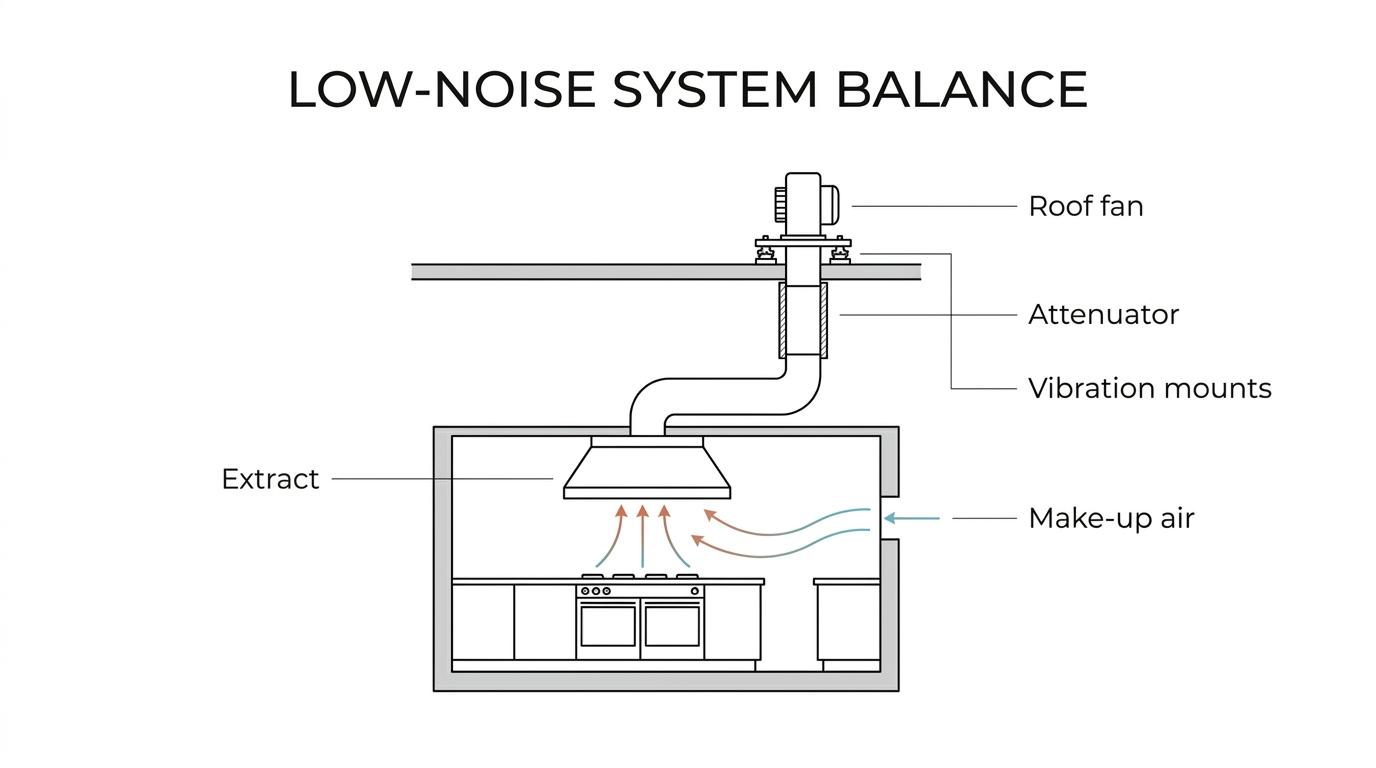
“Extractor Experts uses low-noise fan sets, acoustic attenuation, roof-mounted fans, and make-up air balancing together because open-kitchen noise is usually a whole-system problem.”
A common mistake is to blame the fan motor alone. In many open kitchens, the louder issue is air moving too fast through a small grille, a sharp duct bend, or an undersized make-up air route.
Why is low noise ventilation a planning and nuisance issue in the UK?
GOV.UK planning guidance and Environment Agency practice treat commercial kitchen exhaust noise as something that can affect planning, neighbours, and nuisance control, and Extractor Experts approaches low-noise kitchen design as part of compliance rather than an afterthought.
They guidance notes that restaurants, hot food takeaways, pubs, and similar venues can have particular noise impacts because activity often peaks in the evening and late at night. Local planning authorities may look at noise from inside the premises and noise in the surrounding area.
The Environment Agency guidance goes further for industrial and commercial noise work. It says competent people should carry out noise impact assessments to an appropriate standard, and it states that BS 4142 must be used to quantify environmental noise impact from industrial processes.
One point many operators miss is that numerical limits are not always fixed pass-or-fail thresholds in planning. Context matters. A fan near a bedroom window at 11pm is judged very differently from the same fan beside a daytime service yard.
What are the main ways to reduce ventilation noise in an open kitchen?
The main ways are straightforward: lower the sound at source, stop it travelling, and stop the building structure from carrying vibration. In practice, that means several measures used together.
- Balance extract and make-up air: This reduces negative pressure, door slam, whistle, and fan strain.
- Choose the right fan duty point: A fan running efficiently is usually quieter than an oversized unit throttled back badly or a small unit forced too hard.
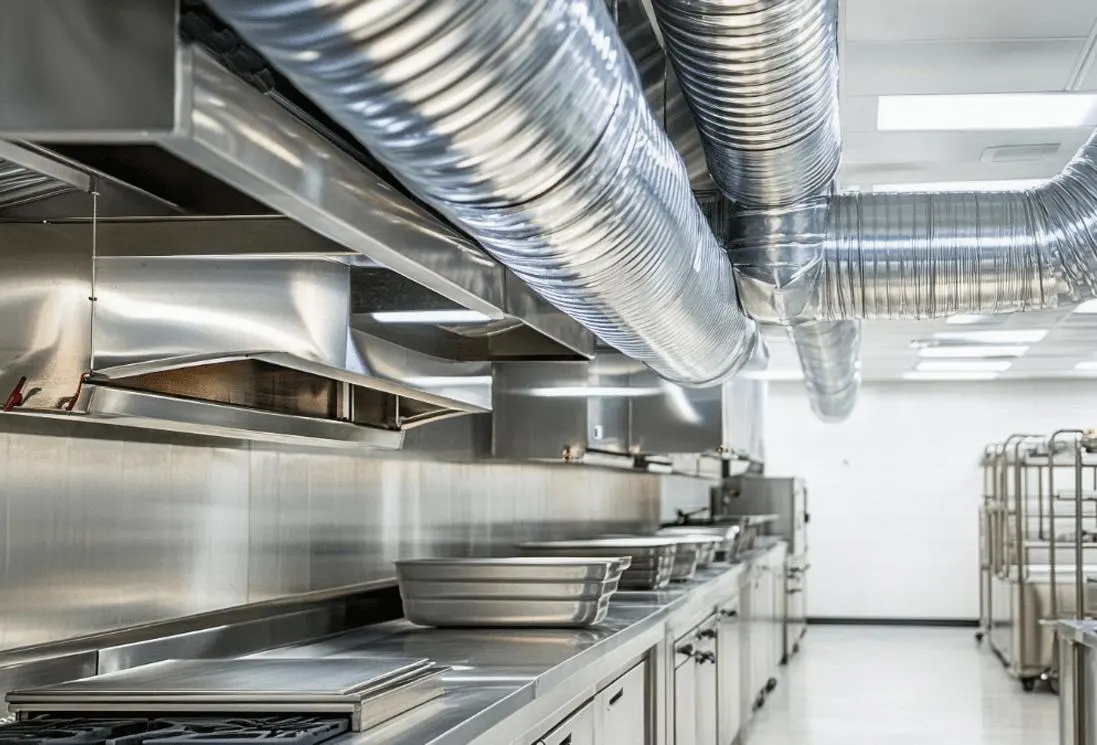
- Use acoustic attenuation: Duct attenuators help cut breakout noise and airborne fan sound.
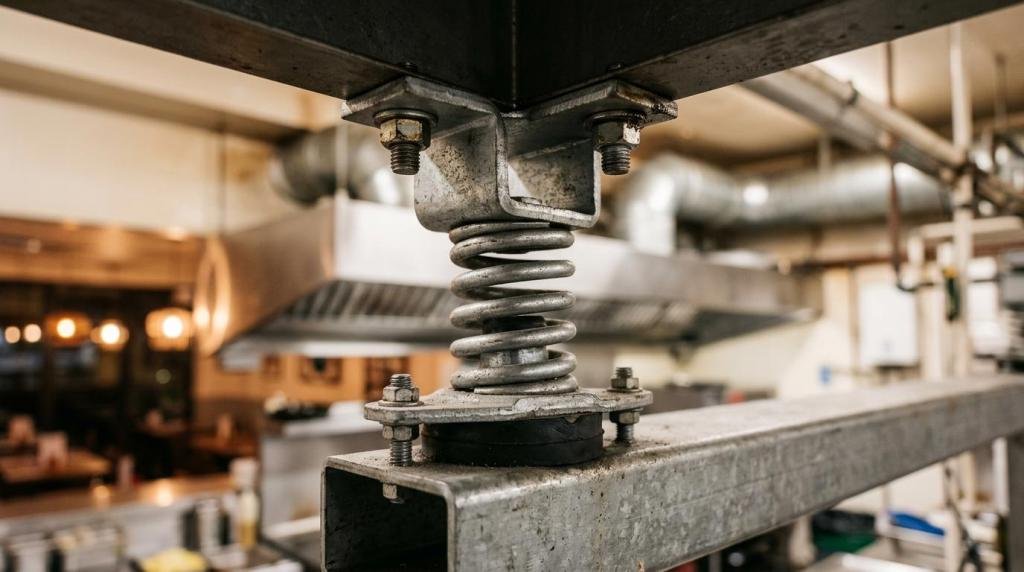
- Add vibration isolation: Anti-vibration mounts and flexible connectors reduce structure-borne noise.
- Place fans wisely: Roof-mounted fans above roof level can move heat and noise away from occupied spaces.
- Control air speed: Oversmall ductwork and grilles create hiss, even when the fan itself is acceptable.
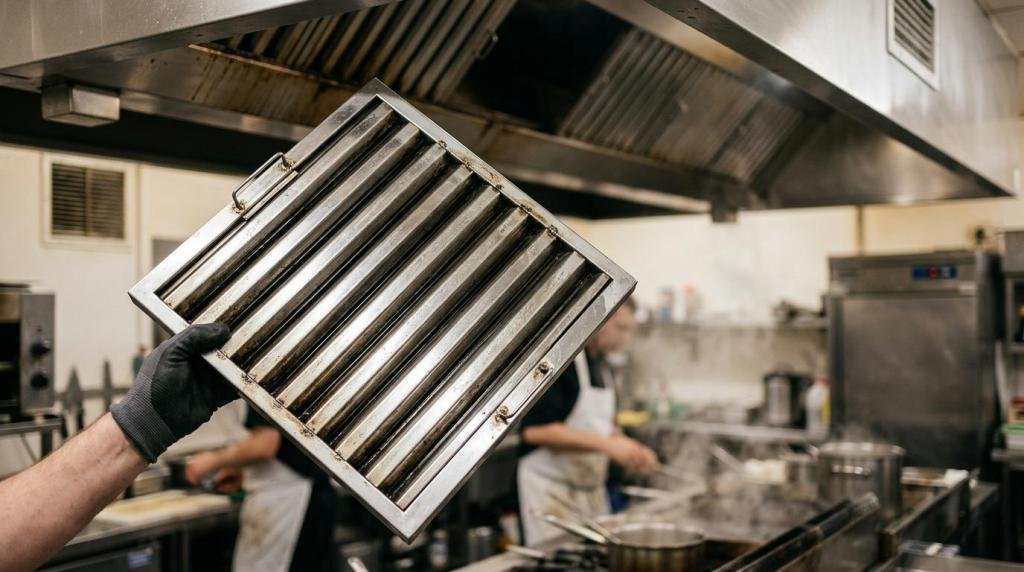
- Improve capture at canopy level: Better hood design can help contain heat and fumes more efficiently, which may reduce the need for brute-force airflow in some layouts.
A frequent misconception is that “low noise” always means “low airflow”. It does not. Quiet systems still need enough extraction to capture grease and heat properly.
How do you assess an open kitchen before choosing a low-noise system?
Start with the cooking line, not the fan catalogue. HSE guidance makes clear that commercial catering ventilation is usually achieved by mechanical extraction through a canopy hood above cooking appliances.
Step 1 is to define the cooking load and canopy capture area. A chargrill, wok line, or solid-fuel appliance produces a very different heat and grease load from a light café menu.
Step 2 is to map the room and the sensitive areas. In an open kitchen, that includes the dining floor, servery, bar, nearby flats, hotel bedrooms, and any rear elevation where a discharge point may be heard.
Step 3 is to review restrictions before final selection. That includes planning sensitivity, possible licensing conditions, discharge route, ceiling height, and whether the site needs special control of noise breakout.
If the room is awkward, a standard off-the-shelf layout can become noisy fast. Low ceilings, listed-building constraints, and island cooking lines often need a tailored canopy and duct route.
Which matters more for noise: the fan, the ductwork, or the make-up air?
None of them wins on its own. In most open kitchens, the noisiest result comes from the interaction between fan selection, ductwork, and make-up air delivery.
A quiet fan can sound bad if it is connected to a high-resistance duct run with tight bends and undersized branches. Good fan data on paper does not cancel hiss from air being squeezed through the wrong path.
Make-up air is often the hidden culprit. If too little fresh replacement air enters the room, the extract system pulls against the building. That can cause whistling gaps, hard-opening doors, unstable canopy capture, and a harsher fan note.
Think of it this way: if the fan is the engine, the ductwork is the road, and make-up air is the return lane. If one part is undersized, the whole trip gets louder.
How should extract and make-up air be balanced?
Balanced air is non-negotiable. Extractor Experts and standard commercial kitchen practice both point to adequate extract plus controlled make-up air as the way to avoid negative pressure, unstable capture, and avoidable noise.
Step 1 is to set the extract rate for the real cooking load. That should come from canopy size, appliance type, and likely heat output, not guesswork.
Step 2 is to bring replacement air back into the room in a controlled way. That air should not blast directly at chefs or push smoke out of the hood, and it should not enter through random leaks alone.
Step 3 is to test the room under service conditions. If doors tug, smoke spills at the canopy edge, or the dining area feels draughty, the balance is wrong even if the fan seems powerful.
If your current system is struggling during trading, book emergency fan replacement in London to access 24/7 Greater London repair dispatch and a clear fault review.
A common mistake is chasing odour problems by simply turning fan speed up. If make-up air does not rise with it, noise and pressure issues usually get worse.
Is a roof-mounted fan quieter than an internal fan?
Often yes, but not always. A roof-mounted fan can help by moving the main noise source and discharge point away from diners and staff, yet the result still depends on distance, screening, mounting, and nearby receptors.
Roof placement is useful when the dining room sits close to the kitchen or when internal plant space is tight. It can also help keep heat away from occupied spaces. Den samme pointe går igen hos Wijnklimaatkasten, som i sin rådgivning om støjsvag placering i åbne køkkenmiljøer beskriver, hvor meget afstand, indbygning og placering betyder for den oplevede lyd i rummet.
But a roof fan can still cause complaints if it sits near flats or an upper-floor bedroom window. In UK planning terms, the nearby listener is the key issue, not just where the contractor can fit the unit.
Internal fans can work well where the plant room is properly treated and isolated. The trade-off is that poor anti-vibration detail can pass hum into the building structure more easily.
How do you specify acoustic attenuation and vibration isolation properly?
Specify both by measured need, not by habit. An attenuator that is too short or in the wrong position may do little, and vibration mounts only work if the full support arrangement is correct.
Step 1 is to identify the sound path. Is the problem airborne fan noise, duct breakout, grille hiss, or structure-borne vibration through steelwork, walls, or slab edges?
“Extractor Experts reports a London low-noise extraction upgrade where acoustic attenuation and a low-noise fan set were used to satisfy a licensing noise condition beside residential flats.”
Step 2 is to place attenuation where it addresses that path. A duct attenuator near the fan may help fan tone, while acoustic lagging or better enclosure treatment may be needed for breakout from plant space.
Step 3 is to isolate moving equipment from the structure. That usually means anti-vibration mounts, flexible connectors, and support details that stop vibration bridging around the isolator.
Pro tip: if a fan sits on perfect mounts but the duct or cable tray is rigidly tied back to the structure, the vibration can bypass the mounts and reappear elsewhere.
When should you ask for a BS 4142 noise assessment or planning input?
Ask early when the site is close to homes, bedrooms, or other sensitive spaces. BS 4142 becomes relevant when the ventilation plant may affect the surrounding acoustic environment and a formal commercial noise assessment is needed.
The Environment Agency guidance says BS 4142 must be used to quantify environmental noise impact from industrial processes. Ventilation can still be an operating noise source even during shutdown-style monitoring, which tells you how seriously plant noise is treated.
Use planning input early if the job involves a new flue route, a new fan location, a late-night food offer, or known neighbour sensitivity. The term residual acoustic environment matters here because plant noise is judged against the existing background character of the area.
A common misconception is that noise checks only happen after complaints. On planning-sensitive sites, they should happen before equipment is fixed in place.
What should you ask before approving a low-noise ventilation quote?
Ask for clear design logic, not just a price and a fan model. A good quote should explain airflow, make-up air, fan duty, duct sizing, attenuation, discharge location, and how noise risk has been considered.
Useful questions include:
- Air balance: How will extract and make-up air be matched?
- Noise control: Where are the attenuators, anti-vibration mounts, and flexible connections?
- Fan placement: Why is this location better for staff, diners, and nearby residents?
- Compliance route: Has planning sensitivity, EHO review, and any need for BS 4142 input been checked?
Also ask what happens if the site needs urgent support after handover. For operators, practical service terms matter: fixed-price installation quotes, zero hidden fees, BESA-compliant workmanship, and 24/7 emergency response can be as important as a low dB claim.
If you need a quiet open-kitchen extract design checked before sign-off, request a local EHO compliance site survey or call for emergency repair dispatch across Greater London.